Monday, 12 August 2013

Book Review: ‘Blue Mercy’ by Orna Ross

Blue Mercy: A Novel by Orna Ross (2013) ****

Just recently, I came across this book as temporarily free for Kindle (it is no longer free). As I happened to be “between books” it so happened I got started on this one pretty much straight away after downloading it. And finished it in just a few days too.

The story is set in Ireland and California. The main narrator is Mercy Mulcahy, who at the age of 40, back in 1989, was accused of having killed her elderly father. Years later, knowing her own life to soon be over, she writes a book about her life, including her version of what really happened on that fatal night. After her death, the manuscript is left to her daughter, Star, who is at first very reluctant to read it, but finally does. She adds her own comments here and there; and so we get some of the events from her point of view as well.

This is a story with lots of twists and turns along the way. The more you learn, the more complicated it gets. It is at the same time a psychological thriller, and a love story covering several different kinds of love – and dependence. (Between lovers, parents/children, friends…) It also made me think a lot about how we do tend to change our perspectives over a lifetime; and I found quite a few quote-worthy passages.

All in all I found the book intriguing enough to keep reading in spite of several minor “typo” kind of errors throughout.  It does annoy me though, when an otherwise good story obviously has not been sufficiently proofread before publication. (It seems to me this happens frequently with self-published books.)

I think I still have to give this book four stars, even with the typos. I also have some difficulties making up my mind what I think of the story and narrative technique as such. But the fact that it makes me argue with myself should probably be weighed in its favour!

The author Orna Ross is a London based Irish writer. Formerly a features journalist, lecturing in Creative and Imaginative Practice at University College Dublin (WERRC), in 2012 she founded The Alliance of Independent Authors. New to me, but I find this is not her first novel. I might consider trying another one by her some day. But I’ll leave it to Time to prove whether that thought will stick in my mind or not!

Quotes:

Time has sliced itself up since my mother died five days ago, and keeps shuffling itslef like a deck of cards in my hand.

When sorrow sours your milk, it’s time to make cheese. A very Irish way of saying: count your blessings.

I still think of myself as living, not dying.

Each I-twist oand if-only turn of my mind only tightened the tie I longed to loose.

There is no what-might-have-been, there is only what-is.

You can’t command the ocean, or strap up the wind, but you can observe them, you can get to know them.


Sunday, 11 August 2013

Book Review: Murder in Burnt Orange

Murder in Burnt Orange: A Hilda Johansson Mystery
by Jeanne M. Dams (2011) ****

Several months ago, someone suggested that I might want to read the Hilda Johansson mysteries by Jeanne M. Dams. I’m not sure whether that was in a comment on this blog or on my Greetings from the Past blog, where I have been writing quite a lot about my great-aunt Gerda, who emigrated to America in 1902 to work as a maid in various households in Chicago for about ten years (and later on as companion for rich English ladies travelling both in Europe and other countries).

Hilda Johansson, the heroine in a series of mystery novels by J.M. Dams, is also a Swedish immigrant working as a housemaid, not in Chicago but in South Bend, Indiana, in the early years of the 20th century.

I had never heard of neither the author nor her books before, but found one of the novels available cheap for Kindle ($2.99), so I decided to give it a go. It must be  at least the 7th book in the series, but the previous ones seem not to be available for Kindle at all.

In Murder in Burnt Orange, Hilda is no longer working as a housemaid, and has also changed her surname, since she is recently married. She is also pregnant with her first child. There are several reminders of Hilda’s background throughout the book though, so not difficult to read it as a stand-alone novel.

The general set-up reminds me quite a bit of the Maise Dobbs novels by Jacqueline Winspear (of which I have reviewed two or three before on this blog) – even if Hilda, unlike Maisie, has not made a professional career of her detecting skills.

All in all I quite enjoyed making Hilda’s acquaintance and was impressed with the auhtor’s use of historical background. The novel is set in 1905, and inspired partly by some real historical events, like labor unrest (in Chicago), strikes and train wrecks.

Here’s the blurb copied from Amazon:

It's a heat wave in more ways than one in the summer of 1905, as strikes, arson, and train wrecks threaten the fabric of civilized society in South Bend, Indiana. In the tumultuous first years of the twentieth century, anarchy seems to rule, with the assassination of an American president and labor unrest like the Anthracite Coal Strike bringing misery to millions. How can a Swedish immigrant like Hilda Johanssson, formerly a housemaid and now pregnant with her first child, possibly affect these conditions? Making deductions worthy of Sherlock Holmes - and using her own "Baker Street Irregulars” - Hilda reognizes a pattern to the disturbing events. No one thinks she'll actually be able to solve matters, especially since custom forbids her even leaving the house. But they reckon without Hilda's quick mind and stubborn determination to see the job through - even when the crime wave turns into murder, and touches her nearest and dearest.

Friday, 9 August 2013

♥ All You Need Is Love ♥

CIMG6189-001

All you need is love

CIMG6188-001

All you need is love, love
Love is all you need

CIMG6195-001

There's nothing you can do that can't be done
Nothing you can sing that can't be sung

CIMG6197-001

Nothing you can say but you can learn how to play the game
It's easy
…

CIMG6190-001

Nothing you can know that isn't known
Nothing you can see that isn't shown  

[or is there?]

CIMG6187-001

All you need is love (All together, now!)
All you need is love (Everybody!)

All you need is love, love
Love is all you need

Thursday, 8 August 2013

Mussel Shells And Other Beach Finds

CIMG6062

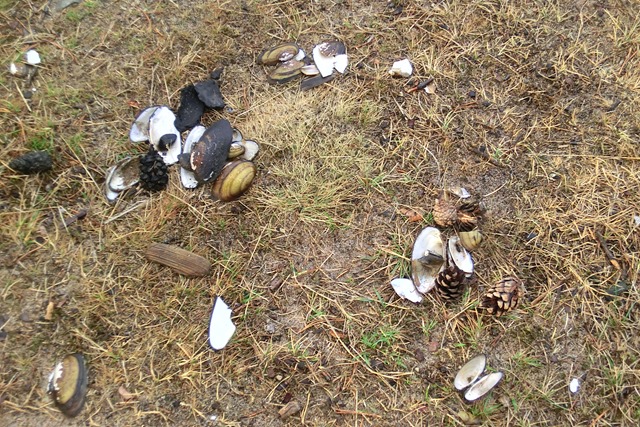
Some of my “beach finds” last weekend.

CIMG6052-001

CIMG6076-001

I suppose they are Anodonta anatina, duck mussels in English (“allmän dammussla” – common pond mussel – in Swedish), as that one, according to Wikipedia, is the most widely distributed large freshwater bivalve in Sweden.

CIMG6079

CIMG6061

CIMG6055-001

CIMG6073-001

CIMG6072-001

A lone duck looking for mussels (perhaps)

CIMG6074-001

Grilled socks, anyone?

Tuesday, 6 August 2013

Collectors’ Quotes

2013_08_06 stamps

“I collect old portraits. They're all just interesting pictures of people, and you just kind of wonder who they were and what they were. There's a guy - I don't know who he is, but he's wearing a suit. He's got his arms folded, and he looks like he sold insurance or something. I'm just wondering why someone painted him.
”Ellen DeGeneres


“I collect records. And cats. I don't have any cats right now. But if I'm taking a walk and I see a cat, I'm happy.”
"Haruki Murakami


“I don't collect any memorabilia. I wish I'd have kept everything I had. But who knew you had to keep it. Just gave it away. And we lost so much and we didn't look after a lot of it.”
Ringo Starr


“But in truth, should I meet with gold or spices in great quantity, I shall remain till I collect as much as possible, and for this purpose I am proceeding solely in quest of them.”
Christopher Columbus


“I collect watches because I'm always late, and I need to know exactly how late I'm going to be - in order to come up with a good excuse.”
Colin Hanks


“I've always been an obsessive collector of things. Richard Briers collects stamps. I collect cars and guns, which are much more expensive, and much more difficult to store.”
Michael Gambon

- - -

I spent a weekend out at the House again. Two years we’ve spent rummaging through that house, and there are still surprises hiding… I’ve told you before that I found lots of still valid stamps 1½-2 years ago while going through dad’s study. About three months ago I decided to use those for postcrossing (link to my first post about that back in May).  

This weekend I decided to look through some boxes we found later, also related to dad’s stamp collection. They seemed to contain mostly first-day covers and foreign stamps. The main reason I started looking through them was that I was curious if there might also be some postcards. Very few of those – BUT in among all the envelopes of foreign stamps (mostly from the rest of the Nordic countries) I found more unused Swedish stamps as well. And when I say more, I mean lots. Probably at least as many more as those already found!

I can maybe (sort of) understand the kind of stamp collecting where you put “one of each” into albums in some sort of order. Here, however, we are talking stamps kept in their original little semitransparent envelopes (usually two of each issue/booklet), each stored with the brochure they were ordered from, in the envelope they came in; and the envelopes in boxes; and the boxes stacked in a wardrobe…

I’m not a stamp collector. I may be committing some kind of sacrilege, but what I do with stamps is (re)sort  them according to nominal value, and some perhaps according to topic – so that I know where to find them when I want to use them.

Now please excuse me. I have some postcards to write…

Related Posts Plugin for WordPress, Blogger...