Showing posts with label Kindle. Show all posts

Sunday, 8 May 2022

What I see on my Kindle

My previous post (with two reviews of books read on Kindle) led to a discussion in the comment section about a recent Kindle update - not made easier by readers perhaps having different versions of the device. 

As one can't add images in the blog comments, it occurred to me to do a separate post with images to illustrate what it is I see on my device. Maybe it can help someone - or maybe not. (If nothing else, it might be helpful to my future self, as I too keep forgetting every now and then where to find things...)

When I open my "Home" screen, vs my "Library" screen, this is what I see:


From the Library page, to find the Sorting and Viewing options,
click the three lines in the top right corner.

At the bottom, choose between Grid, List or Collection.
With Grid, I see only book covers.
With List, I see a small cover picture + title and author
With Collections, I see collections (folders) that I created myself.
(Inside the folders, the 'grid' view.) 

In Grid/List, you can sort by Most recent, Title, Author or Publication date.
In Collections, you can only choose between Most Recent, or Title.
In all three, you can also choose between Ascending or Descending order (A-Z or Z-A).

Create new collections by clicking "+" to the left of the three lines in the top right corner. The same book can be sorted into more than one collection.

In Collections, one folder is 'Uncollected'. (I don't think I created that one myself.) There I find books from the cloud not downloaded on this device. (Including my Audible books.)


Tuesday, 26 October 2021

The 'One and Only' Kindle

 Back in October 2012, I bought my first Kindle e-book reader: A 'Kindle Touch', which has kept  serving me faithfully for 11 years by now. But one day last week, I think it was on Thursday, it was suddenly behaving very sluggishly - it took forever just to turn a page, and every now and then it went on auto-restart, but seemed unable to finish the job properly. I also tried to restart it manually a few times, but that did not seem to help either.

As I'd been thinking for a while about perhaps buying a new one anyway - just to get a brighter, 'paper white' display -  I decided that it was probably time to go ahead and do so. 

Since a year or so, I know Amazon has also established themselves in Sweden, so I went to the .se website to  check what was on offer there. It turned out they did not have the one called Paperwhite, but they had one just called Kindle (I think "10th generation") - a little simpler (like lower resolution), but otherwise similar, and looking paper white enough to me. It also seemed to be the only kind in stock. So I ordered it, I think this was on Thursday - and got prompt response that it would be delivered on Monday, to my nearest parcel delivery service (= my nearest neighbourhood convenience store).

As soon as I'd got that confirmed, I discovered that my old Kindle had managed to cure itself from whatever it was it had been struggling with, and was back to functioning as well as ever again. I suppose it had  been spying on me and did not like the idea of getting replaced...

I told the Oldie not to worry - as I have almost my whole Kindle library (with hundreds of titles) downloaded and sorted on it, I'll not abandon it but keep it on as 1st Archivist (as long as it's feeling up for that job) while the Newbie's job will be primarily to deal with what I'm currently reading...

Over the weekend, while waiting for my delivery, I visited amazon.com for some comparative research. To my surprise, I found that there, every kind of Kindle e-reader was marked as either "currently unavailable" or "temporarily out of stock"! Wow. I was beginning to feel very lucky that I had managed to order one at all!

The package arrived yesterday as promised. I had also ordered a special cover for it, and that arrived as well, in a separate package. Also no problems downloading the software and connecting to my account etc - I've just had to spend some time to figure out where to find things etc, as they've made some changes (and hidden some things in different places compared to my old one).


The main difference is the possibility to change the brightness of the display though, and that was what I wanted. (My old one has a grey display, which works comfortably enough in the right light, but can't be adjusted to varying light conditions.)
 
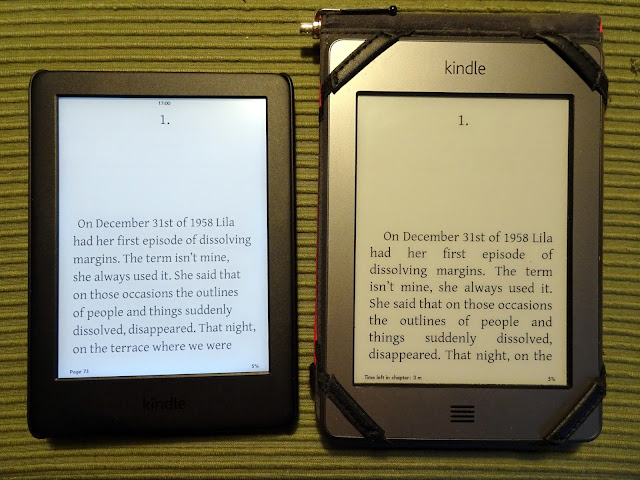
My new Kindle to the left, the old one to the right:

(The book I've recently started reading is Elena Ferrante's Neopolitan Novels (boxed set), which I recently found as a cheap deal for Kindle.)


The Oldie has a pink leather cover which flips upward/back (so that it can stand by itself on a table, for example). The Newbie has a grey cloth cover that flips open like a book, but on the other hand it has the ability to automatically turn off the Kindle when you close the cover - and when you next open it, the Kindle also opens automatically to the last thing you were reading. (Again, this was the only cover available for that model, so I just bought it...)

What's giving me the most headache at the moment is trying to sync my book "collections" between different devices (also including my computer, my phone and my tablet). That's a total mess, because when I tried to do that, old collections that I thought were long ago deleted and replaced, also turned up again... Ah well. It's mostly a problem with all the free titles by unknown authors that I never yet found time to read. I now have no idea in what category some of those belong... (My old Kindle, the Archivist, is probably still the one who knows best.)

Today, I went back to the Swedish Amazon website to check something... Guess what? Now they too seem to have no Kindle e-readers at all in stock. Did I manage to get the last one in the world??

Sunday, 29 December 2019

Read in Nov/Dec - Book Reviews

Trying to "catch up" with a number short reviews of what I've been reading and listening to in November and December...


The Murder at Redmire Hall by J.R. Ellis
(Kindle + Audible)
No 3 in the Yorkshire Murder Mysteries series


Lord Redmire intends to perform an impossible locked-door illusion on live TV. But the trick goes fatally wrong - and right in front of special guest DCI Jim Oldroyd... As Oldroyd and his DS Stephanie Johnson soon discover, nearly everyone at the event had a reason to resent the eccentric lord. But in this case, it’s not just a question of who did it and why - but how?

It may have been this locked-door mystery that made me look up and re-read another classic in that genre. (Which I've read before, in Swedish, but I always seem to forget the details of mysteries after a while, so usually fall for the same traps when I reread ...) 


The Red House Mystery by A.A. Milne (1922)
(Kindle)
 
Yes - by the author of Winnie the Pooh! Milne wrote other things as well, but I think this was his only mystery novel. The book was an immediate success when it was first published, frequently reprinted, and is still regarded as a classic in its genre. The setting is an English country house, where the owner has been entertaining a small house party, when a long-lost brother, the black sheep of the family, arrives - and is shortly afterwards found shot under mysterious circumstances. A friend of one of the guests turns up, and together the two friends take on trying to solve the mysteries in a Sherlock & Watson fashion.


Miss Hargreaves by Frank Baker (1940)
(Kindle + Audible) 

This is a book I got curious about after reading a review by Terra at the blog *Terra Garden*. I first read it on Kindle, but then decided this was one I'd also probably enjoy listenting to (and perhaps more than once) - so bought the audio as well. (I don't regret that. The audio narration is very good too.) 

The narration style reminded me a bit of one of my favourite classics, Three Men in a Boat by Jerome K. Jerome. However, Miss Hargreaves also has a touch of magic to it - although I don't think the word magic is ever used in the story. (Mary Poppins also came to mind for me - even if I suspect that both Mary and Miss Hargreaves might resent the comparison...)

It is not a children's story, but it involves a great deal of whimsicality or "spur of the moment" ideas - and afterthought. It all starts when the narrator, a young man by name of Norman, and his friend Henry, are away on a holiday and visit a church as tourists. In conversation with the man showing them around in that church, they "happen" to invent a fictive acquaintance - Miss Hargreaves. This spur of the moment impulse comes to cause them a lot more trouble than they could ever have imagined...


The Starless Sea by Erin Morgenstern
 (Audio, 18:37, multiple narrators)

Quick summary: Not worth the time!!

I kept hoping that at some point I'd reach an 'aha' moment in this book... But it never came! It's a fantasy story, and like many great stories it starts with a door to a different world. However, to me this book read like a tedious computer game of the kind where ever so often you just come to a dead end, and have to start over; and then it's the same story all over again with very little change; until another dead end, and so on and so on. For a while I thought that perhaps to realize this was meant to be "the point" - but having reached the last page, I still couldn't really see it leading anywhere. So either I missed the point, or else there wasn't one. Only one thing seemed certain, and that was that I wasn't going to try and listen to it again to find out.  So for once, I actually made use of my Audible membership benefit to send back a book one didn't like (and get a credit to use for another instead).

Decided to "play it safe" with the next listen, and catch up with the latest Botswana No 1 Ladies' Detective Agency adventures... Oops, I found there were two I had missed...


The Colours of All the Cattle by A McCall Smith
(Audio, 8 h, narrated by Adjoa Andoh) (2018)
No 19 in the No 1 Ladies' Detective Agency series 

Mma Potokwane suggests to Mma Ramotswe that she run for a seat on the city council - against Mma Makutsi’s old enemy Violet Sephotho...


To the Land of Long Lost Friends by A McCall Smith
(Audio, 7:35 h, narrated by Adjoa Andoh) (2019)
No 20 in the No 1 Ladies' Detective Agency series 

Mma Ramotswe takes on a case for a childhood acquaintance; and Charlie is dreaming of getting married, but wondering how to be able to afford it.

McCall Smith is one productive writer...!
I actually found both these quite enjoyable, though.


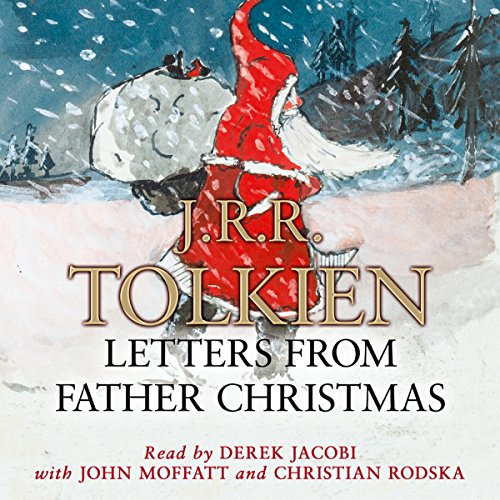
Letters from Father Christmas by J.R.R. Tolkien
(Audio, 2:07 h) 

Letters written by J. R. R. Tolkien (alias Father Christmas) for his children, between 1920 and 1943. The book was released after his death. I'm guessing it's best read in print with the original illustrations - but the audio presentation was quite nice to listen to as well (with Christmassy music interposed between the letters).


The Sugar Queen by Sarah Addison Allen
(Kindle) (2008)

I haven't quite finished this book yet, but hope to do so before the end of the year (or else, at the very beginning of the next one). Sarah Addison Allen writes novels classified as "magical realism" and "chic lit". I think I've read them all now; this was her second out of six. (They're stand-alones so the order doesn't really matter.)  
Typically the magic in her books has to do with food (especially sweets) - like women having inherited a special witchcraft kind of knowledge how to use secret ingredients to create certain effects. In this book, she also sort of gives new dimensions both to hiding things (or people!) "in the closet", and of books turning up just when you need them (even if you're not looking for them), giving you hints to what you ought to do...

Tuesday, 12 November 2019

Murder in the Dales

Last month, I also read two murder mysteries by J.R. Ellis. According to the presentation on Amazon, the author is a retired teacher who has lived in Yorkshire for most of his life. I've never come across him before, but it turns out he has written a series of (so far) four murder mysteries. I happened to find the first one as cheap daily deal (or something) for Kindle+Audible - and as I have a soft spot for Yorkshire (spending a bit of time there in my teens), I let myself be tempted. 

That I was not disappointed is probably proved by the fact that after finishing that one, I went straight ahead and bought the next one in the series as well. (I suspect I'll also get No 3 and 4 at some point.) 


The Body in the Dales by J.R. Ellis
Audio book narrated by Michael Page (9:48)

In the first book, a body is discovered in a cave beneath the Yorkshire Dales. The deceased man was well known in the village, but not well liked. A big part of the mystery is how his body came to be found in a very remote part of the cave system. There are details involved that make all suggested explanations just seem impossible. In charge of the investigation is DCI Jim Oldroyd, a Yorkshire man with plenty of local knowledge and experience, and his new partner DS Carter, who has just come to join them from London ('city boy' getting a rather tough introduction to rural Yorkshire). 

I liked both the setting and the main characters (the detectives); and I also enjoyed the Yorkshire dialect (both in the written form and the audio narrative). 


The Quartet Murders by J.R. Ellis
Audio book narrated by Michael Page (9:30)

The second book starts with DCI Oldroyd actually witnessing a murder. A world-famous violinist is shot during a concert, with Oldroyd sitting in the audience. Whoever did it disappears - and so does a unique and very valuable violin... A lot of twists and turns follow before the mysteries are sorted out; and the reader also gets an insight into the world of fanatic collectors of priceless old instruments - like Stradivarius violins.

Sunday, 17 February 2019

Book Review: The Sound of Language


The Sound of Language
by Amulya Malladi (2007)

(Read on Kindle in February 2019)

This is a story about a young woman, Raihana, who comes as refugee to Denmark from Afghanistan, fleeing from the war and chaos in Kabul. In Denmark, she is staying with relatives, a couple with a small child. As is prescribed for all immigrants, she goes to language school to learn Danish. At first, the Danish language sounds to her like the buzzing of bees. But thinking of the sound of bees also stirs up some good childhood memories for Raihana, of visiting an uncle who had a bee farm back in Afghanistan. She finds a new friend in her Danish language teacher, and when in some context Raihana mentions thee bees, the teacher is inspired to help her to get an apprenticeship with a man she knows who keeps bees. This man, Gunnar, is an elderly recent widower. He and his wife started beekeeping as a hobby and enjoyed working with this together. After his wife died, Gunnar has sunk into a state of depression, and doesn't really care much about anything any more – including the bees. However, he reluctantly agrees to have Raihana coming to help him with the bees three days a week.

In the beginning, both of them feel rather skeptical and awkward about the arrangement, and so do their families (Gunnar's daughter-in-law, and the family Raihana is staying with). But they decide to give it a trial period. In the beginning, Gunnar and Raihana don't really communicate much at all, and Raihana doesn't even come into his house (the beehives are outside in the garage). But with time, they get used to each other, and a sort of friendship grows between them. Raihana also finds a beekeeping journal that was kept by Gunnar's wife (Anna), and uses that (with Gunnar's permission) to learn more both about beekeeping, and the Danish language.

The author also uses quotes from Anna's beekeeping journal as introduction to each chapter, subtly indicating certain parallels between the behaviour of bees vs people. Slowly, we also get to know each of the characters in the book better – their strengths as well as their prejudices and weaknesses, and also background stories which perhaps explain why they react and feel like they do.

It's all put to a serious test when violence and persecution towards immigrants shows its ugly face even in Denmark, awakening bad memories for the refugees – but also challenging the local Danish community to take a stand.

I was somewhat surprised to learn from the Afterword in the book that the author is neither Afghan nor a beekeeper herself. (So the background story in the book must have involved quite a lot of research.) Amulya Malladi was born 1974 in India, studied electronic engineering and journalism in the US, lived for several years in Copenhagen (Denmark), and has written seven novels. Her books have been translated into several languages, including Dutch, German, Spanish, Danish, Romanian, Serbian, and Tamil.

I liked the book because although I was never under the pressure of being a refugee seeking a new life in a foreign country, I do recognize the difficulties (and joys!) involved in learning foreign languages. Moreover, as Denmark and Sweden are neighbour countries with a lot in common, I also recognize the social structure and the range of difficulties and fears involved in meetings between immigrants and ”natives” - from both sides! I think the author describes all that very well.

I downloaded this book to my Kindle for free in May 2018. It's no longer free but still quite cheap, if anyone feels tempted.


Sunday, 1 November 2015

Turning Leaves Through October

CIMG6694

Besides Havana Sleeping by Martin Davies (which I thought deserved a book review of its own), I also in the month of October read/listened to the first two (out of six) ‘Chronicles of Barsetshire’ by Anthony Trollope – The Warden (1855) and Barchester Towers (1857).

CIMG6721

As far as I can recall, I have not previously read anything by Trollope, even though I’ve often seen references to him, and this series especially.

CIMG6799

Being old classics, these books can nowadays be found for free on the internet.  Back in my pre-internet university days, it was a very different story (here in Sweden) to get hold of English classics that weren’t on the prescribed list of study course literature…

CIMG6775

Which means that ever since I got the Kindle (I can hardly believe that was only three years ago – it feels like I’ve had it much longer!), I’ve been on a constant happy free-shopping-spree, downloading just about every old classic, read or unread, that has happened to come to mind for me. No doubt more of them than I will ever in reality find the time to read…

CIMG6824

The Barsetshire Chronicles were actually among the first lot of classics that I downloaded just after I bought the Kindle back in the autumn of 2012. What made me decide to read these just now was that more recently I also happened to notice that ‘whispersync’ audio versions of them were also available at reduced price (about 3$ per book).

CIMG6828

I really love that possibility of being able to switch back and forth between reading and listening – especially with lengthy books, because it means I can keep reading even when I need to rest my eyes, but I can also go back and check things (which is very hard to do if one only has the audio version), or read some chapters the usual way if I’m in the mood for that.

CIMG6860

I still find it harder to write reviews of audio books, because one does not pick up details in the same way as when seeing the text.

CIMG6866

And as I’ve mostly listened to these two, I’ll just say that I found them enjoyable. Not all easy to keep up with all the various titles and finer nuances of the mid 1800s ecclesiastical, aristocratic and social hierarchy – which is pretty much what the author is mocking in these books, and also spinning his plots around – but even without looking up every detail of all that, one soon gets the drift. Society may have changed a bit over the last 150 years, but the ways we relate to other people really haven’t changed as much as we might like to think… (Prestige, envy, gossip etc.)

CIMG6899-001

I really loved the poor honest warden’s struggles with his conscience in the first book (receiving very little or no credit for all his efforts to be just and fair); and all the misunderstandings in the second arising from people just assuming what’s going on in the minds of others, without really bothering to ask – for example!

CIMG6948

I’ll continue reading/listening to the rest of this series. I find they make excellent “bedstories” as in the midst of all the intrigue they’re still kind of peaceful…

CIMG6947

 [And in between reading, I have been out walking a lot in fine autumn weather! The photos in this post were taken on different occasions from the beginning of October to about a week ago.]

Wednesday, 19 August 2015

Reading By Ear

This summer most of my reading has been in the form of audio books – of which quite a few have been old favourites revisited.

At bedtime, for example, I often prefer a familiar story that doesn’t require too much concentration…

One of the many things I appreciate with Amazon’s Kindle/ Audible is that with many free Kindle classics, it’s also often possible to find Audible recordings of them quite cheap. At best they are even synced so that (if you’re on wifi) you don’t even have to remember yourself which device you last used to read or listen… The next one you pick up will check it for you and ask if you want to go to the furthest read location.

On my re-reading/listening list this summer have been the classic novels by Jane Austen: Mansfield Park, Emma, Pride & Prejudice, Sense & Sensibility, Northanger Abbey (listening to that now) and Persuasion (downloaded, but remains to listen to).

I think Northanger Abbey may still be my favourite, because of the way she makes fun of the whole Gothic Horror Romance genre that was popular at the time. (Finding it even more amusing now, after actually reading Anne Radcliffe’s The Mysteries of Udolpho some years ago – which is frequently referred to in NA.) A strong contender is Emma, though, because in that one too, Austen manages (and in a more subtle way) to present an ‘imperfect’ heroine.

In between the Austen re-reads I’ve been listening to some other audio books as well, though.

Last week, for example, I was held captive by a new  biography about Joy Davidman, the woman that C.S. Lewis married rather late in life. This I bought only as audio (not finding any “package” deal).

Joy: Poet, Seeker, and the Woman Who Captivated C. S. Lewis | [Abigail Santamaria]

Joy: Poet, Seeker and the Woman Who Captivated C.S. Lewis – by Abigail Santamaria

Some of you may know a bit about their love story from the film Shadowlands (1993). It’s been a good while since I last saw or read Shadowlands (I think I shall have to return to both book and film for comparison). But my impression is that this biography gives a fuller portrait both of Joy’s early life (including her first marriage), and of the complexity of the relationship that grew between her and Lewis. And one thing I did not know or did not remember from before was that besides being Jewish and having been (for a while) a member of the Communist party in America, Joy was also (for a while) a follower of L.R. Hubbard (the founder of Scientology) and a practiser of Dianetics. (I suppose I may have read this before, without paying much attention – but as it happened now, by pure coincidence, only a week or two before I bought this biography I had watched a TV documentary about Scientology, from which I learned a lot more details about that movement than I ever knew before.)

I found Joy: Poet, Seeker… (etc) a very interesting read, easy to follow and with facts well presented. I also found the audio narration by Bernadette Dunne quite excellent and easy to listen to. (I have to confess I sometimes find it harder to listen to audio books in American accent –being more used to British English myself – but in this case it was no problem; and as Joy was American, it also ‘felt right’.)

Tuesday, 13 August 2013

Book Review: A Mind to Murder by P.D. James

A Mind to Murder by P.D. James (1963/2012)

Among the Kindle Deals this month (from Amazon International) I found A Mind to Murder in the Adam Dalgliesh series by P.D. James, at the price of $1.99, and with the Whispersync for Voice Audible book for $4.59 – read by Roy Marsden who plays Adam Dalgliesh in the TV series.

(I like it when I’m able to read parts of a book on Kindle and listen to other parts as audio book. It means I can go on reading even when I have other things to do, or am too tired to keep my eyes open!Winking smile)

At first I was under the impression that this was one of the more recent books in the series (it’s been a long time since I last read any of them). It soon became obvious though, that this story took place in pre-computerized times. Checking up on it (after having finished the book), it turns out that it is in fact the 2nd in the series, first published in 1963 (50 years ago).

No doubt this also explains my general impression of a good old-fashioned “whodunit” mystery; focusing on sorting out the possibilites and motives among a narrow circle of suspects rather than going into an excess of gruesome forensic details, or lots of extra complications to do with the private lives of the detectives rather than the case as such. (There is a hint of that side of things, but compared to modern crime novels, it plays a very small part.) That does not mean the mystery in itsef is without complications, though!

Recommended if you like that kind of book; and especially if you use Kindle and live in a part of the world where this special deal happens to be on at the moment.


Monday, 12 August 2013

Book Review: ‘Blue Mercy’ by Orna Ross

Blue Mercy: A Novel by Orna Ross (2013) ****

Just recently, I came across this book as temporarily free for Kindle (it is no longer free). As I happened to be “between books” it so happened I got started on this one pretty much straight away after downloading it. And finished it in just a few days too.

The story is set in Ireland and California. The main narrator is Mercy Mulcahy, who at the age of 40, back in 1989, was accused of having killed her elderly father. Years later, knowing her own life to soon be over, she writes a book about her life, including her version of what really happened on that fatal night. After her death, the manuscript is left to her daughter, Star, who is at first very reluctant to read it, but finally does. She adds her own comments here and there; and so we get some of the events from her point of view as well.

This is a story with lots of twists and turns along the way. The more you learn, the more complicated it gets. It is at the same time a psychological thriller, and a love story covering several different kinds of love – and dependence. (Between lovers, parents/children, friends…) It also made me think a lot about how we do tend to change our perspectives over a lifetime; and I found quite a few quote-worthy passages.

All in all I found the book intriguing enough to keep reading in spite of several minor “typo” kind of errors throughout.  It does annoy me though, when an otherwise good story obviously has not been sufficiently proofread before publication. (It seems to me this happens frequently with self-published books.)

I think I still have to give this book four stars, even with the typos. I also have some difficulties making up my mind what I think of the story and narrative technique as such. But the fact that it makes me argue with myself should probably be weighed in its favour!

The author Orna Ross is a London based Irish writer. Formerly a features journalist, lecturing in Creative and Imaginative Practice at University College Dublin (WERRC), in 2012 she founded The Alliance of Independent Authors. New to me, but I find this is not her first novel. I might consider trying another one by her some day. But I’ll leave it to Time to prove whether that thought will stick in my mind or not!

Quotes:

Time has sliced itself up since my mother died five days ago, and keeps shuffling itslef like a deck of cards in my hand.

When sorrow sours your milk, it’s time to make cheese. A very Irish way of saying: count your blessings.

I still think of myself as living, not dying.

Each I-twist oand if-only turn of my mind only tightened the tie I longed to loose.

There is no what-might-have-been, there is only what-is.

You can’t command the ocean, or strap up the wind, but you can observe them, you can get to know them.


Sunday, 11 August 2013

Book Review: Murder in Burnt Orange

Murder in Burnt Orange: A Hilda Johansson Mystery
by Jeanne M. Dams (2011) ****

Several months ago, someone suggested that I might want to read the Hilda Johansson mysteries by Jeanne M. Dams. I’m not sure whether that was in a comment on this blog or on my Greetings from the Past blog, where I have been writing quite a lot about my great-aunt Gerda, who emigrated to America in 1902 to work as a maid in various households in Chicago for about ten years (and later on as companion for rich English ladies travelling both in Europe and other countries).

Hilda Johansson, the heroine in a series of mystery novels by J.M. Dams, is also a Swedish immigrant working as a housemaid, not in Chicago but in South Bend, Indiana, in the early years of the 20th century.

I had never heard of neither the author nor her books before, but found one of the novels available cheap for Kindle ($2.99), so I decided to give it a go. It must be  at least the 7th book in the series, but the previous ones seem not to be available for Kindle at all.

In Murder in Burnt Orange, Hilda is no longer working as a housemaid, and has also changed her surname, since she is recently married. She is also pregnant with her first child. There are several reminders of Hilda’s background throughout the book though, so not difficult to read it as a stand-alone novel.

The general set-up reminds me quite a bit of the Maise Dobbs novels by Jacqueline Winspear (of which I have reviewed two or three before on this blog) – even if Hilda, unlike Maisie, has not made a professional career of her detecting skills.

All in all I quite enjoyed making Hilda’s acquaintance and was impressed with the auhtor’s use of historical background. The novel is set in 1905, and inspired partly by some real historical events, like labor unrest (in Chicago), strikes and train wrecks.

Here’s the blurb copied from Amazon:

It's a heat wave in more ways than one in the summer of 1905, as strikes, arson, and train wrecks threaten the fabric of civilized society in South Bend, Indiana. In the tumultuous first years of the twentieth century, anarchy seems to rule, with the assassination of an American president and labor unrest like the Anthracite Coal Strike bringing misery to millions. How can a Swedish immigrant like Hilda Johanssson, formerly a housemaid and now pregnant with her first child, possibly affect these conditions? Making deductions worthy of Sherlock Holmes - and using her own "Baker Street Irregulars” - Hilda reognizes a pattern to the disturbing events. No one thinks she'll actually be able to solve matters, especially since custom forbids her even leaving the house. But they reckon without Hilda's quick mind and stubborn determination to see the job through - even when the crime wave turns into murder, and touches her nearest and dearest.

Sunday, 17 March 2013

Book Review: The Curiosity Cabinet

The Curiosity Cabinet by Catherine Czerkawska
****

The Curiosity Cabinet

I found this e-book free for Kindle, combined with the whispersync Audible audio at bargain price, and I bought that as well. In this case I’m very glad I did, because the reading by Carolyn Bonnyman is excellent. The novel is set in the Hebrides (on a small fictional island named Garve) and it enhanced the total experience to listen to it read in a Scottish accent by someone who could even manage the occasional quotes in Gaelic. (Well, at least to my Swedish ears it sounds right!) (If there’s one thing I find very hard to digest when it comes to audio books, it’s an obviously British book read in a broad American accent...)

The book interweaves two stories:

Alys, from modern-day Edinburgh, revisits the small (fictional) Hebridean island of Garve after twenty five years. She is divorced and misses her son who is on holiday elsewhere with his father and his new wife. On Garve, Alys gets reaquainted with Donal, an old playmate from holidays back in their childhood. In the hotel where Alys is staying, she also gets fascinated by an old embroidered cabinet on display. This turns out to have connection to Donal’s family.

The cabinet also turns up in the parallell story of a woman who was brought to the island three hundred years earlier; and Donal’s forefather Manus.

Compared to some other back-and-forth-in-time novels I’ve been reading lately, this one has less focus on mystery, and more on romance. The two stories, present and past, run parallell rather than being all tangled up. (And yet…) Even if perhaps the book’s strongest point is not the “plot”, I still found it a good read though – and as I said above, listening to it read in the “right” accent added further to enhance the magic embedded in the landscape and history of the islands themselves. I read some chapters on the Kindle and listened to others; but I think it’s a book I’m likely to listen to again just for the joy of a good reading performance.

Quote:

“You’d be surprised how many facts about the history of places and people are embedded in tales. Passed on, passed down. It’s like when they find shells in rock strata, miles from the sea. You think it’s all nonsense, fairtytales, fantasy. Only somewhere inside the fantasy there’ll be this nugget of truth. If only you can dig it out.”

From Amazon.com:

The Curiosity Cabinet was one of three novels shortlisted for the prestigious 2005 Dundee Book Prize. It has been out of print for some time. The new cover design for the Kindle edition is by distinguished Scottish textile artist Alison Bell, who interpreted her own response to the book as follows: ‘The narrative works on many layers of memory and time, some hazy, some forgotten, but the island’s presence is constant, as a refuge and a place to grow and start afresh. I wanted the colours to be soft, subtle, muted, with hints of turquoise, like the sea up there. It is a gentle book which drifts into the mind’s eye as each chapter unfolds.’

Catherine Czerkawska is an award winning author of historical and contemporary novels, short stories and many plays for the stage and for BBC Radio 4. She loves the Highlands and Islands of Scotland, Scottish history and music. When not writing, she also finds time to collect and deal in antique and vintage textiles, especially those with a Scottish or Irish provenance. She's fascinated by costume history and often finds that antique textiles: embroideries, lace, silks and satins, find their way into her fiction.


Sunday, 6 January 2013

The Diary of a Nobody (Book Review)

***
The Diary of a Nobody is an English comic novel written by George Grossmith and his brother Weedon Grossmith, with illustrations by Weedon. The book first appeared in Punch magazine in 1888 – 89, and was first printed in book form in 1892. It is considered a classic work of humour and has never been out of print.

In The Diary of a Nobody the Grossmiths create an accurate, if amusing, record of the manners, customs and experiences of lower-middle-class, suburban Londoners of the late Victorian era. The diary is the fictitious record of fifteen months in the life of Mr. Charles Pooter, a middle-aged city clerk of lower middle-class status but significant social aspirations. Other characters include his wife Carrie, his son Lupin, his friends Mr. Cummings and Mr. Gowing, and Lupin's unsuitable fiancée, Daisy Mutlar. The humour derives from Pooter's unconscious gaffes* and self-importance, as well as the snubs he receives from those he considers socially inferior, such as tradesmen.

[Source: Wikipedia]

  * gaffe, noun: An unintentional act or remark causing embarrassment to its originator; a blunder

 George Grossmith (1847 – 1912) was an English comedian, writer, composer, actor, and singer. His brother Weedon Grossmith (1854 – 1919) was a writer, painter, actor and playwright.

File:George Grossmith - English comic and actor - Project Gutenberg eBook 12223.jpg

George Grossmith, as illustrated in The Idler magazine, 1897

…

I can’t remember now if someone recommended this book or if I just happened to come across it randomly  when searching for free classics for the Kindle. Anyway the title seemed familiar (I’ve probably seen/heard it referred to in various bookish contexts). After reading it, one main impression is that it might be best read as it was first published, in weekly portions. I was amused by the first few chapters, but have to confess I found it growing rather repetitious before the end.

Another thought that crossed my mind was that it’s kind of a 19th century equivalent of a blog. (Or a blog mocking other blogs.)

Why should I not publish my diary? I have often seen reminiscences of people I have never even heard of, and I fail to see - because I do not happen to be a ’Somebody’ - why my diary should not be interesting. My only regret is that I did not commence it when I was a youth.

Charles Pooter
The Laurels,
Brickfield Terrace
Holloway.

The Kindle copy I downloaded lacked the illustrations, but they can be found (with the full text) here.

Thinking of other classic British writers, the style reminds me perhaps most of Jerome K. Jerome, whose masterpiece Three Men in a Boat (one of my absolute favourite books ever) was also published in 1889.

However, my thoughts also wandered to The Sacred Diary of Adrian Plass aged 37 3/4, by British author Adrian Plass, written about a century later - 1987. A book I found absolutely hilarious when I first read it, and have returned to with pleasure many a time since then. (I was going to call it a ‘contemporary’ equivalent here, and then did some maths and changed my mind… realizing that I may have readers who think 1987 belongs in History too.  Hm!)

Anyway, it never occurred to me before, that Plass might have picked some inspiration from some old classic that I had never read. Now, having widened my own reading experience, this suspicion does suggest itself! – even if I have no hard evidence. (Plass is a Christian writer and his fictitious Sacred Diary is set in a free church context. But other aspects are remarkably similar: Middle aged male diary-writer with wife and one young son of dating age, a few friends coming and going, and a cleverly exaggerated tendency for “gaffes”.)

Wednesday, 26 December 2012

A Little Book of Christmas

I spent part of Boxing Day reading A Little Book of Christmas which I happened to come across as free Kindle book just before the holiday. It contains four short Christmas stories. My Kindle took me right to the first page of the first story, but I soon felt need to click myself back to the “cover” page to double check: was the book really an old classic as I had assumed…?

Hetherington wasn’t half a bad sort of a fellow, but he had his peculiarities, most of which were the natural defects of a lack of imagination. He didn’t believe in ghosts, or Santa Claus, or any of the thousands of other things that he hadn’t seen with his own eyes, and as he walked home that rather chilly afternoon just before Christmas and found nearly every corner of the highway decorated with bogus Saints, wearing the shoddy regalia of Kris-Kringle, the sight made him a trifle irritable. ---

But yes, this book was first published in 1912. Not 2012. And still after finishing all four stories, the impression that lingers with me is that the world – and big city life and crazy Christmas shopping – has not really changed as much as one might think in the last 100 years…

John Kendrick Bangs (1862 – 1922) was an American author, editor and satirist, born in Yonkers, New York. His father was a lawyer in New York City, as was his brother.

Bangs himself started at Columbia Law School but left after one year in 1884 to become Associate Editor of Life. In 1888 he moved on to Harper & Brothers where he soon got the title of Editor of the Departments of Humor of all three of their magazines. In 1904 he was appointed editor of Puck, perhaps the foremost American humor magazine of its day.

His first wife with whom he had three sons, died in 1903. He then remarried and in 1907 moved from Yonkers to Ogunquit, Maine. He died from stomach cancer in 1922 at age fifty-nine, in Atlantic City, New Jersey.

The partial (!) bibliography in Wikipedia is quite impressive. I also learn that he’s even got a whole genre named after him – Bangsian fantasy which is “a fantasy genre which concerns the use of famous literary or historical individuals and their interactions in the afterlife”. I also find that there are lots of titles by Bangs available as free ebooks at Amazon… So if you’ve had enough Santa-stories already this Christmas, you could try something else. I might, some day. (Just now I feel like my reading list keeps growing instead of shrinking, with every book I read!)

Book Review: The Lewis Man by Peter May

Product Details

The Lewis Man by Peter May is the second book in a trilogy set on the Isle of Lewis off the west coast of Scotland. I went pretty much straight on to this one after the first one in the series, The Blackhouse (which I blogged about two weeks ago).

Amazon's introduction:

A MAN WITH NO NAME
An unidentified corpse is recovered from a Lewis peat bog; the only clue to its identity being a DNA sibling match to a local farmer.
A MAN WITH NO MEMORY
But this islander, Tormod Macdonald - now an elderly man suffering from dementia - has always claimed to be an only child.
A MAN WITH NO CHOICE
When Tormod's family approach Fin Macleod for help, Fin feels duty-bound to solve the mystery.

My comments:

Some six or eight months have passed between the previous book and this one. Fin Macleod has resigned from his police detective job in Edinburgh and is back on Lewis for private reasons. While in the first novel his personal experiences and memories from growing up on Lewis came to play a part in unravelling the crime he was then sent there to investigate officially; in this book it is (sort of) the other way round. When he gets involved in a case involving an old unidentified corpse just found in a peat bog, this is because of his private connections on the island, and not as an official police detective. But still experiences from his previous job gets integrated with his inofficial quest.

Like in the first book, the landscape and climate is still very much interwoven with the events and the characters. All the time in the background, you feel the weather. I don’t think I've ever come across an author with quite the same skill to make the descriptions of nature inseparable from the story itself.

The wind howled its disapproval all around them.

The sun had rediscovered its warmth, and fought to take the edge off the wind.

Heavy low cloud scraped and grazed itself against the rise and fall of the land, pregnant with rain, but holding it still as in realisation that the ground below was already beyond saturation.

In this novel too, we get the story served in parts, and from different narrative and time perspectives. In this book, we are also faced with the added complication of old age dementia. I kept thinking of my own father (who suffered from this in the last years of his life), which at times made it a somewhat 'uncomfortable' read  (stirring up my own emotions and memories). But at the same time, I have to say I'm really impressed with Peter May's respectful attempts to describe and unscramble the old age ”clouds of the mind”, involving all sorts of odd mix-ups of people and places and times.

'We walk into that nursing home, and all we see are a lot of old people sitting around. Vacant eyes, sad smiles. And we just dismiss them as … well, old. Spent, hardly worth bothering about. And yet behind those eyes every one of them has had a life, a story they could tell you. Of pain, love, hope, despair. All the things we feel, too. Getting old doesn't make them any less valid, or any less real. And it'll be us one day. Sitting there watching the young ones dismiss us as … well, old. And what's that going to feel like?'

Just as with the first book, with this one too I found it harder and harder to put it down as the story began to draw to a close... Parts of the ‘main plot’ are perhaps not quite as believable as the general setting – but I'll give it at least four stars (out of five). **** I find Peter May a really talented writer who must also be putting a lot of effort into his background research.

Some more quotes I highlighted during the reading:

When you are young a year is a big part of your life and seems to last for ever. When you are old, there have been too many of them gone before and they pass all too fast. We move so slowly away from birth, and rush so quickly to death.

He wore dark-grey suits that concertinaed around thick black shoes which squeaked on the tiles so that you always knew when he was coming, like the tick-tock of the crocodile in Peter Pan.

Whatever is à la mode today somehow seems ridiculous in retrospect.

No carved stonework or religious friezes, no stained-glass windows, no bell in the bell-tower. This was God without distraction.

You only have to look around you, and life will always remind you that you are not like others.

And he realized that you can never tell, even when you think you know someone well, what they might have been through in their lives.

Related Posts Plugin for WordPress, Blogger...