Showing posts with label books. Show all posts

Tuesday, 28 July 2026

Second Childhood


English title: Poo-Poo and the Dragons; originally published in 1942.
My copy in Swedish translation was printed in 1952.
Available for Kindle for about USD 1.05

---

This month of July, with the weather shifting between too hot and too wet, and my bad knee still limiting me a bit as well, I seem to have reverted to a "second childhood" in my reading. On a whim, I started checking if some old childhood favourites of mine in Swedish (which I still also have in print) were also available in audio format from one of my library services - and as they were, I have been re-reading some of those "the lazy way" - i.e. by listening while resting, when too tired to do anything more productive... 


Alas the series that I dived into first (about "Kulla-Gulla") does not seem to be available in English: Only one or two of the books were ever translated to English at all, and none seem to have been turned into e-books. So the only chance of finding even the first two seems to be second-hand. (The series does seem to have been translated to German, but probably the same thing there - not likely to have been more recently re-published.) 

So really not much point in reviewing them here... But I'll give you a brief summary anyway - hopefully you might understand why I still feel inspired to do so, before I get to the end. 

I read these books more than once in my childhood/early teens, when visiting my maternal grandfather. Originally they belonged to my mum and my aunt - and later on, when that house was sold, they were among a few books that I decided to keep from there. 

Published in the 1940s, the story in these books takes place a few decades earlier (early 1900s). The main character is a girl (Gulla) who grew up in an orphanage, and then had to go into service very early on (still really just a child herself) to help in the household of a poor crofter with many children. (The croft called Kulla, and thus the girl came to be known as Kulla-Gulla.) Back in those days, orphanage children were "auctioned" out as servants to whoever demanded the least money from the village authorities to keep them. As things turn out for Gulla, though, it is discovered after some time, that she's really the illegitimate grand-daughter of the lord of the manor in the village. So in the later books, we find her having moved to live with her grandfather at the manor, and struggling to balance between having grown up extremely poor but then suddenly being expected to become a "lady". 

It's been several decades since I last read these books, but to my surprise I found I still liked them better than I expected. In some ways I can probably relate to them even more now, because of in later years also having learned more about my other grandfather's childhood: He was born the only child of an unmarried mother, and grew up in poor circumstances in a small croft cottage, too. After only a few years in the village school he became a shoemaker's apprentice - but then managed to change his career and became a journalist instead; and wrote a book about crofts in the village where he grew up (which was published after his death, by my parents).
...

Another of my old childhood books that I recently managed to find to listen to in Swedish is the book at the top of this post: Poo-Poo and the Dragons, originally written in English - and available cheap for Kindle if anyone should feel tempted...

It seems that this author, C.G. Forester, wrote many novels - and this one is not among the those he's best known for. (You can look him up in Wikipedia if you want to know more.) Personally I can only recall having read this one, though. Poo-Poo and the Dragons (1942) was created as a series of stories told to his son George to encourage him to finish his meals. (The boy had mild food allergies and needed encouragement to eat.) It is a totally whimsical story (involving dragons kind of "taken for granted"), but I found myself still enjoying it!

Now I'm curious to know if others among my blogging friends who have reached "senior" years also still have kept some of your old childhood favourites - and perhaps even re-read them now and then... ? (In my own case, as I don't have grandchildren, I can't "hide" my re-reading of children's books behind such excuses!)


Saturday, 8 November 2025

Déjà Vu - "A Good Story Never Gets Old"


 In a recent post (Resting) I shared the message in the image above, which I recently received from my Audible app. If you are in the habit of going back to check answers to comments, you already know what audio book(s) it was that gave me that "déjà vu" comment about having listened to the same audiobook "at least 20 times". It appeared after I had (again) recently finished Harry Potter and the Philosopher's Stone, read by Stephen Fry. 

It's also very fitting that the message appeared on my screen just under the "Night Owl" badge - as it is at night that I'm most prone to re-listen to old favourites, rather than start something new. I've long been in the habit of falling asleep listening to audio books - and also to continue to listen if I wake up later in the night. And nowadays, I also need to rest my eyes in the daytime now and then (as a change from all the "screen time"...). I usually set the app on timer - but if I forget, a book may sometimes continue to chatter away for hours in the night without me being aware of it... (So some of my Audible awards may not really be quite as well deserved as it might seem!)

Anyway, the Harry Potter series (especially read by Stephen Fry), but also for example C.S. Lewis' Narnia series, and a number of other "classics" and series that I like - belong to my favourite "night time" listening, because I know them well enough for it to not matter much if I miss parts here and there. What does matter with audio books (especially in the night!) is that I also like the voice and rhythm etc of the person reading, though...

My habit of listening to audio books goes way back, long before mobile phones and apps. It even goes back to before mp3 and CDs - to cassette tapes. I remember borrowing cassette books from the library, and also buying a few of my own. Even back in the 1990s, while I was still working, I liked to just rest and listen sometimes - and did not mind listening in English as well as Swedish. And then I had a neck/shoulder/arm injury that led to early retirement, and also to difficulty holding books to read. And that was still before the days of Kindle and e-books became an option. 

As for Harry Potter, I didn't read the first of those books until a few years after it was first published, and didn't really get "caught up" in them until the middle of the series. (I might write more about that some other time.) Before HP, I already had a few other favourites on cassette or CD/mp3 that I may well have read/listened to 20 times. One of those is the Bristish classic Three Men in a Boat by Jerome K. Jerome, read by Ian Carmichael. I originally got that book as Swedish paperback back in my early teens. I do think I read it before, or in connection with, our first family trip to England (London) in 1969. (My Swedish copy was printed in 1967, and has an image of the maze at Hampton court on the cover; and we visited Hampton Court on that trip in -69). Later I bought and reread it in English. And then at some point I got it recorded on cassette tapes, with Ian Carmichael reading; and then transferred from cassette to mp3/CD. And nowadays I also have it in my Audible library. (Two different versions even! but I still like Ian Carmichael best.) I've have no idea how many times I may have reread or listened to that one. Considering that it's been on my favourites list for around 55  years, it probably beats Harry Potter!

Saturday, 23 March 2024

A Book Fair


This old wooden building in our city centre is used for various activities and study circles etc organized by local associations. A few times they've also held book fairs, with focus on books and authors with local connection. I think the last time I attended one of these was back in 2019. (Link to a post of mine from back then.) After that the pandemic probably put a stop to this kind of event for a few years...

I wasn't aware that there was going to be one this year either; until last week I came across an ad announcing a combined Books and Crafts Fair, taking place today. They were also featuring an author, Maria Bouroncle, whose recently published new book I had intended to buy anyway. (Actually I bought her first one at that 2019 book fair.)

Maria was also going to speak about her books today at noon; so I decided to go and listen. I arrived a little bit early and had a look around some book stalls first (everything was indoors as it's still rather chilly here, and raining on and off). I found Maria's table, and there was no other customer there just then, so I got to chat a bit with her, bought her book, and also got it signed. I'm looking forward to reading it as it is about (or is at least inspired by) a relative of hers (back then a young woman) who emigrated to Chicago in 1921. My own grandmother had a sister who emigrated to Chicago in 1902; so I'm curious to see what Maria has made of her relative's story. (My own great-aunt I've blogged about now and then on my family history blog 'Greetings from the Past', while sorting out inherited photos and postcards.) 

I also talked to (or rather, listened to) a couple of more authors selling their books, but I did not buy any more - excusing myself by saying I wanted to have a look around before deciding. The main reason, though, is that I find reading small print is increasingly tiring for my eyes. (There are still a few books that I feel worth buying, like if they're part of a series and I may want to be able to go back to them later and check things etc. But I try to avoid piling up too many new ones that may never get read at all...)

I then went across (a courtyard) to the café building, where I had a cup of tea and a piece of pie while listening to Maria (on the right in the photo) interviewed by a local representative about her books, on a small stage at one end of the café. I could only find a seat at the other end near the counter, though, where it was a bit noisy. But I heard most of it ok. 

I also had a look at some "crafts" tables (Easter decorations and whatnot), but did not buy anything, as I didn't see anything that I felt immediately drawn to. (The best items had probably already been sold - most of those tables were rather empty by the time I got there.)

I felt quite pleased with my little outing though, as I haven't really been "anywhere special" this side of New Year. And before I went back home, I also made a detour to my favourite tea shop at the main square to stock up on a couple of favourite tea blends.

These are my three books by Maria Bouroncle, in Swedish. (Link to the author's website.) I learned today that the first book, on the left, which I bought back in 2019, has since been translated into English, Dutch and Finnish, and is currently used on a Scandinavian Crime Literature course at the University of California in Los Angeles. It's available for Kindle on Amazon, entitled: It Came to me on a Whim - The Story of Ingeborg Andersson, Child Murderess.

The second book is about to be published in Finnish as well - that one is about a little girl from Finland who came to stay in Sweden during WW2. 

Hopefully the third book will also later be translated into English. (Chicago Dreams)

Friday, 28 January 2022

A Bookish Challenge

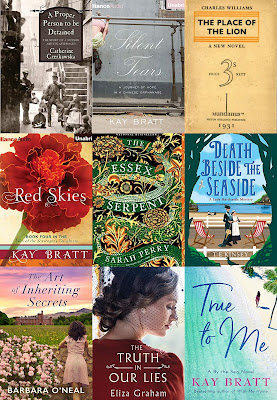
A friend posted a challenge on Facebook which I found quite amusing, so I thought I'd pass it on here, together with my answers. I don't know who originally came up with the questions. But it actually turned out easier than I thought to find answers to them among the titles of books I read or listened to during 2021 ;-)  

How about you? 


Can you answer the following questions
using the titles of books you read last year?

DESCRIBE YOURSELF
A Proper Person to be Detained (Catherine Czerkawska)

HOW ARE YOU?
Silent Tears (Kay Bratt)

DESCRIBE THE PLACE YOU LIVE IN
The Place of the Lion (Charles Williams)

IF YOU COULD GO ANYWHERE, WHERE WOULD IT BE?
A Promised Land (Barack Obama)

YOUR FAVOURITE MEANS OF TRANSPORT
The Joy and Light Bus Company (Alexander McCall Smith)

YOUR BEST FRIENDS
Remarkable Creatures (Tracey Chevalier)

WHAT IS THE WEATHER LIKE?
Bitter Winds (Kay Bratt)

WHAT IS YOUR FAVOURITE MOMENT OF THE DAY?
Red Skies (Kay Bratt)

WHAT IS LIFE FOR YOU?
The Art of Inheriting Secrets (Barbara O'Neal)

YOUR FEAR?
The Essex Serpent (Sarah Perry)

WHAT IS A PIECE OF ADVICE YOU HAVE BEEN GIVEN?
How to Raise an Elephant (Alexander McCall Smith)

THOUGHT FOR THE DAY?
The Truth in Our Lies (Eliza Graham)

HOW YOU WOULD WISH TO DIE?
Death Beside the Seaside (T.E. Kinsey)

THE CURRENT STATE OF YOUR SOUL?
True to Me (Kay Bratt)

YOUR DREAM?
Equal Rites (Terry Pratchett)


Friday, 31 December 2021

Some Books I Read in 2021


I just had a look at my list of books that I read in 2021. On average, I've consumed about 1 book per week - which is pretty much what it usually adds up to at the end of a year for me. That includes printed books, e-books, and audio books. Some bought, others borrowed; some in English, some in Swedish: some new, some old; some read for the first time, and some re-read; some reviewed before on this blog, and others not.

Below is a selection of titles, including some that I did write reviews about, and some that I didn't. Normally I don't review Swedish books here unless I know they can also be found in English. But I'm making a few exceptions here... Even if you can't read the books, mentioning them may still say something about what kind of books I've been reading.

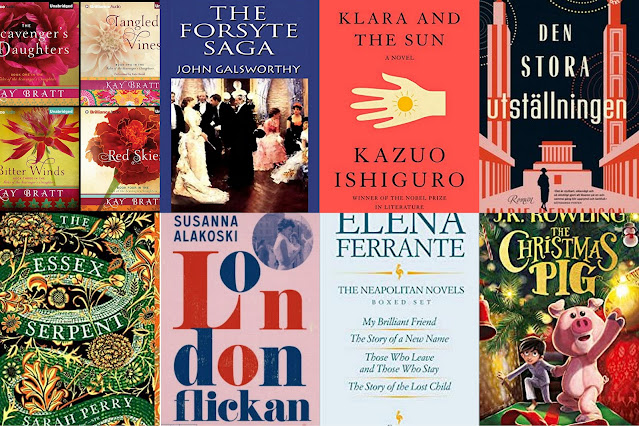
In the early months of the year, I read a series of books by Kay Bratt, set in China, The Scavenger's Daughters. From those, I'm still left with a lot of "images in my head" of lives very different to my own. Around the same time, I also read a book in Swedish written by a friend of mine who lived in China for many years and who was recently asked to write a summary of the history of missionary work in China by a certain Swedish church/denomination.    

In March, I read a Swedish book that made a much deeper impression on me than I had expected. You won't be able to find it in English, but I'll mention it briefly anyway. It's one I inherited from my parents. It's a diary kept by a Swedish soldier, crofter, navvy and blacksmith who lived in this area of Sweden 1843-1925, during the same time as some of my own ancestors on dad's side of the family. The manuscript was found in 1990 and was published by the local history society in the village where my parents lived. The title translated would be something like 'Many dogs will be the death of the hare' (a proverb). It's written in the local dialect of 100+ years ago - and moreover there were no spelling rules back then! I always thought it would be hard to read. But once I got started, I found myself fascinated. I could see quite a few parallels to the life of my p. grandfather's grandfather, who was a soldier, crofter and  stone mason. Around the same time, I was also going through and re-typing (into my computer) some family history notes by my grandfather. 

In May, I listened to The Forsyte Saga by John Galsworthy, as audio book. That brought back memories of the black & white TV series based on those novels from the 1960s. Quoting from my own review:

If you're not familiar with the story, it spans over three generations of a "commercial upper-middle class" family in London, starting in the Victorian era during the 1880s and ending in the early 1920s. It's a lot about their relationship to money and social status, but also deals the general developments within society during that time - and not least the changing position of women.

In July, I read Klara and the Sun by Kazuo Ishiguro (winner of the Nobel Prize in literature in 2017). It's another one not easily forgotten, as it has an AI robot as the main character.

In August, I read a Swedish novel which I first borrowed as e-book from the library, but then decided to also buy in paperback, as I really liked it and may want to return to it. The author's name is Marie Hermanson. Several other books by her have been translated into English, but alas I can't find this one among them (yet). It was published in Swedish in 2018, and the title in English would probably be 'The Great Exhibition'. It's about the Gothenburg World's Fair in 1923, and involves Albert Einstein who was invited to hold his Nobel Lecture there. The author has taken some liberties in getting the famous man involved in the plot of her novel - but it's done in a both clever and entertaining way. If it has not yet been translated into English, it ought to be!

In September, I read another Swedish novel, by Swedish-Finnish author Susanna Alakoski. It's the second in a series of novels about the history of textile workers in Finland and Sweden. This book takes place in the 1950s and (among other things) involves the immigration of many Finnish textile workers to Borås, where I now live. Where I grew up myself in the 1960s (100 km or so north of here) we had a lot of Finnish immigrants as well. Part of this novel is also set in London, though, and the book title in English would be 'The London Girl'.  I love the author's short introduction to the book: "My mother worked as a nursemaid in London for five years. There she bought a coat and met Frank Sinatra and Liz Taylor. That's all I know." And from that she built a whole story... I found that inspiring!

Another book I read in September was The Essex Serpent. Quote from my review: 

I found this a captivating but rather unusual sort of novel - hard to quite categorize. It's far from a straight forward love story; and at the same time, the Essex Serpent remains more of a background mystery than the real focus. Themes of love, friendship, grief, fear, obsession, superstition, faith and science keep intertwining throughout.

In October, I listened to a new children's book by J.K. Rowling - The Christmas Pig. It's a story for young children, but still enjoyable for adults as well (at least if you're still in touch with your inner child). It's about a boy who loses his favourite toy, a plush pig. Just before Christmas, it gets thrown out of a car, and is lost. For Christmas, he is given a new one - but replacing a favourite toy is hard: a new one is never quite the same... However, Christmas Eve is "a night for miracles and lost causes" ... The replacement pig takes Jack on a magical journey to seek for his old friend in "the land of the lost" - which turns out to be the mystical place where all kinds of lost things go - not just toys, but also things like scissors or combs or whatever... (I can see this book being turned into an animated film one day!)

After I got my new Kindle towards the end of October, I started reading the Neapolitan Novels by Elena Ferrante. I came across a cheap Kindle offer of all four novels in one. So far I've read the first two parts: My Brilliant Friend and The Story of a New Name. I think I'll wait to write more about them until I've finished all four, though.

Happy New Reading Year 2022 to everyone who loves books! :) 

(If you wish, name a favourite book of yours from 2021 in the comments!)


Sunday, 8 August 2021

Getting Reacquainted with the Library


Do you have a local library near where you live - and do you still go there to borrow books?

Yesterday was another good day for a walk, and I decided to pay a visit to our city library; situated in the same building as the art museum and the local theatre. 

My main errand was to check if my library card was still even valid... 

The thing is, I haven't been using the library's services for a while (explanation below), but  recently I felt inspired to check out their current online services. I found there was a new app for online loans of e-books and audio books. I was able to download the app, but wasn't able to log in. Reflecting about how long it was since I last made use of my card, I realized that perhaps I needed to get that updated as well...

We used to have a small branch library like only five minutes walk from where I live. Very practical. Besides what I could find on their shelves, I could also order things from the main library and pick them up at "my" library. And likewise, I could return books at the branch library, even if I'd borrowed them from the main library. However, the branch library was closed down a couple of years ago, as the building was going to be renovated. (As far as I can see, they still haven't even started that job, though...) 

And then came the pandemic... with restrictions in the main library's opening hours and services as well. So I haven't been borrowing anything from the library in at least 2-3 years. In some ways, I haven't really missed it all that much (except as "a place to go to"). For one thing, in later years I've acquired quite a collection of English Kindle and Audible books  from Amazon and Audible. And I've also had access to a national Swedish online "talking book" library service (for people with visual or other impairments). (However, their recordings are not the same as the audio books sold commercially, and the quality varies a bit.)

Since last autumn I'm an "old age" pensioner, though, and I've been thinking maybe it's time to cut down on my collector's mania a bit and start making more use of the library again. 

So off I trotted to the library yesterday, to at least get my library card sorted!

Walking to the city library means my usual walk downtown; and then a bit further up a hill. I chose a side street on this occasion, and took the opportunity to snap some photos of town views I pass less often. There's a mix of old and new blocks of flats in this part of town:


The white building is our "cultural centre", including library, art museum and theatre.
The tower sticking up belongs to our biggest church (Church of Sweden)


Another church across the road from there (a "free" church, i.e. not Church of Sweden)


Across another street, an old building which I think used to be the town hospital back in the late 19th / early 20th century. 

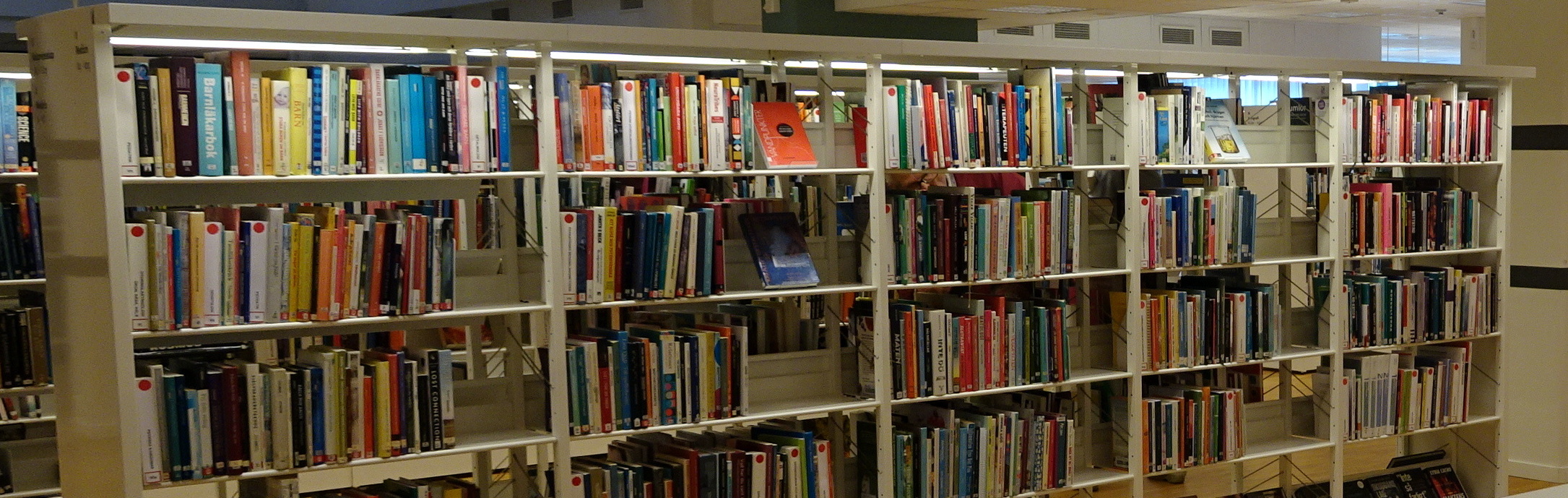
The city library is huge and I have to admit I feel rather lost among the shelves there these days, not visiting all that often... I just snapped a couple of random photos. This I think is part of the children's section.

I got my errand sorted out, though - no problem. Got a new library card and pin code; and when I got back home, was able to log into the new app, and borrow my first library e-book. I found it seems to work quite well for me to read in this app on the tablet, being able to adjust text size and background brightness etc. So now I can continue to catch up with some books in Swedish in between all the English ones still waiting on Kindle (I've downloaded soo many old English classics and other free or cheap bargains over the past decade...)

Before going back home, I also revisited the art museum, plus took another little detour on my way back as well... But I'll save those photos for another post.

Sunday, 3 January 2021

Read in Nov/Dec 2020

 November


The Palest Ink
by Kay Bratt (2015)
Audio book narrated by Will Damron (12h 15min)

"A sheltered son from an intellectual family in Shanghai, Benfu spends 1966 anticipating a promising violinist career and an arranged marriage. On the other side of town lives Pony Boy, a member of a lower-class family - but Benfu's best friend all the same. Their futures look different but guaranteed...until they're faced with a perilous opportunity to leave a mark on history.

At the announcement of China's Cultural Revolution, Chairman Mao's Red Guard members begin their assault ---. With political turmoil at their door, both Benfu and Pony Boy must face heart-wrenching decisions regarding family, friendship, courage, and loyalty to their country during one of the most chaotic periods in history."

This is supposed to be a prequel to a series I never read or heard about (The Scavenger's Daughters). I think this book works quite well as a stand-alone, though. Besides being interesting as a historical novel from Mao's Cultural Revolution in China in the 1960s, it also made me reflect on recent news reports of re-education camps in China in our own time. (Now for minorities of different cultural background, rather than "intellectuals".)


Harry Potter - A History of Magic

(Pottermore Publishing)
Audio documentary narrated by Natalie Dormer (11h 39 min)

This is a "audio documentary" rather than a book; inspired by an exhibition held at the British Library in 2017, and at the New-York Historical Society in 2018. 

It reveals some of the hidden stories behind real-world magic and explores some of J.K. Rowling's own inventions alongside their folkloric, cultural and historical forebears. Having been a HP fan for a while now, I already knew some of these things - but found this audio presentation enjoyable as well.

December

Lewis Amnesia by [FMT Macdonald]

Lewis Amnesia
by FMT Macdonald (2020)

This is a sequel to St Kilda Fever by the same author, which I reviewed here in 2019. It is still the 1970s, and Doctor Helen MacAllister (with her dog George) returns to the Outer Hebrides to again work in a medical practice on the west coast of Lewis. She is hoping for a quiet time and a chance to get her own life in order - but of course things do not turn out quite as she hoped, as she begins to suspect that some recent deaths and fires on the island may not be quite accidental. And then there is the handsome fireman who keeps turning up everywhere, but whom George the dog seems not to like... 

As in the first book, the author is good at making the reader feel both the charm and the quirks of island life, seen through the eyes of the doctor - who is herself an "incomer" (even if not from further away than Glasgow).


The Ickabog by J.K. Rowling (2020)
Narrated by Stephen Fry (7:52 h)

This is a story of fairy tale kind that J.K. Rowling started writing in between the Harry Potter books, but which has nothing to do with that magical world. She used to read it aloud to her own children, but never quite finished it, and the manuscript got put away for over a decade. But when the covid-19 pandemic struck in the spring of 2020, she got the idea to dust off this story and put it online for free for all the children stuck at home, and unable to attend school - and also to invite children to illustrate it. She published the the story online back in the summer, one or two chapters per day - and I too (still a child at heart!) first read it that way. When later in the autumn the book was published in print, including illustrations by children from different countries, I also decided to use a gift card I got for my birthday in August to buy it. And when I saw that the audio book was narrated by Stephen Fry, I could not resist getting that as well... Just like the Harry Potter books, I suspect I'll be listening to this story more than once, too.

"The kingdom of Cornucopia was once the happiest in the world. It had plenty of gold, a king with the finest moustache you could possibly imagine, and butchers, bakers, and cheesemongers whose exquisite foods made a person dance with delight when they ate them.

Everything was perfect—except for the misty Marshlands to the north, which, according to legend, were home to the monstrous Ickabog. Anyone sensible knew that the Ickabog was just a myth to scare children into behaving. But the funny thing about myths is that sometimes they take on a life of their own..."


Monday, 30 December 2019

2019 Statistics

Reading

Since many years, I keep a list (database) on my computer of the books I read (or listen to, as I do much of my reading via audio books nowadays). I probably sometimes forget or leave out some (for example when listening again to old favourites in between other books). But usually I seem to end up with an average of about one book per week - and 2019 again seems to have been a pretty average reading year for me: 51 titles listed. (As for which ones also get mentioned here on my blog, that really depends more on my own inspiration to write, rather than on the book!) 

Languages


Every now and then I also try to sum up my language learning progress on Duolingo. This year, in mid December, I got an email from Duo himself (the little green owl, see image) to celebrate my achievements in 2019. Besides confirming that I'd been practicing every day (which I knew), it says that (over 351 days) I spent a total of 156 hours learning, completed 2340 lessons, and learned 8190 words (!)

As for the number of words, I suspect it depends on how you interpret the word "learn". Considering how many different languages I've been juggling, I don't doubt that from their point of view, they did throw 8190 new words at me... However, how many of those were words that I already knew, vs how many truly new ones stuck in my memory, is probably a different story. I also find the number of lessons surprisingly high, compared to the number of hours. But it may have something to do with my having "tested out" of some lessons in some languages (German, French, Danish, Norwegian). But never mind: I think I can still safely say that I've kept making some progress...

The language I'm primarily working on is still Spanish (slowly but steadily...) I've also been trying to better my French, and update my German (after all, society has seen some changes since my school & university days). With lower ambitions, I've also been continuing with Dutch, Welsh, Turkish and Russian. Ranked in Duolingo points (XP), my list currently looks like this:

Spanish - 51987, German - 22455, French - 20690
Dutch - 19670, Welsh - 15545, Turkish - 15090
Russian - 13191, Danish - 8773, Norwegian -7111
Swahili - 1348, Latin - 918, Scottish Gaelic -157

The last three are recent courses that I added out of curiosity... Swahili because it's "different" but still uses our alphabet. Gaelic to see how it compares to Welsh. (Seem to differ more than I thought.) Latin because I took Latin for two years back in secondary school (nearly 50 years ago) - but usually don't talk about this (shh!), as someone might then get misled to believe I actually know it... The Duo take on it seems to be to treat it like any other [modern] language (rather than jumping straight in to old quotes and tons of grammar). I may give it a few more lessons, and see how it goes...

Sunday, 6 October 2019

Recently Read


A Single Thread by Tracy Chevalier (2019)
Audio narration by Fenella Woolgar (11 h) 


It is the early 1930s, and the losses of the First World War are still keenly felt. Violet Speedwell, mourning for both her fiancé and her brother and regarded by society (and herself) as a ‘surplus woman’ moves to Winchester - a city rather dominated by its great cathedral. There she lives in a boardinghouse and works in an office, but also decides to join a group of women embroidering cushions and kneelers for the cathedral. She also gets fascinated by the intricacies of bell-ringing - and perhaps one bell-ringer in particular...

I did not find this novel quite as fascinating as some of the others by Tracy Chevalier, but enjoyable all the same. (My favourites are probably Girl with a Pearl Earring, and Remarkable Creatures.)


 Silas Marner  (The Weaver of Raveloe)
by George Eliot (Mary Ann Evans) (1861)

Audio narration by Andrew Sachs (6:45 h)

A classic which I have read before (many years ago) but I wanted to refresh my memories of it, and did so by listening to it narrated by Andrew Sachs; but also having access to the text on Kindle.


Silas Marner, a weaver, is falsely accused of stealing money from the Calvinist congregation he belongs to. He loses not only his friends but also his fiancée and his faith, and moves to a remote village where no one knows him. Here he lives an isolated life and focuses completely on working on his weaving (in his own home), and putting aside (hoarding) the money he earns. When that too gets taken from him, he sinks into deep depression. But then a small orphan girl unexpectedly comes into his life, turning it upside down in a different way... There are more twists and turns to the plot before the story comes to an end though. The outcome may be kind of typical for its time, but at the same time the story is perhaps more intricately woven than one might be tempted to think at times.


The Noble Path by Peter May
(1992/2019) (Read on Kindle) 


This book by Peter May was originally written in 1992 but recently re-edited and re-published. The story is set against the background of the situation of south-east Asia in the 1970s. 

I have to say I found it very "tough" reading... To begin with, I found it a bit hard to get into because of the apparent apathy and callousness of some of the characters (but if you keep reading, you will come to understand that there is a point to that); also followed by too much war and weapons and violence and general misery for my general "taste" in fiction... (I'm glad I decided to buy this one for Kindle rather than audio, because when listening it's harder to "skim" parts that get uncomfortable.)


But: Primarily I think it is tough reading, and "gets under your skin", because you gradually come to recognize that there is much more to it than "just fiction"; and it cannot even be shrugged off as history... Today it may be (partly) different countries and borders and ethnic groups etc involved. But the same kind of things still happen, all the time - and even closer to home than the Far East. (And we know that; but don't really want to know that.)

Quoting what Peter May himself says in his foreword:

"[The story] takes place in the aftermath of the war in Vietnam, when the murderous and anarchic regime established by the Khmer Rouge in neighbouring Cambodia systematically annihilated three million people. --- Rereading the book nearly thirty years later, I note with some sadness that one of the primary themes - a refugee crisis caused by the mass migration of people trying to escape war and poverty - is with us every bit as much now as it was then. ---"


So as contrast, absurdly, I felt I had to read/listen to something soothingly whimsical in between, allowing me to pretend there are no worse problems in the world than the kind that may be sorted out by Jeeves (the perfect gentleman's gentleman). (I'm kind of taking for granted that you're acquainted with both him and his employer, Bertie Wooster. If not - look them up!) 


Jeeves & Wooster - The Collected Radio Dramas (BBC) (18 h)


Based on the novels by P.G. Wodehouse   1881-1975
The Inimitable Jeeves
The Code of the Woosters
Right Ho, Jeeves
Stiff Upper Lip, Jeeves
Jeeves and the Feudal Spirit
Jeeves: Joy in the Morning


In between all of the above, I've also been listening to:
 

Language Families of the World
by Professor John McWhorther, Columbia University
(16 h, 32 lectures)

This is not a book, but a series of lectures. Being generally interested in languages, I found it fascinating and enlightening, even if I quickly forget details. But there are around 7000 languages in the world, and most linguists believe they all originate from one original language (just as it is now generally believed that all the people in the world originate from Africa a long long long time ago). But as we can't trace language changes back all that far, that remains a theory. So for now, languages are (still) classified as belonging to various families and groups, based on things they have in common (or not). Language history also ties in with other parts (and conundrums) of migration history - and theories will no doubt continue to change a bit with every new discovery made in those fields. But one thing I take with me from this series of lectures is that "small" languages tend to have a more complex structure than those spoken by larger populations (like English, or Spanish). The "small" languages are in no way "inferior" to the more widely spread ones; just different, and usually extremely hard to learn if you're not born and raised with them - and especially if they are only spoken, and have no writing system. But there are even languages without any alphabet or documents, which can still be said to have their own literature - for example in the form of complex epic poems (of a specific structure and rhythm etc) passed on orally and memorized from generation to generation. 

Monday, 25 March 2019

Visiting the Book Fair

A local book fair at the end of March seems to be on the way of becoming a tradition in Borås. This was the third year in a row. I blogged about the first back in 2017. I bought two books on that occasion. Last year it seems I did not blog about it, but I did pop in at the book fair then too, and bought one book. This year, I came home with three! 

One of them was given away for free - an offer hard to resist...  (That's the one with "Sarajevo" in the title.) 

One is about a tragedy that the author discovered in her own family history, and decided to research and write about. (I have not read it yet but the cover says it's the story of a woman who murdered her children - back in 1929.) I was intrigued by it because it reminded me of things I've been meaning to perhaps try to continue looking into myself, related to my own family history. Nothing as drastic as murder; and not likely to result in a book. But, as I said to the author while chatting briefly to her about hers, while buying it: Sometimes one does comes across bits and pieces here and there that makes one wish that someone had written the full story. 

The third one is the first in a 'cozy crime' series that escaped my attention until now. One of the rather many such series set in an otherwise rather idyllic small Swedish Town. In this series, the scene is Hjo, such a small town on the west coast of Lake Vättern, in the province of Västergötland (the same province where I live). And as it happens, Hjo is one of the towns that my brother and I visited on our tour around Lake Vättern two summers ago. I resisted the temptation to buy the whole series (five books so far) but I did buy the first one, and am enjoying reading it now. If nothing else, it's fun to read a book where one can call to mind quite a few flashbacks from one's own memories of what the place looks like. Here's a shortcut to one of my blog posts from Hjo from 2017. (To find even more, look up September 2017 in the Archive in the sidebar of my blog.)

I also attended a lecture by a well-known Swedish-Finnish author, Susanna Alakoski (link to Wiki article in English). One of the very many who moved to Sweden from Finland back in the 1960s, in her early childhood; the parents to work and the children just having to "jump right into it", going to Swedish school and learning Swedish etc without much special introduction for immigrants back in those days. I had several classmates from Finland throughout my school years. Children pick up language and dialects very quickly. Harder for their parents! With Susanna Alakoski (having come here in early childhood) you'd never guess now except for her Finnish surname that she is of Finnish origin. But in her lecture she talked a bit about these things - language, immigration, integration, identity etc; comparing the situation back then (1960s, with immigrants coming here from Finland + eastern and southern Europe, to work), and today (with immigrants coming from "all over the world", lots of different backgrounds, and many as refugees). Some interesting observations and thoughts, well worth considering. I'm also looking forward to reading her next book which she said will be published in the autumn and will be the first in a series that involves the Swedish textile industry. So just now she was in Borås to do some research. (As some of you know, if you've been following my blog for a while, Borås is an old textile industry town, and we also have a Textile Museum and a Textile College.)

Friday, 22 February 2019

Bookish Postcards


Two bookish postcards that arrived last week, only a few days apart, from my "favourite British brothers" ... Made me laugh as I seem to have buried myself in books a lot after New Year!

This week I'm reading a novel in Swedish for a change. (No point in writing details here as it's not available in English...) 

Sunday, 4 November 2018

Read in October 2018

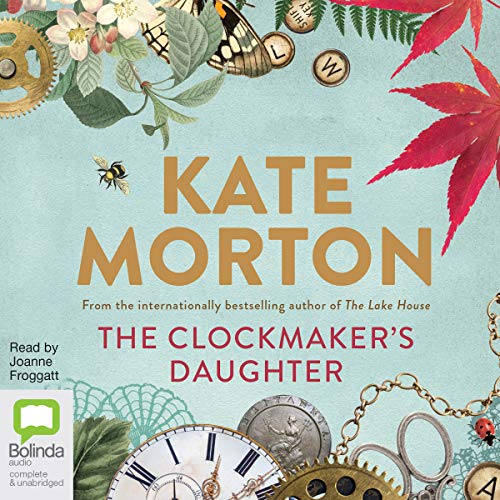
The Clockmaker's Daughter audiobook cover art

The Clockmaker's Daughter
By: Kate Morton
Audiobook narrated by: Joanne Froggatt
Length: 17 hrs and 3 mins


Kate Morton is one of my favourite authors from later years and as I had an Amazon gift card to spend as well as my monthly Audible credit, I got this new novel of hers both as Kindle and as Audible. I’m glad I did, as the construction of the novel is of the complex multi-layer kind, moving between different periods of time and different narrators; and it is definitely an advantage to be able to turn back to previous chapters sometimes. That said, once I felt I had kind of grasped the structure of the story, I really enjoyed listening to Joanne Froggatt reading it, though. (Best known perhaps as the actress who played ‘Anna Bates’ in the TV series Downton Abbey.)

The novel could be said to be a kind of ghost story; but at the same time, even though some gruesome mysteries of the past are involved, it’s not really an all dark and sinister atmosphere that dominates the book, but – as for most of us – a mix of both good and bad memories, not always easy to separate from one another – and with the dead continuing to play their part along with those living here and now.

The contemporary frame of the plot involves a young girl, Elodie, working in an archive; and a forgotten old box labelled “Contents of attic desk drawer, 1966 – unlisted”.

But rather than attempt to summarize all the plot layers, and risk spoilers, I think I’ll just give you this quote from the author’s own notes at the end of the book:

“The Clockmaker’s Daughter is a book about time and timelessness, truth and beauty, maps and map-making, photography, natural history, the restorative properties of walking, brotherhood ---, houses and the notion of home, rivers and the power of plce; among other things. It was inspired by art and artists including the English romantic poets, the Pre-Raphaelite painters, early photographers --- and designers --- with whom I share a passion for houses, and who drew my attention to some of the unique ways in which the buildings of the Cotswolds mimic the natural world.”


As an aside, I just have to mention that I still seem to be haunted by The White Horse of Uffington. It’s mentioned in The Clockmaker’s Daughter as well – although in this book, more in passing.

Those of you who read my post Read in September, might remember that this landmark also turned up in Lethal White by Robert Galbraith; for me coinciding with also then just having read about it in a blog post Chalk Horses and Ancient Mysteries by Jenny Woolf (including pictures).


Lethal White (A Cormoran Strike Novel Book 4) by [Galbraith, Robert]

Lethal White
by Robert Galbraith (pseudonym for J.K. Rowling)
4th in the series about private detective Cormoran Strike and his (female) assistant Robin.

Read on Kindle in September/October.


I think this book may be my favourite in this series so far. The previous one especially – Career of Evil – I found a bit too gruesome for my taste. I found Lethal White more of a classical detective novel, both in the type of investigations they get involved in, and in the development of the main characters. At the same time, parallells with the Harry Potter novels also come easily to mind. (That can be seen in the previous novels in this series as well, but keeps getting clearer.) In Lethal White, set against the background of London hosting the Olympic Games, Cormoran and Robin get involved in two cases which turn out to have some common ingredients.  One involves a mentally unstable man saying he keeps having flashbacks of having witnessed a murder back in his childhood; the other starts out as a case of blackmail against a government minister (but develops to events even more serious). This also places Robin for a while working undercover as an intern in the Houses of Parliament. (The underground Ministry of Magic in the Harry Potter world comes to mind, even if Robin does not have access to Polyjuice for disguise). It’s a long book with quite a lot of sidetracks. There are also some developments in both the main characters’ personal lives going on in the background. Not all easy to keep up with all the twists and turns and details in the plot, but I quite enjoyed it.


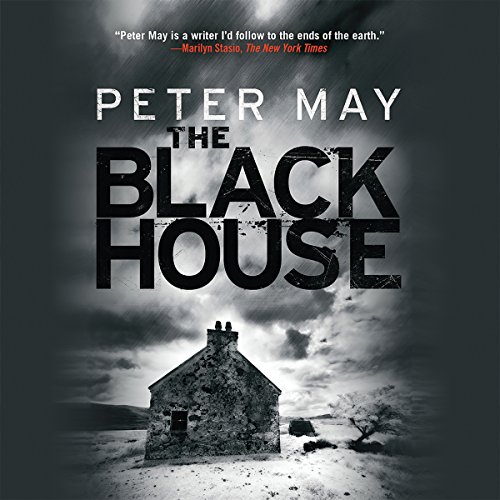
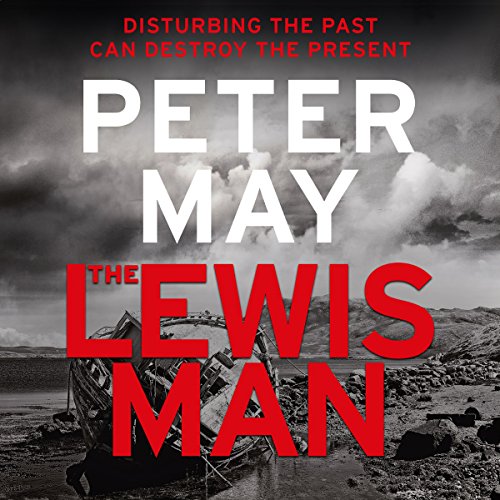
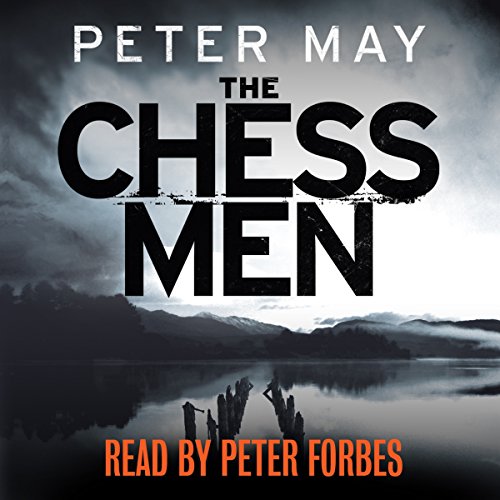
The Blackhouse audiobook cover art  The Lewis Man audiobook cover art  The Chessmen audiobook cover art


In October I also re-read Peter May’s Lewis Trilogy – The Blackhouse, The Lewis Man and The Chess Men – this time as audio books. I first read them on Kindle back in 2012-13; but enjoyed listening to them now – read by Peter Forbes, in what I presume to be proper Scottish accent with the correct pronunciation of names etc. ;-)

Wednesday, 3 October 2018

Read in September

To Kill a Mockingbird audiobook cover art

To Kill a Mockingbird

  • Author: Harper Lee (1926-2016)
  • Audio narratation: Sissy Spacek
  • Length: 12 hrs and 17 mins
  • To Kill a Mockingbird, first published in 1960, has been translated into more than 40 languages and sold more than 30 million copies worldwide. I’ve seen the title on lots of “Must Read” lists over the years, but never got round to reading it – until now. Actually I never even really had a clue what it was about. But when it recently turned up for me at Audible, I decided that maybe it was time to find out!

    So during the month of September I listened to this book – twice! Because I tend to drift off sometimes, and when I reached the end I felt that I might have missed some bits and pieces. So I gave it one more turn, to fill in the blanks. And I’m glad I did, as it is indeed one of those books where quite a few “clues” kind of lie hidden in things that may not seem all that important until later – when you begin to get the whole picture. Just like Life, really!

    The story takes place during three years (1933–35) of the Great Depression in a fictional town in Alabama. The story is told from the point of view of a young “tomboy” girl (Jean Louise, but nicknamed Scout); only six years old at the beginning, and living with her older brother Jem, and their widowed father, Atticus, who is a lawyer.  One major thing that happens in “the adult world” in the town is that Atticus is appointed to defend a black man who has been accused of raping a young white woman. In spite of Atticus (as always!) doing his best to stand up for justice and fight against prejudice, the same cannot be said for all of the town’s inhabitants…

    The plot and characters are said to be loosely based on Harper Lee's own observations of her own family and neighbors and an event that occurred near her hometown of Monroeville, Alabama, in 1936, when she was 10 years old. In her novel, she manages to combine the innocence and misconceptions of childhood with the gradually increased insights of growing up, as well as the adult perspective of looking back at the past from a more mature point of view.

    I liked the audio performance by Sissy Spacek (read with a southern accent), I think it helped set the “mood” of the story.


    This is not the only book I read/listened to in September, but the others were in Swedish and/or not yet finished.

    2/ As daily radio series (38 episodes), I’ve been listening to Swede Hollow, a novel by Swedish author Ola Larsmo (born 1957), published in 2016. It is about Swedish emigrants in the 1800s who settled in Swede Hollow (‘the Swedish valley’), a neighbourhood of Saint Paul, Minnesota. It was one of the oldest settlements in the city, but also the poorest. I don’t know if the novel has been translated into English.


    3/ I’m also currently listening to a Swedish crime novel set in the city and province where I live, and written by our district police chief (Lena Matthijs). Her characters and turns of events and details etc are fictional, but the stories inspired by real cases. I think she has written four books so far. I bought one at a local book fair back in the spring (her third), and now I borrowed the first as audio. I was impressed by the one I bought, and I am with this one as well (although not having finished it yet). Alas I don’t think her books have been translated (even though the one I’m listening to now has an English title: Killing your darlings.) Just thought I’d mention it anyway…


    4/ On Kindle, I am reading another crime novel: Lethal White by Robert Galbraith, alias J.K. Rowling. It’s her fourth about the private detective Cormoran Strike and his (female) assistant Robin. I still have about 25% left to read (and no idea how it’s all going to come together at the end), but can’t resist mentioning one of those extraordinary coincidences that happen sometimes… You know: you happen to read or hear about something, somewhere; and then, just afterwards, it happens to turn up again in a completely different context! In this case: the White Horse at Uffington, Oxfordshire, a giant prehistoric chalk figure on a hillside. Jenny Woolf  recently wrote about it on her blog *An English Travel Writer* (September 12th). The new Galbraith novel was downloaded to my Kindle a week later (I had pre-ordered it, weeks before, knowing no details about the story) – and it turns out to involve the very same chalk horse. No need for me to look it up, as I had the images fresh in my mind already! (Thanks Jenny!)


    Monday, 2 July 2018

    Read in June 2018

    Last Train to Istanbul audiobook cover art

    Last Train to Istanbul
    by Ayse Kulin (2002)

    Audio book narrated by Sanjiv Jhaveri (12:09 hrs) (2013)
    (Bought from Audible in May 2018)

    The story is set in Turkey and Paris in the early years of World War II. Among the main characters are two sisters born in a privileged Muslim family, Sahiba and Selva. Sahiba marries a prominent Turkish diplomat, while Selva falls in love with a Turkish Jew, Rafael. Although Turkey had long been a safe haven for Jews, marriage between a high-ranking Muslim girl and a Jewish boy was still strictly forbidden. Selva and Rafael defied their parents and fled to Paris in hope of a better life there - only to find themselves trapped when France got invaded by the Nazis. Turkey attempted to remain neutral in the war, and Turks living in France were encouraged to return to Turkey; also including Turkish Jews. Unofficially some Jews were given Turkish passports and identities in order to be helped out of France. An intricate plan to escape from France back to Turkey by train is involved in this book (not really a major spoiler because of the title!) I found the story interesting as it involved aspects of WWII that I knew very little or nothing about before. (Had you asked me before I read this book, about Turkey’s role in WWII, I wouldn’t have had a clue!) At times I found some details of the story a little difficult to follow (only listening to it as audio book, without access to the text); but on the whole I liked it, and I think the narration also added to the atmosphere. I’m sometimes a bit sceptic about texts being read with “foreign accents” in English just because the story happens to take place in different country - but in this case, in an “international” setting, I think it works well.


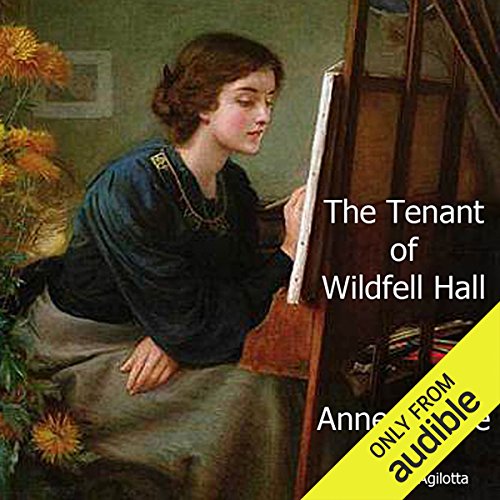
    The Tenant of Wildfell Hall audiobook cover art

    The Tenant of Wildfell Hall
    by Anne Brontë (1848)

    Audio book narrated by Mary Sarah Agliotta (13:33 hrs) (2010)
    (Bought from Audible in June 2018)

    The Tenant of Wildfell Hall is the second of two novels by the English author Anne Brontë (1820-1849; sister of Emily – author of Wuthering Heights – and Charlotte – author of Jane Eyre). It was first published in 1848 under the pseudonym Acton Bell. Probably the most shocking of the Brontës' novels, it had an instant success, but after Anne's death Charlotte prevented its re-publication. (Their brother Branwell and Emily had also both died before Anne did; in the autumn/winter of 1848.) So The Tenant kind of fell into oblivion for a period of time; but was later “rediscovered” and included among the classics together with her sisters’ more famous novels. Most critics now consider The Tenant of Wildfell Hall to be one of the first feminist novels; and I do feel I agree with that.

    I think I read it many years ago, but don’t really remember what I thought of it then. The style in which it is written may feel a bit outdated as it consists of letters written by the main male character Gilbert Markham to a male friend, and diary entries by the main female character Helen, who moves into Wildfell Hall under the assumed name of Mrs Graham, a young widow with a little son. (In reality, her husband is still alive – but she has had to flee from him to protect herself and her son). In spite of her cover story, Helen soon becomes the victim of village gossip and slander.

    I recently watched a BBC mini-series from 1996 based on this novel (three episodes on DVD), and that made me curious to re-read the original story.* Finding it available as fairly cheap audio book, I ended up listening to most of it, but also reading some parts on Kindle. I’m not wholly enthusiastic about the audio narration performance… thinking I might have done better to choose a version with a male and a female actor alternating to read the different parts. (It gets a little confusing at times whose story it is that one is listening to at the moment.) But that aside… From today’s perspective, 2018 and with all the #metoo discussions and stories stirred up last year, I think this book still stands out as a really strong voice not only for women’s rights (which, one has to remember, were practically non-existent in those days) but also about abusive relationships.

    And if anyone is thinking that “fake news” and rapid spreading of rumours and slander can all be blamed on modern technology – think again!

    … Well, I only “tell the tale as ‘twas told to me”: I don’t vouch for the truth of it, but at the same time, I don’t see what reason Sarah should have for deceiving me, or her informant for deceiving her; and that was what she told me that the footman told her …
    The Tenant of Wildfell Hall, chapter 51

    *(PS. The BBC mini series really does a pretty good job of retelling the story as well – in three hours rather than 13. Felt a little bit “episodic” though which is what made me want to go back and compare it to the original novel.)


    Wednesday, 9 May 2018

    Read in April 2018

    The Punishment She Deserves: A Lynley Novel by [George, Elizabeth]

    The Punishment She Deserves
    by Elizabeth George (2018)
    #20 in the Inspector Lynley series
    (Read on Kindle)

    In the small town of Ludlow, one of its most revered and respected citizens - Ian Druitt, the local deacon - is accused of a serious crime. Then, while in police custody, he is found dead – thought to have killed himself. Barbara Havers is sent to Ludlow, not together with Thomas Lynley, but in the company of their boss Isabelle Ardery, to double-check on the local investigation (as there have been complaints about how that was carried out). Isabelle has other things on her mind, and sees the investigation as a routine formality to be sorted out as quickly as possible; while Barbara gets the feeling that there’s more to it. At the same time, Isabelle as usual takes every opportunity to criticize Barbara’s way of dealing with things; and Barbara in turn is struggling with strict orders to do only exactly what she is told to do, and nothing else (or her job is at stake). Through the first part of this novel, the never-ending tension between Isabelle and Barbara really keeps the reader in constant frustration as well! (Or at least it did with me… I have to confess I kind of want Isabelle removed from the series as much as Isabelle wants to have Barbara transferred to some obscure place in the countryside…)

    A bit later, Barbara gets to go back to Ludlow again, this time with Lynley. Their cooperation throughout the rest of the book is almost back to the earlier novels in this crime series. The slow progress with solving the mystery as such is still rather infuriating, though. Is anyone in this town telling the truth about anything?!

    All in all, and in spite of the infuriating bits, the complexity of this story still makes it a page-turner. And also makes one ask oneself moral questions like: At which point does holding something back become a lie – when no one has actually asked about it?


    The Forgotten Girl by [Barrett, Kerry]

    The Forgotten Girl
    by Kerry Barrett (2016)
    (read on Kindle)

    I bought this one (cheap) because I recently read another one by Kerry Barret that I quite liked (The Girl in the Picture, see my review here). This one too is a stand-alone novel with a “double timeline”, i.e. one story set in our own time, and another from the past – which sort of come together at a certain point.

    In the present time, Fearne has landed what she believes to be her dream job, as editor of the Mode magazine. However, she soon finds out that the magazine is struggling, and her job is really to come up with a way to turn things around (on a tight budget and a deadline), or the magazine will be closed down. While looking for ideas, she and her staff turn to the past, trying to recreate the spirit of the magazine’s heyday back in the mid 1960s – also involving trying to find the former editor of Mode from way back then.

    The parallell story is told from the point of view of Nancy and her friend Suze coming to London in the mid 1960s, and their struggle back then to work their way up in the glamourous fashion magazine world as well.

    I have to say that I felt less interest in this book than The Girl in the Picture. Perhaps partly because I’ve never been really interested in glamourous fashion magazines myself. But I also think I felt that the story somehow lacked “depth” in the details (and characters). 


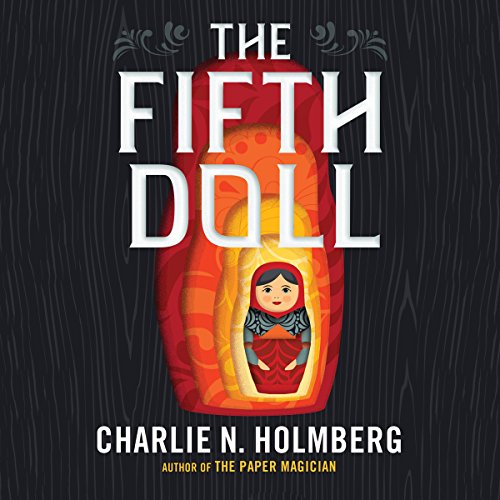
    The Fifth Doll audiobook cover art

    The Fifth Doll
    by Charlie N. Holmberg (2017)
    Audiobook narrated by Angela Dawe
    (8:34 hours)

    Speaking of stories involving “layers” of truth and revelations…

    The Fifth Doll belongs in the YA fantasy genre (I suppose) but my impression of it is that it was rather eerie, and lacks the relief of humour that make me love certain other books in that genre - like Harry Potter. 

    Matrona is a young woman who lives in an isolated village, together with her parents. Village life is very much centered on family life; and Matrona herself is about to get married to someone chosen for her by her parents. For some reason that I don’t remember now, one day she goes to visit a local tradesman, Slava, but finds his house empty. Inside, she finds a collection of (Russian) painted nesting dolls, and is mystified when she realizes that each of the dolls is made to resemble the actual inhabitants of the village. There is one doll for every person living there. She tries to open the one resembling her own father, but she either fails or is interrupted (I don’t remember). Anyway, she leaves the doll in a slightly twisted position. When she gets back home to her family, she notices that her father is suddenly ill, or behaving strangely. Matrona comes to realize that there is some kind of weird magic connection between the dolls and the real people. When Slava finds out that she has been into his house and has begun to suspect the connection, he decides to kind of make her his apprentice, and let her into the secrets hidden in the different layers of the nesting dolls – starting with her own…

    I have to say I found parts of the story confusing; and as I only have the audio version, it’s not easy to go back and check details. I’m not quite sure whether it is meant to be a stand-alone novel, or the first part in a series. It did seem to come to an ending and an explanation of sorts, but still perhaps leaving an opening for a continuation.(?)

    (As I often listen to audio books at night and/or in the early morning, it does happen that I nod off while listening, and lose track a bit… Having finished this book it left me with a feeling that perhaps I’d better go back and listen again to the later chapters – but I haven’t got round to it, and not sure if I will! But I would say the story involves some underlying thoughts about dictatorship vs free will – like who has the right to decide what may be the best thing for other people.


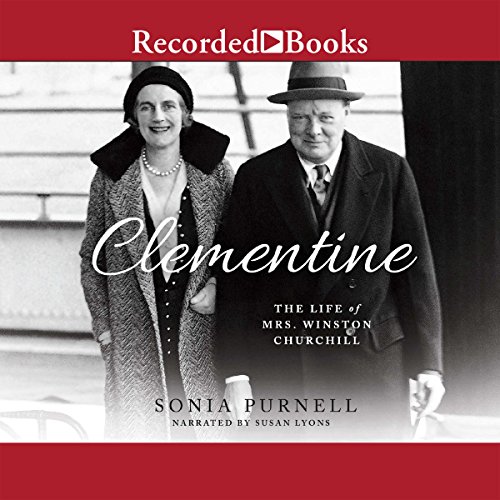
    Clementine audiobook cover art

    Clementine* – The Life of Mrs. Winston Churchill
    (*Alternative title: First Lady)
    By Sonia Purnell (2015)
    Audiobook narrated by Susan Lyons
    (17:32 h)

    This I found to be a very interesting biography and reflection on the life of Clementine Churchill, wife of Winston Churchill. It presents her very much as “the woman behind the man”, not just as his wife and mother of his children, but as his equal partner throughout their relationship and with more influence on his career than perhaps usually mentioned in accounts of Churchill’s life and his role in WWII and British politics.  The author is an English journalist. The book is well written; and the audio narration is excellent too.

    Related Posts Plugin for WordPress, Blogger...