Showing posts with label BookingThroughThursday. Show all posts

Thursday, 22 September 2016

Booking Through Thursday – ‘Location’

btt button

In real estate, it’s all about location, location, location. But how about books? Does where a book is set affect your reading choices? Are you more or less likely to read books set in places you know or love?
Question from
Deb on September 22, 2016

I would say yes on both points. Where (and also when!) a book is set does affect my choice whether to read it; probably more often than I’m conscious of. 

For example, I usually do feel a lot more “at home” reading British books compared to American. (I’ve never been to the US, but travelled nearly all over Britain on family holidays back in my teens.) And, thinking about it, with Swedish books too I suspect I’m probably often drawn to the kind of settings (landscapes) that I feel I can easily visualize in my head. (On the other hand I sometimes feel that too detailed descriptions, depending too much on the exact location of real streets and buildings in big cities, can be rather tiresome, whether I’ve been there or not.)

But of course, sometimes it’s the other way round too, and I get interested in reading a book set in a foreign country precisely because I realize I know very little about it, and hope to learn more.

A memory pops up while I’m thinking about all this - from a holiday to Germany back in the 1980’s, while I was studying German at the university. It was my first trip to Germany at all, and it was in late August or even beginning of September, which means I missed the first week or so of the term (but I had asked permission). To somewhat make up for that absence, I had brought one of the study course novels with me: Goethe’s Die Leiden des jungen Werthers / The Sorrows of Young Werther. I remember it as a rather special experience to sit outdoors and read this particular book, and look up and find myself overlooking the very landscape where it was set - the valley of the river Lahn, which was where I happened to be staying. (Not the exact spot where Goethe sat, perhaps… But close enough!)

Saturday, 6 February 2016

Multiples (BTT)

160202 RU-4370430 stamp

160202 RU-4370430

Booking Through Thursday (by Deb), February 4, 2016

btt button

Do you own multiple copies of any books? Why? Is it the format? Size? Just because you love it?

To start with – the Bible. I have collected several of those over the years; in different translations, sizes and bindings.

There are also a number of other books I have both in Swedish (my first language) and in English. With most of those, I had a Swedish translation first, and later on wanted to read it in English too. Only with a very few has it been the other way round. The exception that comes to mind is the Narnia series by C.S. Lewis: I first bought those in English (the whole series in a box of separate paperback volumes). But later on I also bought the series in Swedish when a new hardback edition was published here.

I also have quite a few books both in print (either on paper or on Kindle) and as audio recordings (on tape, disc or downloaded – depending on when in the technical/digital evolution they were bought!)

By now I have also added a lot of classics on Kindle, which I already had in printed editions. It is physically easier  for me to read on Kindle now… But I’m still rather reluctant to get rid of the printed books. Especially if I’ve read them many times!

…

The pictures at the top are of a postcrossing card (and stamp) I received this week.


Thursday, 16 April 2015

BTT: Unread

image

Booking Through Thursday

“What proportion of the books you own are unread?”

I’d say that perhaps 20-25% or so of my books are of the “reference” kind rather than the kind you read straight through from cover to cover. Besides dictionaries and grammar books etc I have quite a few on for example history, religion and mythology that I have only used to look things up in - even if also some in those genres that I have read from cover to cover as study course books.

When it comes to novels, I don’t have many of those unread. Except on my Kindle… where I’ve collected lots of free ones in the last few years.

Thursday, 26 March 2015

BTT: Carrier

(Picture borrowed from some .org site on the web.)

“Do you carry a book around with you? Inside the house? Whenever you go out? Always, everywhere, it’s practically glued to your fingers? (And yes, digital books very much DO count as long as you’re spending time reading on your Kindle or iPad and not just loading them with books that you never actually read.)”

btt button

In Swedish, my answer would be “Nja”, which expresses an hesitation between No and Yes… I only carry a book (or my Kindle) with me if I do expect to actually use it. On the other hand, when I go out, I do usually always carry my smartphone; on which I can also read and listen to books. But as I don’t travel much, and most of the year only go out for shorter walks and errands (or else in company), it’s normally only in summer that I sometimes sit and read outdoors (or anywhere else than at home). 

With a good audio book it might happen though, that I carry on reading/listening almost throughout the day – both while resting and doing routine housework, and maybe even while going for a walk as well. (When I walk into town and have to cross busy streets etc I don’t usually listen to either books or music though, but prefer to be aware of what’s going on around me!)

Today it’s been raining, and I have been staying in most of the day, pretty much glued to the Kindle, reading the third book in the Ruth Galloway series by Elly Griffiths (cf my Tuesday post). I’m reading these books with my eyes though, which does force me to take a break now and then during the day whilst doing other things!

…

For those of you interested, I just discovered that the price on books 4-6 in that series (for Kindle) had been lowered since I last checked (about 50%, perhaps to do with the 7th now being out as well?) … Not knowing whether that will last, I decided to buy! (click-click-click) … Remains to be seen whether I’ll also end up reading them all in one swoop; or take a break and read something else in between!)

Thursday, 19 March 2015

Booking Through Thursday

CIMG3535-001

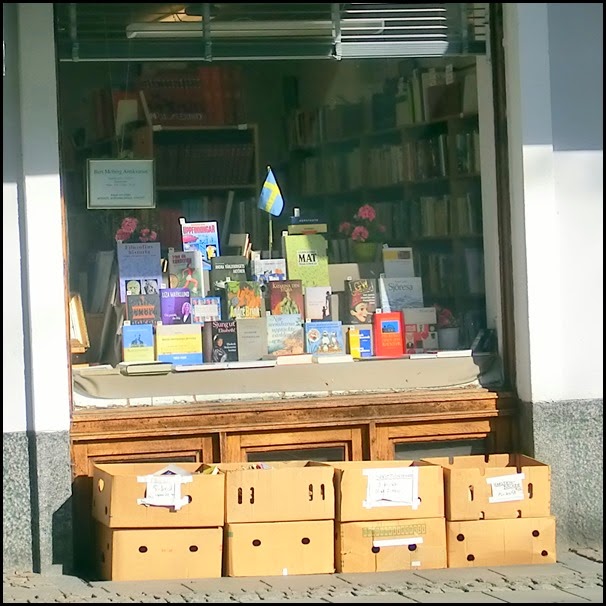
A 2nd hand bookshop in town I passed by today.
(Yes, I did pass by!)


It seems it was a while since my last BTT post, so I’ll make up for it by short answers to a few old ones as well this week…


 Spring (March 19)

What new book would make you spring out of your chair and run to the bookstore? (Or library, or nearest computer screen, depending on your book-delivery-method of choice.)

The first author that sprung to mind for me to check up on to see whether there might be a new book coming was Kate Morton. (I’ve read her previous four.) Yes! Her Facebook page, post dated 17 March, says “It's coming! New book, October 2015.” (Lake House).


Bookcases (March 12)

Two part question:

In an ideal world, what kind of book cases would you have? Built-ins? Barrister ones with glass doors? The cheapest you could find so you could have lots of them?

And … what kind of bookcases do you REALLY have?

A library with built-in look-alike book cases from floor to ceiling would of course be great… But I think I’d like to be able to adjust the distance between the shelves. And while glass doors would of course be great to protect the books from gathering dust, I do think that open shelves are more inviting. I suppose I could go for a compromise – glass doors on some only. And I think I might also want drawers at the bottom of some.

Reality? A hotchpotch of different cheap ones (and none with glass doors), bought or inherited over 40+ years… Some genuine wood, some veneer. Some dark brown, some pine, some white. Some high, some low. Even if the majority of my books are in my study, there are also bookshelves (and books) in the living room and the bedroom.


Covers (March 5)

Hardcovers or paperbacks?

What I prefer depends on the kind of book. Hardcovers are of course better for books frequently used. Paperbacks on the other hand are cheaper, lighter and take up less space… And the last few years (my bookcases being full, and my eyes getting more easily tired) I’ve mostly bought ebooks and audio books…  Allowing my library to keep growing without taking up more physical space!


Short (Feb 27)

So, in honor of the shortest month of the year … how do you feel about short stories? Love them? Prefer them to novels?

On the whole I must say I usually prefer novels to short stories. Of course sometimes a short story can be just the thing – or even a collection of them. But if there is no common theme (or characters), I prefer to read short stories only now and again (like in between longer books) rather than a whole collection of them all in a row. I prefer it, I think, when I can “remain” in a story for a bit longer (if I like it!) and it doesn’t end too abruptly.

Thursday, 12 February 2015

Book Review: The Moonstone by Wilkie Collins (1868)

Wilkie-Collins.jpg

Wilkie Collins (English novelist and playwright, 1824 – 1889)

I can’t remember Wilkie Collins ever being mentioned back in my English Literature studies (long time ago); but looking him up now, I learn that he was a contemporary and friend of Charles Dickens; and The Moonstone originally published in Dickens’ magazine All the Year Round.

Collins is also mentioned together with Dickens in Baugh’s A Literary History of England, which sits in my bookcase (a heavy volume of 1800 pages that does not get taken down very often now that it’s so easy to look things up online instead).

It seems they both had some influence on each other:

Dickens’ shift from novels of humous character to novels of sensational intrigue was partly due to Collins’ precepts and example. But there are differences. Whereas Dickens conceived his characters and then invented a plot to set them in motion, Collins invented his plot and then fitted characters into it.
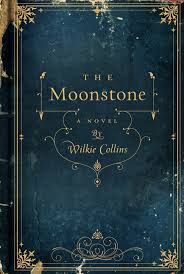
Image result for wilkie collins the moonstone

The Moonstone is an “epistolary” novel, told in basically chronological order, but at the same time narrated through a number of different charcaters, each adding their own perspective and “flavour”. The story also turns out more complex than one might at first be deceived to believe; time and again we are sidetracked and led astray along with the narrators, as each of them can only see the events in his/her own light, and no one (for a long time) understands to interpret all the facts correctly.

The moonstone is a precious jewel originating from India – its background is explained at the very beginning of the novel, but most of the story takes place in Britain (in the late 1840s). The style of Dickens did come to mind for me often during the reading; but the first parts, narrated from the perspective of servants at the big country estate where the events take place, also led my thoughts to the recent (and still to be continued, I think) BBC TV series Downton Abbey.

Actually, one aspect of The Moonstone that strikes me as kind of “ahead of its time” compared to many other novels from the same period, is the fact that the narration does include the perspective of both masters and servants.

Parts of the story tend to get a little long-winded; but at the same time, suspense is kept up. I think one has to consider that it was originally published in episodes not unlike modern TV series (like Downton), with parts of the events getting explained or solved along the way, but other things still remaining a mystery until the very end.

As for the final whodunit revelations, I could say that at some point earlier I did sort of guess at it – I think – but then again, I could probably have said the same whoever turned out guilty, as suspicions did tend to shift quite a few times along the way!

I would recommend this book to those who also enjoy for example Dickens, detective stories like Arthur Conan Doyle’s Sherlock Holmes – and upstairs / downstairs series like Downton Abbey!

I can also recommend the Audible companion to the Kindle edition of the book, read by James Langton; a very enjoyable narration. (I read some chapters on Kindle, and listened to others.) The ebook was free and the audio addition cheap ($3.44).

♥ ♥ ♥ ♥ ♥

btt button

A question on the theme of
Love Stories
from DEB at Booking Through Thursday
(February 12, 2015)

“I’m not asking if you like romances … what I want to know is what is it about stories that you love? Is it the stories themselves? The people? The plot twists?”

Timely question for me, as was thinking about that while reading the book reviewed above anyway; and not least when pondering about the quote from A Literary History of England, about the difference between Dickens and Collins – Dickens inventing the characters first, and then the plot; Collins starting with the plot, and then fitting characters into it.

While I do appreciate a clever plot with twists and turns, it is often the characters, and also the “setting” of a novel (if well described) that stay with me in the long run, rather than the details – actually, astonishingly often, even such details as who in the end turned out to be the murderer in a murder story.

I suppose the best books are really those where it all comes together and both characters and some of the basic plot stick in memory, but which are also so well written that you can still enjoy rereading them after a certain time.

With The Moonstone, just having finished it, I feel that some of the characters stand out more than others; and not all quite in relation to their importance to the plot. There are also some plot twists in this book that might well have a potential for being memorable. And I guess the fact that it still seems to be quite widely read after nearly 150 years supports that many find it still standing up rather well to the Test of Time.

Thursday, 19 June 2014

BTT: Format

btt buttonDeb at Booking Through Thursday asks:

All other things being equal, what is your favorite format for reading? Hardcover? Paperback? New book? Old book? Leather-bound first edition? E-book?

I know I’ve answered similar questions before, but sometimes one’s answers change with time, so the same question may be worth mulling over again.

In my bookcases you’ll find both hardcovers and paperbacks. I’ve also always borrowed library books.

Hardbacks in nice covers always look great on the shelves, of course; but as my library grew, I came to prefer paperbacks – for one thing, because they were cheaper to buy, but also because they took up less space (and were lighter to carry).

With age, other aspects also started coming into it: like small print getting harder for me to read, and some books more difficult than others to physically hold – some because they’re heavy, others because they don’t “fall” open but need to be actively “held” open.

Since I bought my Kindle back in October 2012, that has become my favourite reading format; at least for fiction (and in English). Besides being much easier on my eyes, and convenient to hold and carry with me, and allowing me to look up words by just pointing at them, it also means I can go on collecting classics (and other favourites) without needing any more shelf-space!

With Swedish books I usually try to borrow those as audio books from the library now.

If I buy a printed book now it’s because I already know I like it and will want to have it handy to reread or look things up in and quote from etc. The main advantage of printed books over e-books I find to be when wanting to get an overview of the work as a whole, looking back for context, or finding a passage without remembering the exact words etc.

Thursday, 12 September 2013

Booking Through Thursday: Imagery

btt button

How much do you visualize when you read? Do you imagine faces for the characters? Can you see the locations in your mind’s eye? Or do you just plunge ahead with the story, letting the imagery fall to the wayside?

Interesting question! – I’ve actually just been thinking about this, while reading the book that has me engrossed just now (I’m only about half way through, so no spoilers in the comments, please!):  The Cuckoo’s Calling by Robert Galbraith – pseudonym for J.K. Rowling (as I already knew when I bought it).

This book is the first crime novel in what is to be a series featuring private investigator Cormoran Strike, a war veteran; and the setting is London.

Knowing the author to be J.K. Rowling, it’s no great surprise to find her conveying vivid visual images to the reader, as well as using a rich and varied vocabulary in general.

I do think it often depends quite a lot on the author’s intentions and skill to describe things (and people), how clearly I come to visualize them during reading.

It’s been too long since I visited London (back in my teens, and only briefly) for me to have a clear idea of the exact geography referred to (street names etc); but I do have an inner image of Strike’s office, and certain other places so far important to the story; and also of Strike himself and various other characters. (Enough, I think, to be able to have an opinion about how well the casting was done if it’s ever turned into film!)

Robin caught the door before it closed on the dingy stairwell. An old-fashioned metal staircase spiralled up around an equally antiquated birdcage lift. Concentrating on keeping her high heels from catching in the metalwork stairs, she proceeded to the first landing, passing a door carrying a laminated and framed poster saying Crowdy Graphics, and continued climbing. It was only when she reached the glass door on the floor above that Robin realised, for the first time, what kind of business she had been sent to assist. Nobody at the agency had said. The name on the paper beside the outside buzzer was engraved on the glass panel: C. B. Strike, and, underneath it, the words Private Detective.

Galbraith, Robert (2013-04-18). The Cuckoo's Calling (Cormoran Strike) (Kindle Locations 190-195). Little, Brown Book Group. Kindle Edition.


Thursday, 1 August 2013

Booking Through Thursday: “It’s Personal”

btt buttonfrom Deb (August 1, 2013)

Do you have a preference between “person” in the books you read? Do you prefer third-person to first-person? Or don’t you care?

And … why??

Interesting question. I think it depends a lot on what kind of story it is. A consistent first-person narrative means keeping a limited perspective. This can be very effective if it is done right but it requires a certain skill from the author if at the same time he/she wants to convey things to the reader that are meant not to be perceived by the fictional narrator. 

On the other hand, there is probably even more danger of careless slipping from an intended main character perspective if the author uses the third-person kind of narrative. I think what irritates me most is when there are sudden illogical side-steps from the main perspective. (Like if 95% of the story is told from the main character’s perspective and we only get a few sudden glimpses here and there from someone else’s unspoken thoughts.)

So I’d say the most important thing is that the author makes consistent and well thought-out use of whatever narrative perspective(s) chosen. Shifting perspective can be totally okay too, but it has to be done in a consistent way or it will come across as “cheating”.

Thursday, 11 July 2013

BTT: Pets

Booking Through Thursday question from Deb

… how do you feel about books about dogs or pets? Fluffy stories of fluffy family members? Solid books on training them or taking care of them? Touching reminiscences of trouble and the way a person’s dog (or pet) has helped get them through? - Any favorite books to recommend?

I have to confess I’m not really a “pet person” myself. For one thing I’m allergic – to both cats and dogs it seems, and probably other fluffy furry pets too (and smelly ones!)  But even before various allergies set in (which was not in my early childhood but in my teens) I was never really crazy about animals. I can’t recall ever craving a pet of my own, nor being seriously envious of those who had them.

Familjefoto m Zepp-001

My paternal grandparents had dogs (one at a time). The one which they had when I was little was a big collie, and a often repeated story in the family was that once upon a time someone asked me what I thought of him, and my reply was: “He’s nice but he’s in the way.” Everyone always laughed at that, but it is still my honest opinion… The thing is, he was in the habit of lying across thresholds and I could not get past him! (See photo for proportions!) 

Their next dog was smaller, but he was also in the way in that he had the bad habit of jumping up on you (uninvited).

My brother’s dog is small, cute and well-behaved; the trouble is that with the years my allergies have got worse.

But I digress; the question was about books! However, as I was never pet-crazy in real life, I guess it’s only logical that I was never overly so when it comes to books either. Talking/magical animals in children’s books and fairy tales etc is one thing (if it talks, I regard it as a character rather than a pet). But generally speaking, in an ordinary novel I’m more interested in the human characters than in their pets. What I mean is, I don’t usually choose to read (or not to read) a book because there are dogs or cats or horses in it. If there are pets in the book, that’s okay as long as they don’t get in the way of the story!

Thursday, 13 June 2013

Booking Through Thursday–Dream Cast

btt buttonfrom DEB at http://btt2.wordpress.com/2013/06/13/dream-cast/

And while we’re thinking about books converted to tv/movies. Do you ever sit and wonder who could be cast as your favorite characters? (Please feel free to give examples!)

What actors do you think have done particularly excellent jobs with some of your favorite characters?

I do think that the casting of the Harry Potter films was very well done; that’s what comes first to mind for me.


Thumb up

In general, I don’t really speculate much about casting. When I read certain books I might feel that I’d like to see it on film, but then I’m usually thinking more about landscapes or historical costumes etc, than about which specific actors I’d like to see do the characters.

But there have been films or series in which I have felt the casting to be “wrong”. One example is the Inspector Lynley mysteries which in my opinion played havoc with the whole background story in Elisabeth George’s books. Some quite important characters were removed completely and the rest do not look like they do in my head ;) (especially not Barbara Havers)

If a film/series is really good, the actors playing the main characters may take over the images one had in one’s head from reading – but this one has failed to do that for me:


Thumb down

Just now I’m reading the last published book in the Maisie Dobbs series by Jacqueline Winspear – Leaving Everything Most Loved (2013). (Yes, that’s right. After having been “behind” in the series for years, for some reason I’ve now been catching up by reading the last three pretty much one after the other.) I think I could see Maise played by the actress who does Lady Mary Crawley in Downton Abbey… Had to look up her name: Michelle Dockery.

Fabulous: Michelle Dockery shines as Lady Mary Crawley - What the devil is going on at Downton Abbey?<br />

Thursday, 6 June 2013

Booking Through Thursday: Choosing

btt buttonfrom Deb at http://btt2.wordpress.com/2013/06/06/choosing/

What makes you choose the books you read?
Genre? Reviews? Certain authors? Covers? Recommendations?

To put it simply: Yes! – to all of the above :)
Plus what mood I happen to be in.

books,emoticons,glasses,learning,readings,reads,smiley,smiley face,smiley faces,smileys,smilie,smilie face,smilie faces,smilies,smily,smily face,smily faces,students,studying,symbols

PS. Just now I’m reading Elegy for Eddie (a Maise Dobbs novel) by Jacqueline Winspear. Because I had it and was still in the mood for it from the previous book in the series (A Lesson in Secrets, link to my review).


Thursday, 30 May 2013

Booking Through Thursday: Ideal

btt buttonfrom Deb @ http://btt2.wordpress.com/2013/05/30/ideal/

I want you to think about your ideal reading experience. Think about the location. (Your bed? Favorite chair? The beach? Indoors or outdoors?). Think about the sounds. (Is there music playing? Happy children playing in the background? Utter silence?) Is there a snack or beverage nearby? Are you alone or with friends/family (presumably being quiet enough for you to read in peace)? What kind of lighting is there? Are you dressed in something ultra-comfy? What’s your position? Curled up? Stretched out?

Now … describe it so that we can all feel exactly how perfect it is … and why.

My preferred reading position is leaned back with good support for my neck and arms – and the book. Sometimes a proper fuss to get everything right (pillows and reading glasses and whatever). (I often prefer reading on the Kindle now as then I can change the font size etc and it’s easier to hold as well – plus it has built-in dictionary.)  Depending the time of day, season, light and noise etc it can be either my bed or my sofa or my TV-lounger or my sun-lounger on the balcony.

Usually I prefer silence; but if it’s not quiet (like the beat of music from some neighbour, or disturbing noise from outside) then I prefer to put on my own music… something with a “steady flow”. I like Celtic music so that’s often my choice in those situations; but it depends a bit on what it is I’m reading.

While I sometimes read while I’m eating, I don’t usually eat while I’m reading. Do you agree there’s a difference? Winking smile

What I mean is that I can sometimes take a book to the kitchen table and read while I eat there. But I don’t very often eat snacks while reading in my “comfy” reading positions, as sticky fingers don’t go well with turning pages. Perhaps a cup of tea or another drink within reach though. (And I might take a break in the reading for snack!)


Thursday, 23 May 2013

BTT: Childhood vs. Adult

btt buttonfrom Deb at http://btt2.wordpress.com/

Have your reading habits changed since you were a child? (I mean, I’m assuming you have less time to read now, but …) Did you devour and absorb books when you were 10 and only just lightly read them now? Did you re-read frequently as a child but now only read new books? How about types of books? Do you find yourself still attracted to the kinds of books you read when you were a kid?

It’s a long time since I was a child… :)

I’d say my reading habits have gone through changes both back and forth and across since I first learned to read (over 50 years ago). I did devour books when I was about 10, I think I borrowed piles from the library almost every week back then – like The Famous Five and Nancy Drew and Anne of Green Gables and Cherry Ames (and similar kinds of books by Swedish authors). I’m sure I read many of those more than once – especially the few I owned myself, but also some borrowed repeatedly from the library.

It still happens that I return to classics like Anne of Green Gables, while other childhood favourites were gradually replaced from my teens onwards by more grown-up mysteries and detective stories and romance novels and whatever.

I still like to go back and reread certain favourites from time to time – and that includes all genres I think (and also to watch favourite TV-series over again on DVD). Stories are much like friends in that way… Spending time with old friends is comfortable, but it’s also stimulating and challenging to meet new ones. (And sometimes you discover new things about old friends, too!)

Thinking back, one thing that strikes me is that there were certain children’s books that I did not read in childhood but which I came to love later on – like the Narnia books by C.S. Lewis. (First published 1950-1956 but I did not come across them until in the late 1970’s when I was in my 20’s.) I don’t recall reading a lot of fantasy and fairy tale kind of books back in my childhood. One reason may be that my mum (who no doubt influenced much of my early reading) was never much into that kind of stories. She preferred books closer to reality. Another reason may be “the spirit of the era”… Correct me if I’m wrong, but my impression is that the fantasy genre was not very big in the 1960s. Especially not the witches and wizards kind. I think there was a bit of a revival for authors like Jules Verne and H.G. Wells though. (After all, the 1960’s was – among other things - the decade of moon landings… More science fiction, and turning towards the future rather than seeking roots in old legend.)

There were some children’s books that stretched imagination without being neither magical nor scientific though, like The Borrowers by Mary Norton (the first four written between 1952-1961), which are among my favourites that I’ve kept returning to. A couple of years ago I read them for the first time in English (in my childhood it was of course the Swedish translations that I had), all in one volume together with the fifth book written much later (1982).

Out of curiosity I just checked the bibliography of Astrid Lindgren, probably the internationally best know Swedish author of children’s books, some fantasy and some not. In the 1960’s she too kept to down-to-earth kind of stories, with the border-line exception of two sequels to Karlsson-on-the-Roof (1st book 1955, the sequels 1962 and 1968).

I guess I made up for a certain lack of magic in my 1960’s childhood by becoming a Harry Potter fan in my late 40’s (onwards)… :D

I still like to read a mix of genres, and a mix of old and new. Since I bought my Kindle last autumn I’ve been exploring both some classic children’s books (for example some by Edith Nesbit) and various authors of contemporary fiction for adults that I’d never heard of before.

Thursday, 9 May 2013

Booking Through Thursday

This week (in honor of her brother-in-law turning 50), Deb at Booking Through Thursday asks us to:

“… please pick up your nearest book or whatever book you’re currently reading, and turn to page 50 and then share the first 50 words [or so].”

The book I’m reading at the moment is Memories of the Curlew by Helen Spring. I probably haven’t got as far as page 50 yet (I’m reading it on my Kindle, no page numbers, and I’m not wasting energy on maths!) but here’s a teaser from a page recently read, anyway:

Meilyr closed his eyes and tried to conjure the image again, letting his mind sink deep into his dream, when the gentle form of the sweet babe asleep in her crib had dissolved into the scampering child, with thick blonde curling hair and clear blue eyes, who brandished her wooden sword like a boy and climbed recklessly up the mountainside.

(That’s 60 words but I did not want to break off mid-sentence.)

I think it was Scriptor Senex who recommended this historical novel, some months ago. It’s based on the life of Princess Gwenllian, known as the 'Welsh Warrior Princess.' Daughter to the king of Gwynnedd, born in 1096,  30 years after the Norman invasion, she was predicted by the bard Meilyr to become a great leader.

I’ve hardly even got to the prediction yet but am looking forward to learning more :)


Thursday, 25 April 2013

Booking Through Thursday: No Sporting Chance

This week’s BTT questions from Deb:
1. Do you read books about sports?
2. How about AT sporting events?
(Kid’s soccer practice?)

My answers:

1. No, I don’t read books about sports – unless you count Quidditch. (If anyone has actually managed to miss it, quidditch is a game played flying on broomsticks in the Harry Potter world.)

I have read, and am proud owner of, Quidditch through the Ages by Kennilworthy Whisp – one of the most popular titles in the Hogwarts school library. No wonder, since it contains lots of useful facts like:

The celebrated annual broom race of Sweden dates from the tenth century. Fliers race from Kopparberg to Arjeplog, a distance of slightly over three hundred miles. The course runs straight through a dragon reservation and the vast silver trophy is shaped like a Swedish Short-Snout.

(The proceeds from the sale of Quidditch of the Ages – © J.K. Rowling 2001 – go to Comic Relief, an organisation for fund raising for projects promoting social justice and helping to tackle poverty, worldwide.)

2. I was going to say I never read at sporting events, because I never attend any, and as I have no kids or grandkids I don’t have to watch soccer practice. But on second thought I have to take that back – as my balcony is only about 20 meters from a kids’ soccer ground! Official team practice and games has not started yet, but in the next few months I’m actually likely to read through lots of that kind… :)

CIMG0571

People not reading while watching soccer.
(Zoomed in from my balcony a couple of years ago.)

---

~ 6.30 pm: This may be a Booking Through Friday post before I get it posted, as my internet cable connection is down on Thursday afternoon…

~ 8.00 pm: (skipping much ado about nothing) It seems to be back, giving it a go to send this off!

Thursday, 18 April 2013

Booking Through Thursday: Languages

Deb at Booking Through Thursday asks:

I saw a Latin edition of “The Hobbit” last time I was at the bookstore… Do you read any foreign languages? Do you ENJOY reading in other languages?


If I did not read any foreign languages – or did not enjoy it – I would not be reading this question…!

I know it’s hard for many who have English as their first language to quite grasp – but there are actually quite a few of us using English daily on the internet, to whom English is in fact “foreign language” even if we use it fluently… :)

My first language is Swedish and I’ve lived all my life (57 years) in Sweden. I started learning English in school at age 10. I’ve been reading books in English since my early teens. I studied it at University. For a period of my life I also taught it to others.

But there’s also the fact that ever since the early days of television back in the 1960s, in this country we are used to hearing English daily, even though it is not our first language. We get all foreign films and TV series in the original language(s) with subtexts rather than dubbed (except some children’s programmes and films). And most of the foreign films and series that we get are English and American.

Besides Swedish and English I also know German well enough to be able to read books in it (I studied German at University too). Have to confess it does not happen very frequently though. We aren’t surrounded by the German language in the same way as with English. I’m not sure when I last read a whole book in German. Must be years ago. While I got really hooked on English classics during my University studies, I can’t say the same of German literature. I don’t own many German books. But I have one favourite, and that’s Michael Ende’s Die unendliche Geschichte (The Never-Ending Story) which I have read in the original a few times. Not just recently, though.

PS. I also know a little bit of French – studied it for five years at school – but don’t think I ever read a whole book in it. (Not in the last forty years anyway!) I also took Latin for two years in senior high school - but I try to avoid even mentioning that!! (as I remember so embarrassingly little…) 

Thursday, 28 March 2013

Booking Through Thursday: Rating

CIMG3580
(Easter gets 5 chickens!)

Deb at Booking Through Thursday asks:
Movies have a rating system to help guide the consumer weed out adult/violent/inappropriate knds of films. Video games do, too. Do you think BOOKS should have a ratings system?

Not wholly familiar with the American film rating system, I had to look it up… Follow the link if you feel you need to as well! In Sweden it’s either children allowed, age 7, 11 or 15+ for movies shown in public movie theatres; and usually recommended the same way for DVDs. Censorship of films for adults (over 15 years) was abolished in 2011.

I think age recommendations for children’s books can be helpful; and I appreciate a blurb that gives an idea about what kind of book it is. (Online I also appreciate the possibility to check out the first chapter before buying.) I don’t think I’ve ever thought about a rating system for books beyond that, so I suppose I never missed one.

Thursday, 21 March 2013

BTT & Book Review: The Year After

The Year After by Martin Davies
*****

This novel is set in Britain, December 1919, just after the first World War. Tom Allen is one of the lucky ones returning from the battlefields seemingly intact; but not knowing what he is going to make of the rest of his life. Meanwhile, he accepts an invitation to spend Christmas with old friends at Hannesford Court, where he used to spend happy days in the past, before the war.

In some ways, it's almost as if nothing has changed. Dinners, games, hunting; plans to resume the tradition of the New Year Ball. Everyone is there who used to be there – except for all the young men that died in the war, and are now mourned and celebrated as heroes. Because what other way is there to make sense of it all?

There were others who died too, even if not on the battlefield. The old German professor… What exactly was it that happened to him, just before the war broke out? And that young girl who supposedly drowned herself? … Everything that happened before the war seems so very long ago now – and seen in relation to all the war-related deaths, does it really even matter?

In returning to Hannesford, Tom finds himself confronted in unexpected ways with the past as well as how to deal with the present and the future.

Some questions are raised early on in this book, but it takes time before they start to come together. I think the slowness is intentional. A fragment here, a glimpse there… It puts the reader in the same kind of reflection and hesitation as the characters in the story. There are two different main narrators: Tom Allen, and Anne Gregory, former companion to Lady Stansbury, and now nurse to the vicar’s wife in the village.

For me this book reminds of Downtown Abbey (the recent TV-series),  Agatha Christie style mysteries, The Great Gatsby (which I recently reread), and Brideshead Revisited (I never read the novel by Evelyn Waugh, but have seen the 1980’s TV-series based on it more than once). (Must put that novel on my list…)

For me, living in a country that was not actively involved in neither WWI nor WWII, this book really drives home the point of how many young men died in the first world war, and what imbalance in society that must have caused afterwards.

Quotes:

And in almost every house, a photograph, prominently displayed. I hadn’t realised that ours had become a nation of shrines.
…
Sometimes it was hard to remember who was alive and who was dead.
…
In every such gathering, that year and every year, there would be young women who did not dance because their partners lay dead in the fields of France. They would be sitting out those dances for the rest of their lives.
…
‘There were telegrams in Germany too, you know. They’ve got the same empty places at their tables. Empty beds. But they can’t stand in church like we can and thank God for victory and try to persuade themselves it was all worthwhile.’
…

As I mentioned in my Teaser Tuesday post, this book is quite different from the previous two titles by the same author (The Conjuror’s Bird and The Unicorn Road) - which in turn were not like each other either. I’ll be curious to read whatever comes out of Martin Davies’s pen next, though. (Yes, it is said that he actually writes his manuscripts in longhand!)

… 

I’m linking this review to Booking Through Thursday, where Deb asks: “Happy Spring Equinox, everyone! What book are YOU choosing to celebrate with?”

As for Spring Equinox… There’s really nothing outside my windows to indicate it yet. Okay, okay – there is the light. The days are getting longer. But the sun has not won the battle against the snow yet. This week some days we’ve had icy winds, snowfall and sunshine at the same time. (I suppose that’s better than snowstorm without any sun, but still… It’s weird!)

Thursday, 14 March 2013

Booking Through Thursday: Mood Reading

btt buttonDoes your current mood affect your reading? Affect your choices? I know there are plenty of books I enjoy, but only if I’m in a particular kind of mood–or books that can lift me out of a bad mood without fail. Surely I’m not alone? /Deb
http://btt2.wordpress.com/2013/03/14/mood-reading-2/

Yes, my mood definitely affects my reading, and my choice of books. As for books to lift me out of a bad mood… If I don’t have a new one waiting that I think may do the trick, I often find it comforting to reread books that I know I have found helpful in the past – classic children’s books and certain other works of fantasy, wit and humour. When we’re feeling angry, sad, jealous, scared, sorry for ourselves, or whatever, I think it often helps to find someone else has been there too and has the words to express it – including suggestions how to find courage, heart, humour and brain to deal with it.


CodeOfTheWoosters.jpg

Related Posts Plugin for WordPress, Blogger...