Showing posts with label children's books. Show all posts

Tuesday, 28 July 2026

Second Childhood


English title: Poo-Poo and the Dragons; originally published in 1942.
My copy in Swedish translation was printed in 1952.
Available for Kindle for about USD 1.05

---

This month of July, with the weather shifting between too hot and too wet, and my bad knee still limiting me a bit as well, I seem to have reverted to a "second childhood" in my reading. On a whim, I started checking if some old childhood favourites of mine in Swedish (which I still also have in print) were also available in audio format from one of my library services - and as they were, I have been re-reading some of those "the lazy way" - i.e. by listening while resting, when too tired to do anything more productive... 


Alas the series that I dived into first (about "Kulla-Gulla") does not seem to be available in English: Only one or two of the books were ever translated to English at all, and none seem to have been turned into e-books. So the only chance of finding even the first two seems to be second-hand. (The series does seem to have been translated to German, but probably the same thing there - not likely to have been more recently re-published.) 

So really not much point in reviewing them here... But I'll give you a brief summary anyway - hopefully you might understand why I still feel inspired to do so, before I get to the end. 

I read these books more than once in my childhood/early teens, when visiting my maternal grandfather. Originally they belonged to my mum and my aunt - and later on, when that house was sold, they were among a few books that I decided to keep from there. 

Published in the 1940s, the story in these books takes place a few decades earlier (early 1900s). The main character is a girl (Gulla) who grew up in an orphanage, and then had to go into service very early on (still really just a child herself) to help in the household of a poor crofter with many children. (The croft called Kulla, and thus the girl came to be known as Kulla-Gulla.) Back in those days, orphanage children were "auctioned" out as servants to whoever demanded the least money from the village authorities to keep them. As things turn out for Gulla, though, it is discovered after some time, that she's really the illegitimate grand-daughter of the lord of the manor in the village. So in the later books, we find her having moved to live with her grandfather at the manor, and struggling to balance between having grown up extremely poor but then suddenly being expected to become a "lady". 

It's been several decades since I last read these books, but to my surprise I found I still liked them better than I expected. In some ways I can probably relate to them even more now, because of in later years also having learned more about my other grandfather's childhood: He was born the only child of an unmarried mother, and grew up in poor circumstances in a small croft cottage, too. After only a few years in the village school he became a shoemaker's apprentice - but then managed to change his career and became a journalist instead; and wrote a book about crofts in the village where he grew up (which was published after his death, by my parents).
...

Another of my old childhood books that I recently managed to find to listen to in Swedish is the book at the top of this post: Poo-Poo and the Dragons, originally written in English - and available cheap for Kindle if anyone should feel tempted...

It seems that this author, C.G. Forester, wrote many novels - and this one is not among the those he's best known for. (You can look him up in Wikipedia if you want to know more.) Personally I can only recall having read this one, though. Poo-Poo and the Dragons (1942) was created as a series of stories told to his son George to encourage him to finish his meals. (The boy had mild food allergies and needed encouragement to eat.) It is a totally whimsical story (involving dragons kind of "taken for granted"), but I found myself still enjoying it!

Now I'm curious to know if others among my blogging friends who have reached "senior" years also still have kept some of your old childhood favourites - and perhaps even re-read them now and then... ? (In my own case, as I don't have grandchildren, I can't "hide" my re-reading of children's books behind such excuses!)

Saturday, 29 January 2022

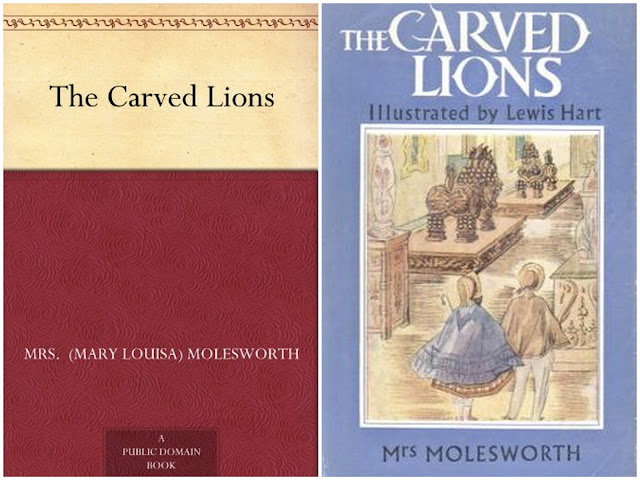
The Carved Lions (Book Review)


The Carved Lions
by Mrs. (Mary Louisa) Molesworth - 1895
(79 pages)

Recently, Meike (Librarian) blogged about another title - Christmas Tree Land - by Mrs Molesworth (1839-1921) - a classic English author of children's stories, previously unknown to me. Meike's review of that book made me wonder a bit if maybe her works could have inspired C.S. Lewis when writing his Narnia series. So I looked up some more of her titles, among which I found The Carved Lions (in the public domain and free for Kindle). Having read it, I'm still wondering... If C.S. Lewis did read this book in his childhood (and he could have - he was born in 1898), I suspect he may have felt (like I do) that there were elements in it that could have made it a good fantasy book - but weren't (in that respect) quite used to their full potential...

Reading it 125+ years after it was written, and as an adult, to me the the story feels "uneven". The narrator in the book is an old woman looking back on her childhood (so the events meant to have occurred in the early 19th century rather than towards the end of the same century). Geraldine and her brother were quite happy living with their parents in a village. They were not exactly poor, but also not rich. ("It never entered my head that there was anything to be ashamed of in living in a small house and having only two servants.") Her brother (a couple of years older) went to school but Geraldine was home-schooled by her mother. Sometimes she wished she could go to school to.

One of both children's favourite things was to accompany their mother when she had some errands in the village. At the entrance of one shop there were two huge carved lions, looking very life-like. Geraldine and her brother used to imagine (or pretend) that these could come alive, and carry them off on adventures.

"A little way in from the front entrance to the shop --- stood a pair of huge lions carved in very dark, almost black, wood. They were nearly, if not quite, as large as life ---"

Then suddenly there is a big change in their lives. The children's father gets a job abroad (which it seems he has to take for financial reasons). His wife has to go with him; but for reasons to do with climate and whatever, they can't take the children. 

So the children are both sent to boarding schools - Geraldine to one for girls in the same village where they lived. Apart from her parents going away, she is actually kind of looking forward to this - hoping to make some new friends.  But the school turns out a huge disappointment to her. And here the story goes off into lengthy descriptions of the school, the teachers, and her growing unhappiness. Until one day she runs away, in the hope of finding someone who might be able to help her get news of her parents. It turns out she doesn't remember the streets of the village as well as she thought, so she gets lost - but eventually ends up at the shop with the lions, so exhausted that she falls asleep next to one of those. 

And then the lions come alive, and wonderful things start happening... Or... do they?
(Spoiler alert for the next paragraph)

Next thing, Geraldine wakes up, and finds herself in a strange bed, surrounded by faces she does not know. It turns out the owner of the shop found her sleeping next to the lion, and had taken her in. She has contracted a bad cold from being out in bad weather, and has to stay in bed for a while. However, it all turns out for the best. Various misunderstandings get sorted out, and she ends up not having to go back to the school, but gets to stay with nice people (including a girl her own age who also likes the carved lions); until eventually her parents come back from abroad.

The book is quite short (79 pages). It has been called the author's masterpiece by some; but as I already said, to me it feels uneven, with some parts of it full of details, but others only very hastily sketched, and the fantasy parts not allowed to mix too much with "reality".

The idea of the carved lions coming alive and letting the children ride on their backs to a faraway place still reminds me of Narnia, though. ;-) 

(Remains to be seen how well I'll remember the book in a couple of years or so - that's usually the best way to tell the quality of a story in the long run!)


Sunday, 12 May 2019

Some Recent Reads (Short Reviews)


The American Agent
by Jacqueline Winspear (2019)


Read on Kindle + Audible
Audible narration by Orlagh Cassidy (11 h)


The 15th installment in Jacqueline Winspear's series about private investigator Maisie Dobbs. In this novel Maisie investigates the murder of an American war correspondent in London during the Blitz. She is asked by police authorities to work on the case together with Mark Scott, an agent from the US Department of Justice whom she previously met in connection with a case in 1938 which took her to Munich in Germany. Nowadays, Maise also has to balance her professional life with her responsibilities for a young evacuee that she has come to love and care for, and wants to adopt.

As usual, my impression is that Winspear does a good job with reflecting the wartime atmosphere that she's writing about. (In the early books, post-WWI - in the later books, WWII.)


Wishes & Wellingtons
by Julie Berry, narrated by Jayne Entwistle

(9 h 29 min)


Wishes and Wellingtons is an Audible original--i.e. only produced as an audio book.
There is no print version. As
Audible member this was one of my monthly
free 'extras' recently.

This is a middle-grade fantasy adventure. Maeve Merritt is a student at  the London boarding school Miss Salamanca's Boarding School for Upright Young Ladies, and not at all happy about that. One day, as punishment for something, she is forced to sort through the trash, and finds a sardine tin that turns out to contain a foul-tempered djinni - who in turn is not at all happy to find his new "master" to be a mere schoolgirl... 

A strange mix of adventures and troubles follows for Maeve, her room mate at the school + and an orphan boy from the orphanage next door, before the story comes to a close. A kind of mix of Charles Dickens and Arabian Nights; with a rather headstrong girl as the main character. I liked the audio narration, but have to say I was less impressed with the plot. But then I suppose I'm not really in the target age group (even if I do still like to read children's and YA books sometimes).


A Girl Called Justice
by Elly Griffiths (2019)

Read on Kindle

I was curious to read this because I like Elly Griffiths crime novel series about the forensic archaeologist Ruth Galloway (11 books so far, I think). I also liked her recent stand-alone novel The Stranger Diaries. 

This time, she is trying her hand at a book for younger readers, and lovers of for example the Enid Blyton mysteries.

While I remember the children in Enid Blyton's stories as always being on holiday, this is another book set in boarding school environment. Not quite as grim as Miss Salamanca's Boarding School for Upright Young Ladies (see Wishes and Wellingtons above!), and missing the magic of Hogwarts - but still reminding a little bit of both... 

But then the heroine, Justice Jones, is kind of set on finding mysteries to solve right from the start when she arrives at
Highbury House Boarding School for the Daughters of Gentlefolk. The story is set in 1936.

Her father, a widower, is a barrister specialising in murder trials, and Justice is sent off to boarding school after her mum died.  Before that, she had been home-schooled by her mum; so coming to live at a boarding school is quite a shock. And when one of the first things she hears about is the suspicious death of chamber maid, Justice at once takes it upon herself to make her own investigations into the mystery. Along the way, she also makes some new friends. But when a winter storm cuts the school off from the rest of the world, the plot thickens...
In an  afterword, Elly Griffiths writes that the school is entirely fictional, but "It is, however, loosely based on ... the school attended by my mother, Sheila, in the 1930s. Like Justice, Sheila was brought up by her father ... and she too heartily disliked boarding school."
For my own part, I prefer the author's adult books; but back in my Enid Blyton days of youth, I would probably have loved this one.

---

Speaking of boarding schools, I'm also currently in the process of spending my monthly Audible credits on collecting the Harry Potter series in Swedish narration by actor Björn Kjellman. 
When I first started reading/listening to Harry Potter, back around 2000, it was in narration by another Swedish actor, and recorded on cassette tapes. (Anyone remember cassette tapes?!) 
Since then, I have also read and listened to them all in English (several times); read by both Jim Dine, and Stephen Fry (my favourite). But it's also nice to keep up with the Swedish translations. 

(For some reason, I never seem to outgrow the Potter books. I think it is because they're so full of details, and with so many hidden or half-hidden references to all kinds of other stories that there's always something new to discover.)
 

Saturday, 7 October 2017

Postcards for the Weekend: Children

170726-170828 from John 1719

From John in England – July 2017
Children at the Village Pump c. 1905

170608-170612 from Jarina 0043

From Jarina in the NL – June 2017
Illustration from Enid Blyton’s Famous Five books

Wizard of Oz

Postcrossing card from Kansas, USA – September 2017
Illustration from The Wizard of Oz


Weekend Linky Party:

Postcards for the Weekend 56: Children


Sunday, 15 February 2015

Book Review: At the Back of the North Wind (1871)

George MacDonald 1860s.jpg

George MacDonald (1824-1905) was a Scottish author, poet and preacher; a mentor of fellow writer Lewis Carroll, and some of his works of fantasy have become classics in the genre, and inspired other authors, like C.S. Lewis.


At the Back of the North Wind was first serialized in the children's magazine Good Words for the Young in 1868, and published in book form in 1871.

I have a Swedish translation printed in 1990; but realised recently that I hardly remembered the story at all, so decided to reread it in English.

At the centre of the story is a small boy named Diamond, son of a poor coachman – who also has a horse with the same name. The boy Diamond sleeps in the loft over the stable (right over the stall of Diamond the horse); and in the wall by his bed there is a knothole, through which the North Wind blows. In Diamond’s dreams (or is it more than just dreams?), the North Wind takes the shape of a beautiful woman with long hair – sometimes small like a fairy, sometimes huge and awe-inspiring like a mighty storm – sweeping Diamond away on nightly adventures, both in his own town and to a distant land, “at the back of the north wind”.

Diamond is at the same time a mystery and a joy to the people around him. Kind and helpful and trusting, and making friends whereever he goes - but also going his own ways, showing both practical initiative, and surprising people by fanciful ideas, rhymes and dreams.  He’s naive in some ways, and yet also wise and philosphical far beyond his age. Some think he’s not quite right in his head; but he never takes offense.

It is not a book easy to categorize. Take the basic setting (including poor little boy) from a novel by Charles Dickens; put it down a rabbit hole (as in Alice in Wonderland - 1865); add a good portion of classic fairy tale and fable; mix in some serious theodicy questions and answers; and serve with a sprinkle of nursery rhymes on top. It’s very much up to the reader’s taste to decide what to make of it!

I suspect that one reason I did not remember much about it (from 25 years ago) may well be that I found it somewhat “difficult”. The story also makes a lot of deviations along the way (like long nursery rhymes and whole fairy tales told within the story).

This time I also tried listening to some parts as audio, but when I got to the end I found I needed to go back and reread some parts (that I probably missed by drifting off into dreams of my own!). Some of the details deserve more attention than one might think at first. For example, there are plenty of parallells between the ‘reality’ vs. stories and dreams within the book.

It’s not a book I’d recommend as a must-read for everyone, but if (like me) you are interested in classic children’s literature and fantasy, you might find that you recognise themes and ideas also used by other authors within those genres.

- - -

PS. I’ve blogged about MacDonald before, back in 2012 – a post entitled Once Upon A Time.

- - -

Linking to Musing Mondays

Thursday, 26 December 2013

Book Review: Liberty Frye and the Witches of Hessen

Liberty Frye and the Witches of Hessen
by J.L. McCreedy (2013) ****

I came across this book as temporarily free for Kindle, and as I had just finished another book and felt like reading something lighter next, I got started on this one directly.

The first chapter or two made me initially suspect that it might be too much of an imitation of Harry Potter; but as the story proceeded, I think it turned out to stand on its own feet. Of course it has evident roots in a magic fairy-tale tradition familiar from both old and new classics in that genre, but it is also spiced with some less common ingredients. It’s a fast-paced story with some unexpected twists, and a variety of characters turning up along the way.

It starts out with a new friendship between two ten-year-old girls in a US small town – Liberty Frye and Ginny Gonzalez. Ginny lives with foster parents that don’t really care much about her. Liberty (or Libby) lives with her parents, but is considered a bit odd by many. She has a tame goose that follows her everywhere, and in her garden grows an unusual tree, in which she likes to sit and read the Fairy Tales collected by the Brothers Grimm. We (and Ginny) also get to meet an uncle of Libby’s, who is very old, but still an active inventor of fantastic machines. However, one day a strange letter arrives for Libby’s parents, and shortly after that, they take her on a sudden trip abroad, to visit relatives in Germany (without giving much explanation as to the reason). More specifically, it turns out that Libby’s mother comes from the town where the Brothers Grimm were born… And from then on, things start to get really complicated! (The title of the book gives a hint.) Ginny is left behind on the other side of the earth; but when she senses that Libby might be in danger, she starts looking for a way to help…

Putting on my critical glasses, I think that the story sprawls a bit too much; with too many “unconnected” ingredients thrown in to the mix. But at the same time I did find it very enjoyable reading, with lots of surprises and suspense – and a good portion of humour to contrast the creepy parts.

From linguistic point of view (spelling etc) the reading of this book flows smoothly (knowing a little bit of German probably gives you an advantage, though). (As I’ve come across many free and/or self-published Kindle books which turned out to contain an irritating amount of printing and/or spelling errors, I feel I want to point out that this is not one of those!)

There are many details in the story that might be interesting to pursue if you like looking things up on the internet. I also think it’s safe to say that I did feel that the story came to a proper ending, but at the same time left a door ajar for the possibility of sequels.

There is a website providing more info about the book and author, without being too revealing:
http://libertyfrye.com/

Monday, 14 October 2013

Classics Book Review: The Railway Children

The Railway Children
by Edith Nesbit (1905)

The Railway Children (book).jpg

I’m working my way through the books by Edith Nesbit on my Kindle :) – the book cover here was copied from Wikipedia.

This story is about two brothers and two sisters who are suddenly uprooted from their previous comfortable life in a town house with both their parents, to go and live with only their mother in the countryside, under much poorer circumstances than before. Their father has suddenly had to go away; but the children get no real explanation of why or whereto or for how long, until near the end of the book. They soon understand that Mother prefers not to talk about it, and learn not to ask questions. Mother is also suddenly very busy writing stories for publication; which means that the children are often left to amuse themselves best they can on their own.

As their house is close to the railway, this becomes their main source of adventures. They make friends with the staff at the railway station, and they also get in the habit of waving to the people on a special train that goes by daily – especially to one old gentleman; with whom they later on get closer acquainted, to their mutual advantage.

Perhaps needless to say, after certain complications all ends well, and at the end mysteries are explained and questions answered, to the satisfaction of all involved.

I’d say that in many ways this is a rather typical children’s book for its time. Personally I enjoyed Nesbit’s  ‘Psammead’ series more, as those books offer the reader more of an intriguing interpretation challenge, balancing between children’s imagination and “real” magic – and with a lot of humour, too.

From historical point of view, The Railway Children bears witness about the impact of the railway back in those days, though.

…

According to Wikipedia, the book has been dramatised several times (between 1951 and 2000) for radio, TV and film.

Amusingly, when googling the book title, one of the results that came up was an article from The Telegraph 11 July 2013, stating that:

After more than 40 years, the board responsible for classifying films in Britain receives its first complaint about classic film The Railway Children. [from 1970]

A viewer raised concerns with the BBFC about the danger of depicting children playing on railway tracks, in what was the first complaint received by the BBFC since the Railway Children was classified U in 1970, a rating which means it is generally suitable for children aged four and over.

David Cooke, director of the BBFC said the film had "always been a U on every platform." In the board's annual report it said it judged that as the Railway Children is set in the Edwardian period, access to trains was very different from today, and also the film showed the “potential harm to children if proper care is not taken” near railways.

Thursday, 23 May 2013

BTT: Childhood vs. Adult

btt buttonfrom Deb at http://btt2.wordpress.com/

Have your reading habits changed since you were a child? (I mean, I’m assuming you have less time to read now, but …) Did you devour and absorb books when you were 10 and only just lightly read them now? Did you re-read frequently as a child but now only read new books? How about types of books? Do you find yourself still attracted to the kinds of books you read when you were a kid?

It’s a long time since I was a child… :)

I’d say my reading habits have gone through changes both back and forth and across since I first learned to read (over 50 years ago). I did devour books when I was about 10, I think I borrowed piles from the library almost every week back then – like The Famous Five and Nancy Drew and Anne of Green Gables and Cherry Ames (and similar kinds of books by Swedish authors). I’m sure I read many of those more than once – especially the few I owned myself, but also some borrowed repeatedly from the library.

It still happens that I return to classics like Anne of Green Gables, while other childhood favourites were gradually replaced from my teens onwards by more grown-up mysteries and detective stories and romance novels and whatever.

I still like to go back and reread certain favourites from time to time – and that includes all genres I think (and also to watch favourite TV-series over again on DVD). Stories are much like friends in that way… Spending time with old friends is comfortable, but it’s also stimulating and challenging to meet new ones. (And sometimes you discover new things about old friends, too!)

Thinking back, one thing that strikes me is that there were certain children’s books that I did not read in childhood but which I came to love later on – like the Narnia books by C.S. Lewis. (First published 1950-1956 but I did not come across them until in the late 1970’s when I was in my 20’s.) I don’t recall reading a lot of fantasy and fairy tale kind of books back in my childhood. One reason may be that my mum (who no doubt influenced much of my early reading) was never much into that kind of stories. She preferred books closer to reality. Another reason may be “the spirit of the era”… Correct me if I’m wrong, but my impression is that the fantasy genre was not very big in the 1960s. Especially not the witches and wizards kind. I think there was a bit of a revival for authors like Jules Verne and H.G. Wells though. (After all, the 1960’s was – among other things - the decade of moon landings… More science fiction, and turning towards the future rather than seeking roots in old legend.)

There were some children’s books that stretched imagination without being neither magical nor scientific though, like The Borrowers by Mary Norton (the first four written between 1952-1961), which are among my favourites that I’ve kept returning to. A couple of years ago I read them for the first time in English (in my childhood it was of course the Swedish translations that I had), all in one volume together with the fifth book written much later (1982).

Out of curiosity I just checked the bibliography of Astrid Lindgren, probably the internationally best know Swedish author of children’s books, some fantasy and some not. In the 1960’s she too kept to down-to-earth kind of stories, with the border-line exception of two sequels to Karlsson-on-the-Roof (1st book 1955, the sequels 1962 and 1968).

I guess I made up for a certain lack of magic in my 1960’s childhood by becoming a Harry Potter fan in my late 40’s (onwards)… :D

I still like to read a mix of genres, and a mix of old and new. Since I bought my Kindle last autumn I’ve been exploring both some classic children’s books (for example some by Edith Nesbit) and various authors of contemporary fiction for adults that I’d never heard of before.

Monday, 11 February 2013

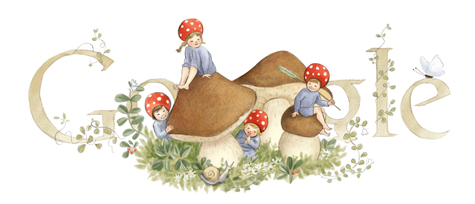
Elsa Beskow–Children of the Forest

Elsa Beskows 139e födelsedag

Google did it again – distracted me from whatever it was I originally intended to look up… And this in spite of the image keeping still this time! But I recognized it, and knew the artist behind it. What I did not know was that today was her 139th birthday…

Elsa Beskow

Elsa Beskow (née Maartman) (11 February 1874, Stockholm – 30 June 1953) was a Swedish author and illustrator of children's books.

And I do remember the Children of the Forest (Swedish: Tomtebobarnen) from my childhood.

Tomtebobarnen (early 1900s, Nationalmuseum Stockholm)

Little elves playing with Tomtebobarnen/Children of the Forest (1910)

Elsa Beskow frequently combined reality with elements from the fairy tale world. She became one of the most well known of all Swedish children's book artists. Many of her books are continually reprinted.

Beskow also illustrated ABC books and songbooks for Swedish schools.

Illustrated poem/song about sleeping trees in winter
(early 1900s, Nationalmuseum Stockholm).

I’ll be linking this post to ABC Wednesday (E for Elsa)
(unless I get distracted again and forget…)

Saturday, 9 February 2013

More Magic (Psammead Trilogy 2+3)

The Phoenix and the Carpet
by Edith Nesbit
(1904)

1st edition

1st edition cover (Wikipedia)

Sequel to Five Children and It.
In this book the children are left alone (in the care of servants) quite a lot in their London home, while their parents are off on various business and trips. Their mother buys a second hand carpet for the nursery. The children find an egg rolled into it, which hatches in the fire into a talking Phoenix. Much the same sort of adventures as in the first book continue to happen, as the carpet can also grant wishes. The Psammead (sand-fairy) from the first book does not appear “in person” in this one, but is referred to.

I found this book as entertaining as the first one, and also interesting from historical point of view (London in the early 20th century). Among the places the children visit is the Phoenix Fire Insurance Company (which the Phoenix assumes to be his Temple).

Fire is a theme throughout the book… There is of course a fireplace in the nursery – no central heating back in those days! I have to admit that had I had children, and read this book with them, I might have got a bit paranoid about locking away all matches and lighters safely out of reach… But since no children, I don’t need to dwell too much on that aspect :)

Quotes:

‘The people who decide what the weather is to be, and put its orders down for it in the newspapers every morning, said afterwards that it was the hottest day there had been for years. They had ordered it to be “warmer—some showers,” and warmer it certainly was. In fact it was so busy being warmer that it had no time to attend to the order about showers, so there weren’t any.

It is very difficult to remember things in the dark, unless you have matches with you, and then of course it is quite different, even if you don’t strike one.

The sound of a bell is quite different, somehow, when there is someone inside the house who hears it. I can’t tell you why this is—but so it is.

Robert stuck steadily to his point. One great point about Robert is the steadiness with which he can stick.

‘I do know a lot of French,’ whispered Robert, indignantly; ‘but it’s all about the pencil of the gardener’s son and the penknife of the baker’s niece---nothing that anyone ever wants to say.’

‘You should always speak politely to people when you want them to do things, and especially when it’s going away that you want them to do.’

Don’t trample on its feelings just because it’s only a carpet.

That is one of the most annoying things about stories, you cannot tell all the different parts of them at the same time.

‘But it’s true,’ said Jane. ‘Of course it is, but it’s not true enough for grown-up people to believe it,’ said Anthea.


The Story of the Amulet
by Edith Nesbit
(1906)

TheStoryOfTheAmulet.jpg

1st Edition cover (Wikipedia)

The Story of the Amulet is the third book in the Psammead trilogy.

In this book the four older children are separated from their parents and their baby brother for a longer period of time. Father is off abroad working, and Mother, with the baby, is away on Madeira recuperating after an illness.  The children are staying with an old nurse who has a boarding house near the British Museum. While the children are staying she only has one other boarder, an old learned man who is an Egyptologist.

The children miss the country house where they spent last summer (and where they first found the Psammead, a sandfairy who can grant wishes). However, they decide to make the most of all the things there are to see in London for free (or almost).

They start by exploring some markets and shops in the neighbourhood, and there they happen to find first the Psammead in a pet shop, and then (half) an old Egyptian amulet. The Psammead can no longer grant wishes to the children (only to other people), but the amulet turns out to to be new gateway to adventures for them, as through it they can travel to other times and places where the amulet has at some point been. The Psammead goes with them, and the learned Egyptologist gentleman gets involved as well (but he of course keeps thinking that he is only dreaming…) Besides Egypt they also visit ancient Babylonia, Atlantis and the Phoenician city of Tyre. They also meet Julius Ceasar before he invades Britain, and even manage a trip into a utopian future.

Comparing this book to the first and second in the series, there is a definite development towards more and more complex fantasy-adventures.

It got obvious to me during the reading of this last book especially, how strongly influenced by this story that C.S. Lewis must have been when writing his Chronicles of Narnia. And I’ll dare a bet that J.K. Rowling read it as well!

Edith Nesbit dedicated The Story of the Amulet to Dr Wallis Budge, an English Egyptologist, Orientalist and philologist who worked for the Department of Egyptian and Assyrian Antiquities in the British Museum – “as a small token of gratitude for his unfailing kindness and help in the making of it”.

Quotes:

‘This isn’t tomorrow!’ ‘Is it still yesterday?’ asked Jane. ‘No, it’s today. The same as it’s always been. It wouldn’t do to go mixing up the present and the Past, and cutting bits out of one to fit into the other.’ ‘Then all that adventure took no time at all?’ ‘You can call it that if you  like,’ said the Psammead. ‘It took none of the modern time, anyhow.’

‘The present’s the present and the past’s the past.’ ‘Not always,’ said Cyril. ‘When we were in the Past the present was the future.’

The Past’s as full of different times as—as the sea is of sand.


Besides enjoying the humour and language and story-telling in this trilogy I also found it interesting from historical and literary history perspective. I’m a little surprised that I’ve not heard more about it; but checking up on it, it seems only some of Edith Nesbit’s books were translated into Swedish at all, and I’m not sure this particular trilogy was available in Swedish in my childhood.

I’ll continue to read some more of her collected works in between other books. I have not yet decided which one to read next.

Saturday, 26 January 2013

Easily Amused

I just read a post by the MadSnapper Sandra, entitled: How to make a post out of Anything/ Everything/ NOTHING … And I wrote in my comment that I was just thinking of doing a post with the title Easily Amused. So now I have to.

Actually I was just going to do that anyway, so all that remains for me now is to try to explain. Which is the hard part, or I would already have done it by now.

The thing is, I’m still giggling on and off at a chapter in a children’s book that I read two days ago. At the age of 57, I’m not sure if that’s something one ought to admit.

But I just checked, and found that after all, Edith Nesbit (1858-1924) was 44 when she wrote it (or at least she was when it was published, in 1902). The book is Five Children and It, and the chapter that had me particularly amused was Ch 9, entitled Grown Up.

If I knew that you (dear readers) had all read the book, the explaining part might not be so difficult. Those who haven’t might need a little bit of background, though.

While playing in a gravel pit near their home, five children—two boys, two girls, and their baby brother, nicknamed “the Lamb”—uncover a rather grumpy sand-fairy known as the Psammead, who has the ability to grant wishes. (Only one per day and they only last for a day, at sunset all goes back to normal.)

Getting your wishes granted turns out more trouble than one might think,  as the Psammead tends to act on the very first “I wish” of the day that happens to come to mind for any of the children, whether they mean it as an actual wish or not.

One day, for example, one of them happens to wish that their (sometimes rather troublesome) little baby brother would “grow up”… Which, of course, he immediately does; and instead of being their baby brother, he becomes their grown up brother for a day. But as his brothers and sisters know he will suddenly turn back to a baby at sunset, they still can’t let him go off on his own. So they have to watch out for him, even though now it’s he who does not want their company.

That is not really the funny part though.
And neither is this, in itself:

The grown-up Lamb frowned. 'My dear Anthea,' he said, 'how often am I to tell you that my name is Hilary or St Maur or Devereux? - any of my baptismal names are free to my little brothers and
sisters, but NOT "Lamb" …

What set me giggling, and still does, is how the author treats that name-issue throughout the rest of the chapter (these are just some examples):

The grown-up Lamb (or Hilary, as I suppose one must now call him) fixed his pump and blew up the tyre.

Quietly but persistently the miserable four took it in turns to try to persuade the Lamb (or St Maur) to spend the rest of the day in the woods.

'He doesn't know who he is. He's something very different from what you think he is.'
'What do you mean?' asked the lady not unnaturally, while Devereux (as I must term the grown-up Lamb) tried vainly to push Anthea away.

[Anthea] caught the Lamb (I suppose I ought to say
Hilary) by the arm.

'Who are these very dirty children?' she asked the grown-up Lamb (sometimes called St Maur in these pages).

Again and again the Lamb (Devereux, I mean) had tried to stop Jane's eloquence, but…

If anyone would like to read the whole chapter you can find it here (Click on Part 3 and scroll down to Ch. 9).

And then you may shake your head at me, if you wish. (Just remember to be careful what you wish for.)


Saturday, 9 April 2011

Saturday Surprise

DSCN2857-1

Going into town, one never knows what one might come across!

DSCN2858-1

DSCN2851-1

DSCN2853-1

DSCN2856-1

The library was having some kind of drive for children’s books.
The last two are unknown to me, but the others I recognize:

image  

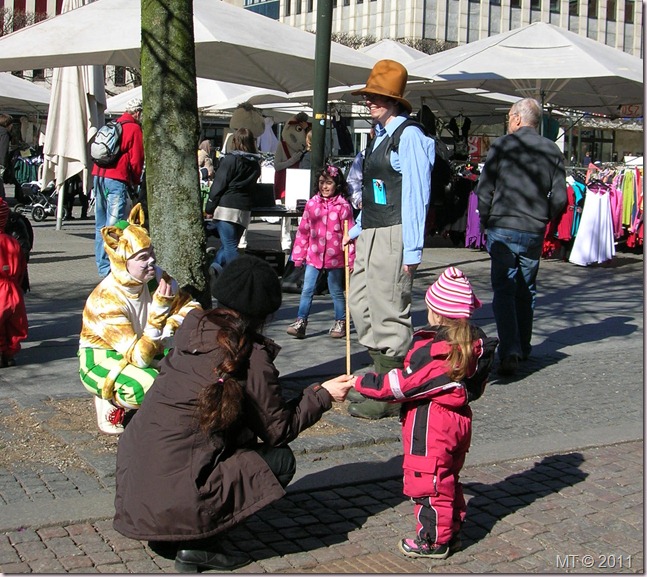
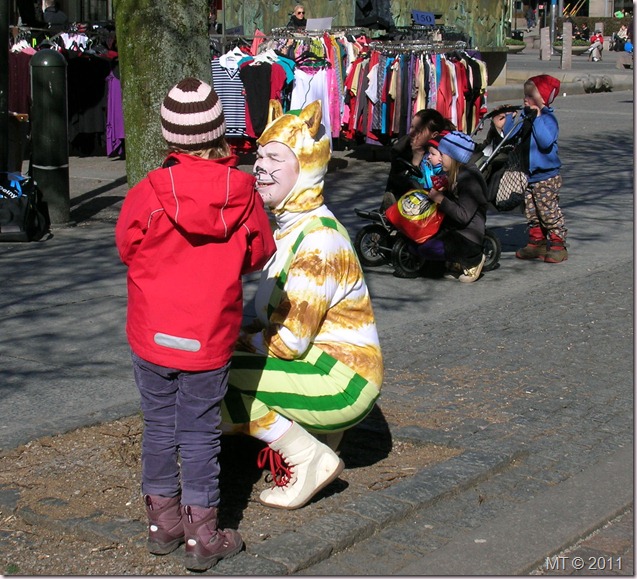
Pettson and Findus is a series of children’s books by Swedish author and illustrator of children’s books Sven Nordqvist. The books feature an old farmer (Pettson) and his cat (Findus) who live in a small ramshackle farmhouse in the countryside.

image

Mamma Moo and the Crow by Jujja and Thomas Wieslander, illustrated by Sven Nordqvist.

Related Posts Plugin for WordPress, Blogger...