From Malmö Old Town: A market stall selling clogs, in front of an old half-timbered building. Half-timbered houses were/are common in Skåne (the southernmost province of Sweden); and clogs belong in their traditions as well.
Showing posts with label Skåne. Show all posts
Saturday, 21 December 2019
Friday, 20 December 2019
December 20 - Friday
"On the road" ... somewhere in Skåne
Typical landscape for Skåne, the southernmost province of Sweden.
Labels:
AdventCalendar2019,
countryside,
landscape,
on the road,
Skåne
Thursday, 12 December 2019
Wednesday, 11 December 2019
Tuesday, 10 December 2019
Monday, 9 December 2019
December 9 - Monday
Red granite sculpture in three parts, Sofiero Palace Park, Helsingborg
This sculpture is in three parts. The ear was lying further away from the other two parts - too far apart for me to catch all three in the same photo, so I made this collage. When I was there, I had no idea what it was supposed to symbolize. I still don't, really - but I managed to find that the artist is a Canadian, George Rammell, and the sculpture (entitled something like "spirit of the tumulus") inspired from old Norse mythology, and the giant Ymer (Ymir). To cut a long story short, the world was created from Ymir's dead body.
Sunday, 8 December 2019
December 8 - 2nd Advent Sunday
Skanör Church, Skåne, Sweden
Love always protects, always trusts,
always hopes, always perseveres.
1 Corinthians 13:7
Cf. The Fourth Day (of our summer road trip)
always hopes, always perseveres.
1 Corinthians 13:7
Cf. The Fourth Day (of our summer road trip)
Labels:
AdventCalendar2019,
anchor,
church,
quote,
Skåne
Saturday, 7 December 2019
December 7 - Saturday
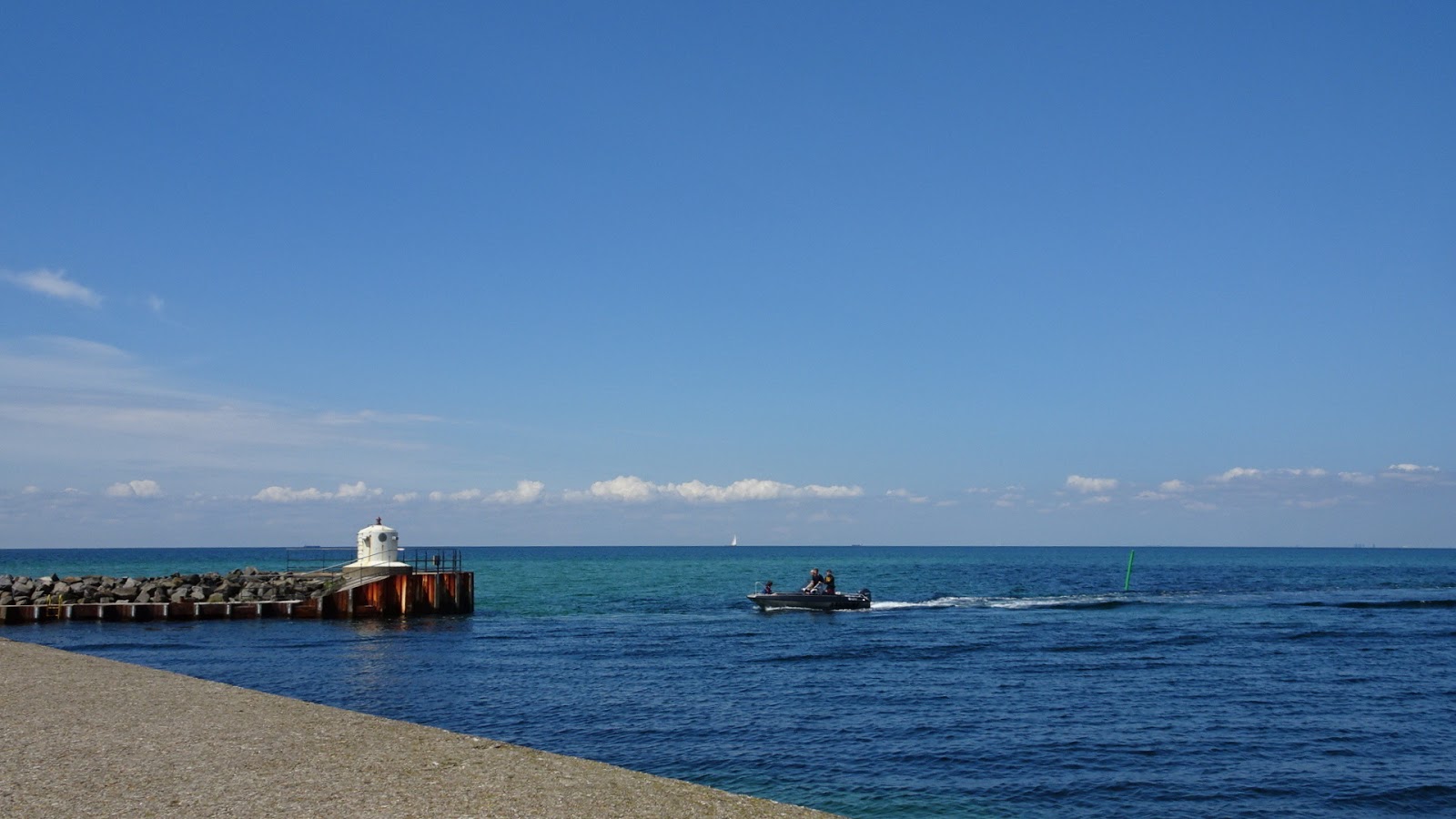
Lighthouse, Skanör harbour
(Skåne, Sweden)
From 1881, still active
Cf. The Fourth Day (of our summer road trip)
Friday, 6 December 2019
December 6 - Friday
Pottery at Höganäs, Skåne, Sweden
Höganäs is known for its ceramics industry, Höganäs Keramik. From visits to Höganäs in the past (decades ago), I remembered the town as full of potteries and shops where you could buy locally made things. I knew that the main industrial production had been moved abroad, but I still hoped to find some smaller potteries in business. As it turned out, we now had trouble finding even one! But finally found this place. I did not need a huge garden pot, though. But I bought one of those plant supports with ceramic head. And I also liked the fence shaped like coloured pencils :)
The plant support I bought in Höganäs is still keeping my geranium company... I took in the geranium from the balcony when nights started getting frosty. My plan was to cut it back when the last flowers had withered. The plant seems to have read my thoughts, though. So just dropped a lot of leaves, but kept on flowering!
Labels:
AdventCalendar2019,
art,
ceramics,
pottery,
Skåne
Thursday, 5 December 2019
December 5 - Thursday
My posts for 2nd and 3rd December from this place caused so many questions that I decided I'd better show you the rest of my photos from there as well. Not all that many, as this was just a short stop way made along the way, on our road trip back in July.
The old castle from the 16th century is not open for tourists to go inside; but one is allowed to go into the park and look at it from the outside. It is situated on a large estate, where there are other buildings as well. On the same estate there is also a 'new' castle from the 19th century, but that is in a private part of the park.
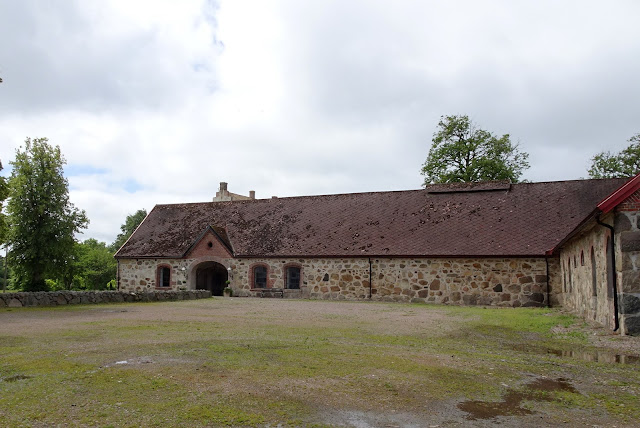
We parked near this building - "P" to the right on the map below. What you see sticking up behind the gateway in the photo above is the gable of the old castle; which on the map is the pink building with wings in the middle. It is surrounded by a moat, although that is not really made clear from the map.
Map borrowed from the castle's website.
Gateway leading to the park - photo from my post Dec 2
Approaching the old castle from the side. Here you can see the moat, which perhaps wasn't really obvious in yesterday's photo:
The front of the castle, with bridge over the moat
- photo used in my post from Dec 3
The courtyard at the back of the building.
View across the moat from the castle. When we were there, I thought that perhaps that pink house was the new castle/palace/manor house. But having done more research afterwards, I know now that the new castle is a much bigger red building with towers (to the left on the map). I'm still a bit puzzled that we did not even see the top of it sticking up from where we were... But maybe it's on lower ground and thus hidden by the trees.
There is a photo of the 'new' castle here (Wikipedia).
Wednesday, 4 December 2019
Tuesday, 3 December 2019
Sunday, 1 December 2019
December 1 - 1st Advent Sunday
The true light that gives light to
every man was coming into the world.
(St. John 1:9)
every man was coming into the world.
(St. John 1:9)
Photo from Hammarlöv Church, Skåne, Sweden
Labels:
AdventCalendar2019,
candles,
church,
interior,
Skåne
Sunday, 27 October 2019
Inspired Sunday: Hammarlöv Church (Skåne, Sweden)
This church dates back to the later part of the 12th century and was originally built in Romanesque style. (Traces of an even older wooden church have also been found.) The round church tower is unusual for Sweden.
The altarpiece was carved in 1700, but the image in the middle is later, from 1869.
The side ailes to the south and to the north were added in the 19th century. The pulpit, originally from the 17th century, had to be moved to be better seen by the congregation.
The organ was first built in 1851, and rebuilt in 1926.
Hammarlöv church is situated not far from Maglarp church, which I blogged about a couple of weeks ago. Some similarities can be seen in the interior design if you compare them.
Inspired Sunday #339
Labels:
church,
Church of Sweden,
InspiredSunday,
RoadTrip2019,
Skåne
Sunday, 13 October 2019
Inspired Sunday: Maglarp Medieval Church (Skåne, Sweden)
This church at Maglarp (F on the map) in Skåne, Sweden, dates back to around 1190. It was used as a parish church up to the year 1909, when a new church was completed. Between 1909 and 1971 the medieval church was abandoned. Only occasional services were sometimes held there in the summer. But in 1971 the church was restored both as a cultural heritage and to again serve as a parish church. So while on the one hand, electricity etc was installed; they also restored the original medieval characteristics - like old painted details on the vaults (which had in between been whitewashed and hidden).
The original architecture of the church was "Romanesque church with a broad west tower ". Over the years it has been rebuilt and extended.
The baptismal font, made of sandstone, is the oldest piece in the church; from the same time as the oldest parts of the church itself.
The crucifix in the triumphal arch is from around 1450.
The altar is medieval and has a small built-in space for a relic (today empty). The altarpiece from 1759 was cut by a man who was an innkeeper but in his spare time also worked as a sculptor.
The pulpit dates from 1568 and is one of the oldest in Sweden. The door to the pulpit was painted in 1639, so probably not added until then. (We found that door rather intriguing: Why a door when the stairs can be seen by those sitting in the pews anyway?)
The organ is from 1842 and was built by a well-known master from the city of Lund (whose name was also Lundh). He built around 25 organs; but this is the only one left (restored, and still used). The portraits on the facade of the balcony, by an unnamed artist, represent Christ and his disciples (plus one of Moses, added later).
(The facts in this post have been picked from brochures I got in the church; but the photos are my own.)
Inspired Sunday #337
Sunday, 29 September 2019
Inspired Sunday: Skanör Church (Skåne, Sweden)
Skanör Church (Diocese of Lund, Church of Sweden / Skåne, Sweden)
Skanör on the north side of the Falsterbo peninsula in south-west Skåne was an important trading center back in medieval times.
There was probably a church there already in the 12th century. The present church dates back to the first half of the 13th century. It was originally built in Romanesque style, which can still be seen in the vaulted ceiling of the nave. But like every other old church it has gone through a number of changes and additions over the centuries. The choir for example has windows in Gothic style; and the main altar is a Renaissance altar, probably made in Malmö.
This is a votive ship that caught my eye. I have had some of those before on my blog, I think. They are very common in Swedish churches, especially in the coastal areas. They were often given as thanks from sailors for having been saved from drowning at sea.
Skanör is "C" on this map
(from the 4th day of our trip back in July)
Skanör today has a popular marina and beach area, attracting a lot of tourists in the summer. Looking north, far off in the distance you can also see the Öresund bridge between Malmö and Copenhagen, and an offshore wind farm near that bridge.
Inspired Sunday #335

Subscribe to:
Posts (Atom)