Sunday, 25 January 2015

The Art of Keeping the Balance

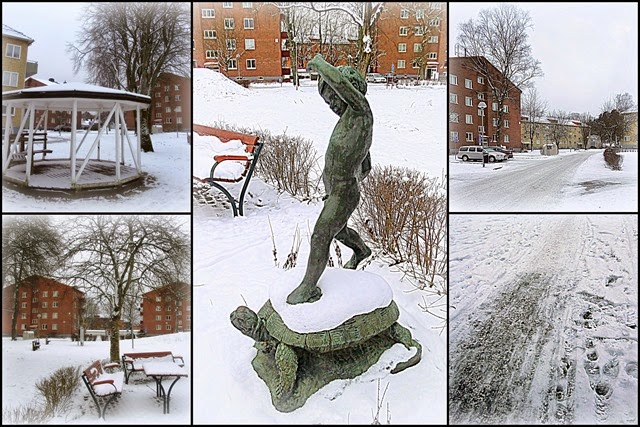
2015-01-23 snow

The weather situation around here has been pretty much “stuck” lately: Temperatures shifting a few deegres up or down around freezing point – with snow one day, rain and thaw the next; then freezing again and dangerously slippery; more snow on top, and then back to rain and thaw and ice again etc…  

The collage was made from photos taken a couple of days ago near where I live.

The balancing position of the boy on the turtle is not unlike the art of walking on icy streets…

… which means I haven’t been going very far!

Linking to Mosaic Monday @ Lavender Cottage

Tuesday, 20 January 2015

Teaser Tuesday

TeaserTuesdays2014e

• Grab your current read
• Open to a random page
• Share two (2) “teaser” sentences from somewhere on that page

. . .

   ‘It was dark and she was two door doors down, so what she actually saw was…?’
  
‘Silhouette of a tall figure in a cloak, carrying a holdall.’

Robert Galbraith (J.K. Rowling) – The Silkworm

. . .

“One day he was adding a line or two with enormous labour to ‘The Oak Tree, A Poem’, when a shadow crossed the tail of his eye. It was no shadow, he soon saw, but the figure of a very tall lady in riding hood and mantle crossing the quadrangle on which his room looked out.”

Virginia Woolf – Orlando: A Biography

. . .

… As I mentioned yesterday, I’m reading Orlando because it was referred to in The Silkworm (recently finished) …

Monday, 19 January 2015

Book Review: The Silkworm

The Silkworm (published in 2014) is the second crime fiction novel written by J.K. Rowling under the pseudonym of Robert Galbraith, and ‘starring’ private investigator Cormoran Strike and his (female) assistant Robin Ellacott. (The first was The Cuckoo’s Calling, 2013 –  link goes to my review from back then).

The Silkworm is set in the publishing world. A middle-aged woman, Leonora, comes to Strike’s office to ask for help to track down her husband, Owen Quine; a semi-famous writer, who seems to have disappeared. He’s been known to go off on his own before, but this time he’s been away for ten days without getting in touch. The family situation is getting difficult (they also have a daughter with some problems) and his wife wants him found. Leonora does not seem overly worried that something might have happened to him – she assumes he has probably just gone off on some kind of writer’s retreat, but she does not know where, and she has not been able to find out herself, as her phone calls to people in the publishing world who might know have not been returned. She also mentions, more or less in passing, that there have been some recent unpleasant incidents adding to her distress – someone putting dog excrements through their letter box at night, a strange woman turning up on their doorstep leaving a mysterious message, and another woman following her in the street… Strike decides to take on the case.

One problem with this novel, from reader’s point of view, is that during the first 1/3 or so of the novel, nothing much seems to “happen”; except for Strike arduously limping around a dreary wintry London (he lost half a leg in the Afghan war), meeting various people in the publishing world, and slowly finding out bits and pieces about Quine - all mixed with bits and pieces from Strike’s and Robin’s personal lives, where various developments are also going on. As for the gossip that Strike is gathering from Quine’s acquaintances, it is hard to make out how much is true or false, and what might be important or not.

Then Strike manages to get hold of one of Owen’s previously published novels, and also a secret copy of his last, yet unpublished work. The book proves to have a tedious and gruesome plot full of allegorical names and gory details of a kind I always find it rather tempting to speed-read rather than pay much attention to… In retrospect, though, I must advise readers of this particular book not to skip too hastily through all that, if you want a chance of understanding the rest.

Another piece of advise is not to skip the quotes at the beginning of each chapter. If you take the trouble to look up some of those authors and titles (if you don’t know them already), there are clues there too. (The connecting theme will also be spelled out later within the context of the story, though.)

As I was aware from before, Rowling is also in the habit of hiding clues and hints in the names of characters. In this novel, we’re dealing with double and sometimes even triple layers of that kind, as she lets her fictional writers within the book use similar tactics; although in the more obviously allegorical way, like it was often done back in the 1600s.

At the end, I have to confess I still had difficulties piecing everything together. Even though I did guess at some things, I also realised I had “missed” a lot. But when I went back and reread the first 1/3 of the book again – and especially the parts that I was tempted to just skim the first time – of course the details were there, hidden in all the chitter-chatter that at the time did not seem all that important…

Because of the complexity of this story, with its double or triple plots, and references to old plays using the same techniques – I think this is one novel that could benefit (just like a play) from having a list of characters at the beginning (or at the end). I did not check out the Wikipedia article until after I’d finished the book – to avoid spoilers – but it seems this idea occurred to the authors of that page as well (because they did compile such a list of characters).

I still find myself hesitating when it comes to rating the total reading experience on a 1-5 scale – my problem being that I can’t really say I ‘love’ the whole story as such; but at the same time I do recognise that it is cleverly constructed and did give me a lot to think about. I guess as a compromise I’ll give it four stars.

* * * *

MusingMondays5

As an extra teaser I might add that one result of reading The Silkworm was that I ended up buying the complete works of Virginia Woolf for Kindle (as the complete works did not cost much more than buying one single novel separately!) and am currently reading Woolf’s Orlando: A biography – finding it not only enlightning in relation to The Silkworm, but also (so far = two chapters) a lot more enjoyable than I expected from first looking up the Wikipedia summary…

…

THIS WEEK’S RANDOM QUESTION:
How many books, approximately, do you think you have in your personal collection?

I’d say about 700 printed + about 500 e-books + perhaps 100 audio…? (having to admit myself surprised at the number of e-books, even if most of them are free classics!)

Thursday, 15 January 2015

The Colour Blue (FMTSO)

CIMG1165-001

Peacock at our Zoo, from my visit back in August 2014.

Monday, 12 January 2015

Read in 2014

I was far from consistent in writing book reviews last year, but I did actually read quite a lot – if you include listening to audio/talking books, which is what I do most these days. I do find it hard to write reviews of books I’ve only listened to, though; as then I can’t go back to check details and find quotes etc.

I keep a list of all the titles I read though (using Works spreadsheet on my computer). And summing up my statistics for 2014, I find that I listed 64 titles, of which

42 were audio + 19 Kindle + 3 printed on paper;
21 in English + 21 written in Swedish + 22 translated

Those numbers do not include certain old favourites that I return to too often to bother about the statistics (like Harry Potter or Narnia). But they do include a few rereads of books I hadn’t read in a long time – like Madame Bovary by Gustave Flaubert and Camille (La Dame aux Camilias) by Alexandre Dumas (fils) (the reason being that on some occasion I found myself confusing the two); and more recently Mary Poppins by P.L. Travers (after watching the film musical from 1964 on DVD, and thinking that surely Mary in the books was a lot more “contrary” than the Julie Andrews version? – an opinion I still stick to after rereading!)

I also read quite a few detective novels. Among those may be worth mentioning one writer who was new to me: Ann Cleeves (and I think it may have been Adrian of the blog Adrian’s Images who first suggested her books to me). Back in the spring I listened (in Swedish translation) to her series set on the Shetland Islands – and what-do-you-know, now Swedish television is showing a Scottish BBC drama series based on those (saw the first episode a few days ago).

On Kindle I read (among others) two novels written by Frances Garrood: Dead Earnest and Basic Theology for Fallen Women (I also read The Birds, the Bees and Other Secrets in 2013). Frances is also a blogger, and I’d been following her blog for some time before I got round to reading her books; something which I found made it a bit tricky to “objectively” review the novels. (Or at least to know whether I could or not. I mean, I do think I’d have found her books worth reading anyway, but how exactly can I know that?)

I also read – or finished reading – in 2014  The Mystery of Lewis Carroll written by Jenny Woolf, whose blog *An English Travel Writer* is also on my bloglist (and was before I read her book). This is not a novel but a biography. I never got round to writing a proper review of this book, partly because of the fact that I read the first half of it in 2012, but then it got put aside for over a year; not because of the book as such, but because of my eye problems making it difficult to read printed books at all.

It is not exactly a chronological biography, but more of a thorough examination of various aspects and myths and rumours about the “elusive” author of Alice’s Adventures in Wonderland – Charles Lutwidge Dodgson, better known as Lewis Carroll. I enjoyed it, and it seems to me that Jenny has done a good job of putting facts and speculations into context, by also taking a good look at the differences between our own time and the English Victorian age when the book was written.

Other English titles that stand out for me from my 2014 list are

Entry Island by Peter May

The Physic Garden by Catherine Czerkawska

The Hunger Games Trilogy by Suzanne Collins

(of these I did write reviews and that’s where the links go)

…

Currently I’m reading the second Cormoran Strike detective novel by Robert Galbraith (= pseudonym for J.K. Rowling) – The Silkworm; and up next (or at least soon) probably Peter May’s new novel Runaway, which will be published on January 15.

…

Linking this post to

MusingMondays5

Musing Mondays

Related Posts Plugin for WordPress, Blogger...