Showing posts with label family history. Show all posts

Thursday, 21 August 2025

Road Trip 2025 (5) - Sturefors Castle

Monday, 11 August - Part 1
Sturefors Castle (near Linköping)

From Linköping we drove south-east to Västervik on the east coast (see map at the bottom of the page); but we also made a couple of stops on the way down there. 

Not far from Linköping, and just a minor detour from the main road, there is an old castle that I wanted to visit: Sturefors. The castle itself is private and not open to the public, but part of the surrounding park (with a view of the castle) is. And the reason that I wanted to see it is that back in the 1920s, my paternal grandmother's older half-sister Gerda (born 1881) worked there for a while, as lady's maid to a Countess Bielke. The castle is still owned by the same family, Bielke (an ancient noble family). 

Back in 2022, I wrote a post about this in my family history blog Greetings from the Past. Sturefors seems have been Gerda's last place of employment before she became lady's maid to Estelle Bernadotte (born Manville; an American young woman from Pleasantville, New York) who married the Swedish count Folke Bernadotte in 1928. I have since got it confirmed from a reliable source that Gerda was kind of "headhunted" for the latter position in the autumn of 1928, before their wedding (which took place in Pleasantville). (Folke was related to the Swedish royal family; became a well-known diplomat towards the end of WWII and after; and was sadly assasinated in Jerusalem 1948. But Gerda remained with Estelle for the rest of her life; and lived to be nearly 92.)

In the 1920s, Gerda sent this postcard of Sturefors castle to her step-mother Selma (my paternal great-grandmother):

(original postdard, yellowed with age)

(edited back to b&w by me)

 ... and I was curious to see for myself how it compares to 2022!

Alas my impression was that the present-day family is probably struggling to keep the estate going at all - or at least keeping the park with the huge mirror pond free from weeds does not seem to have been their first priority of late... The maintenance of the park also seems to have deteriorated quite a bit even since the photos in the Wikipedia articles were taken! So it takes quite a bit of imagination now to try to envisage what it all looked like when my great-aunt was living and working there, a hundred years ago. (I'm still glad we took the trouble to find it, though.)


The castle itself still looks rather impressive - but alas, the public is not allowed any closer than that yellow sign.
 
Turning around, and looking in the other direction: 


Walking back towards the car park, and some other buildings belonging to the estate:


Even this "cultural heritage" sign looks rather old and tired by now...


Linking to Sepia Saturday 789 

 Sepia Saturday

Sunday, 11 August 2024

Time Travel (On the Trail of Our Ancestors)

(3 August, continued)  

On our way back from lunch at the old mill café, I wanted (if possible) to check some distances between a few places in the neighbourhood of where our paternal grandparents grew up. Back in July 2012 we managed to locate both the farm where our grandmother was born and lived until she got married (easy enough to find), and the small wooden cottage on the grounds of a neighbouring farm where our grandfather grew up (more difficult to find the way to). But I forgot back then to make note of the distances. Over the years since then, I have been going through a lot more old photos and letters and family history; and often find myself wishing I had a better grip of places frequently mentioned.

However, this time we even failed to find our way back to the childhood home of our grandfather. Rereading my old post from 2012 again now, I'm thinking we probably made some of the same mistakes now as we did back then - and gave up quicker... On the other hand, as our last expedition was 12 years ago, even more thoroughfares on narrow dirt roads across farm land may also actually have been closed to the public since then. So we decided not to pursue. I did get one distance properly confirmed, though - between the farm house and the railway station (which back at the beginning of the previous century also served as post office) it's around 1½ km (or 1 English mile). Just about the same distance as my own walk into the town centre these days - so not really "all that" far.

We also drove a roundabout way (more car-friendly) to one of the other places often mentioned in my grandmother's letters (Komlösa). A hundred years ago, I understand there was a chapel there that she walked to sometimes. Nowadays there is a rural museum with a collection of old wagons at an old farm in that neighbourhood. They're the kind of museum that is only open occasionally, though - or on special request. Their website did say it would be open on Saturday afternoons throughout summer (June-August); but when we got there, it looked as closed as the last time we tried (also years ago). We wandered around a bit outside but no person appeared. Never mind - I got a few nice countryside photos, anyway!


Thursday, 14 September 2023

Elsewhere and in Another Time

Oops, I see that somehow a week has flown by again without me posting anything new here. The rather summery temperatures have continued - but changing now, and it seems to be getting a bit more autumn-like again. I've been out on my daily walks, but just along the same old paths as usual; and for the most part I've let the camera rest. 

The thing is, in my head I've spent a lot of this week Elsewhere and in Another Time - which is not all that easy to illustrate by photos from the Here and Now...

Just now, I let Bing Image Creator have a go at it, though. My first instruction was simply 'Time Travelling 1920s' - which, for some reason, only rendered pictures of Men. I added the word 'Woman' for another search; and then created this collage using images from both:

Time Travelling 1920s - Images by Bing Image Creator

I also tried the phrase I used above - "Elsewhere and in Another Time". Besides mystic images, that also seems to have inspired Bing to invent a whole new language...

The "real story" is not quite as mysterious as all that; but it involves recently having been contacted by A Stranger, who some time ago happened to come across two of my ancestors in his own research for a book. And then he found me via my family history blog... 
 
And it is a little bit delicate, as he's writing about people (including my two ancestors) who ended their lives in a certain mental hospital. His book project is about trying to bring some of those tragic fates out of anonymity. Besides a draft of his chapter about my relatives, he also offered to send me scanned copies of their hospital records that he'd been able to access from visiting a physical archive (most of the hospital records so old now that they're no longer confidential). As I've been digging into that part of family history a bit myself, none of it was shocking news to me; and I don't mind him writing about it. But I've not had access to the full hospital records before, so I said 'yes please' to that... And I'm now spending some time comparing those to my own private family documents, to see what I can perhaps add. So that's where my mind has been a lot during the past week!  


Sunday, 10 October 2021

Sepia Saturday 591 - Mowing the Lawn


Prompt picture for Sepia Saturday 591:
"... an unknown lady, striding purposely into the future.
Little does she realise that there is a lawn roller coming up behind her,
ready to flatten all her dreams!
Such is life."
(A. Burnett)

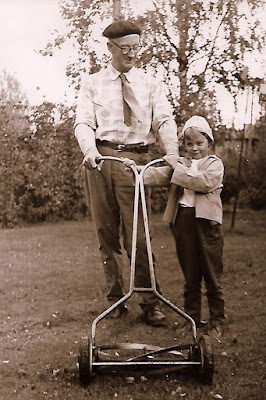
The lawn roller here made me go in search of a photo of my paternal grandfather with his lawn mower. I started looking for it in my inherited albums - but ended up finding it in one of my own childhood albums. And it turned out I'm in the photo too! It was taken in 1961, sixty years ago. I'm 6 years old here, and grandpa 57. He grew bald early, and I do remember him in that beret at lot, in casual contexts. I also remember him walking that lawn mower a lot - they had a huge garden!


Alas, a few years after this photo was taken, grandpa got Parkinson's disease, and died at age 65. I think grandma had help from a neighbour with the lawn for number of years. After she moved to a care home, we kept the house as summer cottage, and my parents went back and forth on summer weekends, tending two big gardens (1½ hr drive apart). Thinking back now, they must have spent an awful lot of time lawn mowing! And they too always used manual push mowers back in my childhood. After dad retired (at age 60), they had en extension built to my grandparents' old house and moved to live there permanently, though. They also got an electric lawn mower for that garden - but still one they walked behind rather than rode on.

For my own part, I became allergic to grass pollen from my early teens onward - and never having lived in a house with a garden of my own in my adult life, I doubt there are any more photos of me with a lawn mower to be found! (Such is life.)


Saturday, 24 April 2021

Sepia Saturday 567 - Men On Horseback (1925)

There are very few photos of horses in my old photo albums, and even fewer of people riding one. The only one that comes to mind is this photo from my grandfather's album, with the subtitle "On horseback. Kviberg 1925". Kviberg was a Swedish artillery regiment in Gothenburg. Obviously this is where my grandfather did his mandatory military service. In 1925, he was 21 years old - the common age for conscription back then.

Who among the men on horseback is my grandfather? I know he must be one of the four in the middle, because there is another photo of him in that kind of uniform (but no horse):

My grandfather to the right,
a friend of his to the left.

I'm hesitating whether my grandfather is the 2nd or the 4th man wearing that kind of hat in the "horseback" photo. Hard to tell as one face is rather blurry, and the other has his hat pulled down over his eyes. Both seem to have the kind of oblong face that my grandfather had.

Whether they had any choice as to what kind of military service to do, I don't know. But I know that my grandfather's grandfather (with whom my grandfather grew up) used to be an artillery soldier. Back in his day, military service was organized a bit differently, though.


 Sepia Saturday 567


Saturday, 10 April 2021

Detective Work & A Team of Women (Sepia Saturday 565)


Since Easter, I have continued to work away at playing detective with the old postcards collected by my great-uncle Gustaf and his sister Gerda (many of those addressed to Gustaf also written by Gerda), during the years when the two of them both lived in America, c. 1902-1910. While Gustaf went to Pennsylvania to find work at sawmills and lumber yards (and ended up living most of the years in Galeton), Gerda went to Chicago, seeking employment as a maid. She changed addresses in Chicago a few times before she ended up working for the same family from some time in the autumn of 1906, and through at least 1910. This I know from addresses written on postcards, plus that (back in 2012) I managed to find both Gustaf and Gerda in the US Population Census of 1910.

The two photographs above, showing Gerda with a rather large team of other maids in what seems to be a countryside environment, have long puzzled me, though, as they don't seem to fit the Chicago city addresses. 

This past week, I think I may have stumbled upon an answer, while deciphering two postcards sent by her to her brother in the summer of 1906.

To give you an idea of what I mean by "deciphering", here are the postcards:

Cave Hill, Belfast (Ireland)

Yes. Gerda has this rather unfortunate tendency to write her messages (often in pencil) all over, around and upside-down on the front of the cards... (The back in those days often reserved for the address only.) She also often used cards with images nothing to do with where she sent them from; and most of the time she starts off with standard phrases (I wonder how you are / I am having a good time / I am waiting to hear from you / I will write a letter soon, etc.) - but then, just when she's running out of space, she remembers something more important she wanted to add, and squeezes that in right at the end, along the edge, upside-down, or in really minuscule writing - and 115 years later, it has faded into obscurity... (To be fair, I don't suppose she ever considered the possibility that her baby half-sister's granddaughter might want to read the cards in 2021...) Moreover, somewhere along the years, some eager stamp collector removed the stamps from all these postcards, which often makes the postmarks/dates unreadable as well!

Add to that a few old photographs with no notes or dates attached.

However, most of the postcards seem to have been sorted by year into Gustaf's postcard album. So on my blog Greetings from the Past, I am trying (periodically, now and then, since 2012) to go through them in order, one card at a time, drawing my conclusions the best I can from what I know so far - but prepared to change my theories along the way, when new pieces of information turn up.  

The card with the view of Cave Hill, Belfast, Ireland, was sent by Gerda from Chicago on June 12, 1906. Upside-down over the hill, the most important piece of information on the card is: I am leaving my place here in 2 weeks. ... However, she does not reveal what her plans for the future are, only says she'll write again to give him her new address. (If she did, that was probably in a letter. And I have none of those, only postcards.)

The next card from her is the one with a view from Minneapolis, Minnesota. That was sent from New London, Minnesota, on Aug 16, 1906, and reads: Just sending you a view from Minnesota to tell you that I am here and having a rather good time. I wish you were here. I'll be going back to Chicago on the 31st. / This view is not very beautiful but there are some, I'll send you another one later.

I looked up New London, and found that nowadays they call themselves "The City on the Pond" and "Gateway to the Glacial Lakes". This led my thoughts to that photo of Gerda with a team of other girls dressed in some kind of maids' uniform, by a lake. (G. is the one sitting on a tree stump on the right in that photo. And on the other, more formal group photo, she is in the middle of the back row.) Judging by the way they are dressed, with the long skirts etc, I'd also say 1906 feels just about right.

Now knowing that Gerda left one employment at the end of June, 1906, and probably did not start her next one until a bit later in the autumn - I'm thinking that this gives her a couple of summer months in 1906 to travel up to Minnesota to work for a while at some kind of summer hotel or lodging-house there. A sort of "working holiday", away from the big city of Chicago.

No brooms to be seen in the hands of the ladies in my photos; but I'm linking to another "team of women" at Sepia Saturday 565


Sunday, 14 March 2021

A Pipe in the Mouth... (Sepia Saturday 561)


 “A pipe in the mouth makes it clear that there has been no mistake–you are undoubtedly a man.”
-A. A. Milne

In a photo album I think my grandfather received for his 50th birthday (1954), there are several photos of him smoking a pipe. I vaguely remember that from my childhood as well, but I think perhaps he mostly smoked outdoors.

The top left photo in the collage is one of my favourites from the old albums. It shows my grandparents at the well on the property they (or my grandfather) bought in the spring of 1930. The house was built over the summer and they got married in the autumn the same year. The well would have been built before the house; and indeed there is also a bill dated 26 April 1930 which does not only serve to date this photo to around that time, but also informs that the well was built by their future brother-in-law (he married my grandmother's sister later the same year). The other two men in the photos above are named in the album, but unknown to me. My grandfather was a journalist, so met quite a lot people.

Linking to: Sepia Saturday 561


Saturday, 6 March 2021

Friends (Sepia Saturday 560)

Since last week, I have continued to go through some more of my paternal grandfather's notes from his own research into his family history. I've also been looking at some of the old photo albums (again). There are very few photos from before the early/mid 1920s. Two of my grandmother's old albums have no notes in them at all. All the original photos are very small. Some later albums have notes, but the photos are not in chronological order, and the notes are more often to do with "where" than with "who" or "when". (To my grandparents, the "who" was probably usually considered obvious... To me, not so much!)

In last week's Sepia post I showed photos of the farmhouse where my grandmother grew up vs the small cottage where my grandfather grew up (with his grandparents). They both lived in the same neighbourhood / village. My grandmother Sally was born in 1900 and my grandfather Gustaf in 1904. In childhood, four years age difference is rather a lot. (When they got engaged, in 1929, she was 29 and he 25. They got married a year later.) However, my grandmother's younger brother Nils was born in 1902, and my guess is that he and Gustaf were friends even from childhood/school. (Back in those days and in a countryside village, school is likely to have been a small one of the kind with children of different ages taught together.)

Please tell me what you think: Is the boy/young man on the left (or in the middle in the third photo) the same person in all three? I recognize the one on the right as my grandmother's brother. I also know that it is my grandfather as a young man to the left in the middle photo; but I'm less sure whether it is also him in the two childhood photos.

The photo on the left is from my grandmother Sally's album, and under it, she has just written "Two friends". The middle photo is from Gustaf's album, a note says it's from around 1922. The third one is also from Gustaf's album, below is the full picture:


The album text under this one is just "In the [village] football team". No names. Comparing it to the middle photo in the collage, can you see why I'm picking out this particular boy from the team as probably being my grandfather? ;) 

As for the first photo, I'm wondering about the occasion, as it seems to be a professional photo. To do with school, perhaps? They're wearing very similar outfits.

Linking to Sepia Saturday 560 

Their prompt picture:


Saturday, 27 February 2021

Ancestry

After my father died ten years ago, my brother and I were left with a house full of old papers and photos, most of which were related either to my grandfather's career as a journalist with special interest in local history, or to my dad's interest in railway history. Luckily, the main efforts of their interests in these fields had already been preserved in printed books.

When my grandfather died (in 1969, only 65 years old), he had nearly finished compiling a book about old 'crofts' in the parish where he grew up (small farms on ground owned by bigger estates - I think the English word croft comes closest). He grew up on one such croft himself. My dad (together with his mother and mine) completed the book and had it printed (much appreciated by the local history society). 

After that, dad also wrote four books about railways in south-west Sweden. (He grew up in a house by the railway in the 1930s, which was what triggered his interest.) 

After he died in 2011, there was an overwhelming amount of papers and photos left in the house to sort through and decide what to do with.

...Dad's study in June 2011...

The railway-related stuff we donated to the national railway museum. In August 2012 three guys from there came down with a big truck and took more than half the contents of dad's very large study away with them. (Phew!) We also gave some papers related to my grandfather's research to the local history society.  Even so, quite a few papers and photos related to our own family history also came home with me. Every now and then, I've taken a plunge into them. Bits and pieces have also got blogged about now and then over the years. But I obviously do not have the same perseverance for this kind of thing as my forefathers. (And I've also no wish for my own study to end up in the same state as dad's in the end...)  After a while, I always feel the need to come up for air and let "here and now" take over again. But that also means that whenever something inspires me to dive into the history again, I always sort of have to start over! (And this, I guess, is a typical starting-over post.)

There are very few photos from before the 1920s; and when you get back to the 1800s and earlier, the name-giving tradition in Sweden usually went something like this: Sven Larsson was the son of Lars Svensson, who was the son of Sven Larsson, who was the son of Lars Svensson, who was... etc... To keep people apart back then they usually also added the name of the farm or the croft where they lived. But to me, most of those place-names don't mean anything (and most people also did not stay in one place their whole life).

One day back in the summer of 2012 (while we were still up to our necks in it all), my brother and I went in search of the places where our paternal grandparents grew up, though - as we knew those still existed, and not too far apart from each other.

Our grandmother grew up on a farm. For both her parents it was their second marriage. Her father died when she was only 7 years old. Until she got married at age 30, she continued living on the farm in a family constellation consisting of her oldest half-brother (30 years older than her), her mother, a half-sister from her mother's first marriage, and a younger brother. (She also had five more grown-up half-siblings, one of whom returned from America to live at the farm again for a while when my grandmother was in her upper teens.) This is the branch of family history I heard most about in my own childhood.

The b&w photo of the farmhouse in the collage below is from the 1920s; the other three are mine from 2012. 

My grandfather on the other hand grew up in a small simple 'croft' cottage. As the only son of an unmarried mother, he was mainly brought up by his grandparents. (His own background was no doubt what inspired him later in life to dig into the history of other crofts in the same parish. But that wasn't clear to me back in my childhood.)

Back then, the cottage was grey and unpainted (the b&w photo). A century later, an idyllic little red holiday house.

So what inspired me to bring all this up again, just now? Well, as so often, one thought leads to another. Recently a fellow blogger wrote about a manuscript left behind by his father. A Swedish friend posted on Facebook about her latest family history research. I discovered my 'new' printer (bought last spring) can scan documents as PDF. And so, one day I found myself returning to some of my grandfather's notes from back in the 1950s. If nothing else, perhaps I can scan some notes to preserve them in a more handy format for the future.

These are notes typed on typewriter by my grandfather himself back in the 1950s and marked as related to family history. Most of them are just "bits and pieces" from different sources. And some things he seems to have kept repeating and putting together in different versions. A bit confusing (for me) - but I can't really blame him, I suppose, as I find myself doing the same thing!

Overall impression: Some ancestors were crofters and very poor; others were farmers and a bit more well off, but still had their troubles. Most families back in the 1800s had a number of children who died very young. Many women died giving birth. People often married again after their fist spouse died. (Which means lots of half-siblings to complicate the family tree.) Some individuals were regarded as odd, mentally deficient or fragile (how each one of those would have been diagnosed today one can only speculate about). Some got some kind of financial support from the parish in their old age. Some were sent away to institutions. Some people died young, and others lived to be surprisingly old (well over 80 or even into their 90s), in spite of poverty and various hardships.  

In among all the sad stuff one can come across some "gems". Like this piece of information:

My grandfather's grandmother's mother Annika (married to one of the Sven Larssons), born 1800 and died 1887, was "one of those women who back in the mid 1800s were hired to teach children to read and write, before there were any regular schools".  My grandfather notes that obviously Annika also taught her daughter Rebecka (his grandmother) these skills, because even in her old age (she lived to be 79), she still had a neat handwriting. 

(This story is included in my grandfather's book, related to the croft where Annika lived, but without making a point of the people mentioned being his own close relations.) 

Alas I have no photos of neither Annika nor Rebecka.

It may be a bit of a stretch, but I'm linking this post to Sepia Saturday 559.


Saturday, 20 February 2021

Zooming in on the Tulips (Sepia Saturday)

20th February was my mum's birthday. She was born in 1930, so if she had still lived, today would have been her 91st. (She died three months after her 79th.) In my mind, I still associate this day with the first spring tulips, because she often used to get tulips for her birthday. Nowadays I often buy some tulips for myself for this day, and think of her. 


We have got out of the cold spell here and it's thawing again. Yesterday, I stayed in all day, as the streets seemed to be covered with a very unpleasant mix of ice and slush (and I couldn't think of any suitable footwear for it). Today, the streets and walkways were almost bare again, though. So after lunch, I decided to try a walk to the florist's shop in town. There were still some tricky spots along the way (like when crossing streets), but not too bad. Mission accomplished: I made it there and back without mishaps, and with a nice bunch of tulips of mixed colours to enjoy for the next week or so. 

The photo below is of my grandmother holding my mum when she was only 3 weeks old. And on the table to the left, what do you see? Yes! Tulips!

 Zooming in on the tulips for
Sepia Saturday #558 - Letter Z


Thursday, 3 December 2020

Read in September - British Humour and Murder Mysteries

Somehow the autumn turned out so stressful that I never got round to writing any reviews of the books I read and listened to during September-November. By now, I've probably forgotten too many details to be able to write proper reviews, but I'm thinking I'll try to at least list them (one post per month), and add some blurb quotes + general impressions.

September:

Born to be Mild - Adventures for the Anxious
by Rob Temple (2020)

Audio book, 8:30 hours, narrated by Mathew Baynton

"Rob Temple runs a social-media empire from the comfort of his sofa. Living the dream! But what happens when a lack of colleagues, bosses and alarm clocks means that your sofa and the four walls of your very quiet living room become your whole world? 

In this tender and life-affirming memoir, Rob explores what it will take for him to become a little less Bear (Pooh) and a little bit more Bear (Grylls) and how mild-mannered, anxious rule-followers can get their own share of (gentle) adventure from time to time."

I know the author as the man behind "Very British Problems" which I've been following on Facebook for years, and whose Very British humour often makes me smile and think that I must have some British DNA somewhere in my genes if I dig deep enough. (Viking ancestors, perhaps?) This book I think I'd call a biographical novel (not knowing exactly how much he's twisting reality). I enjoyed it very much, and in some ways it remins me of one of my all-time British favourites, Three Men in a Boat by Jerome K. Jerome (1889). I bought it as audio book and I think it's one I'll return to when in the mood for some mild and humorous encouragement. I'd also say it's a great book for Corona times, when even the more sociable among us have been forced to live a more isolated life than usual.


I also read/listened to four detective novels by T.E. Kinsey (new author to me), which I bought on special offers including both Kindle + Audible version. (There are three more books in the series, so far; whether I'll some day buy those as well remains to be seen.) The audio books are narrated by Elizabeth Knowelden; each about 8-9 hours long.

The author T.E. Kinsey grew up in London, studied history at the University of Bristol, and had some other writing jobs before he started writing his own historical murder mysteries. 

A Quiet Life in the Country (1)

The first book is set in 1908 and introduces Lady Hardcastle, an eccentric widow with a secret past, and her lady's maid/companion Florence (Flo) Armstrong, as they have just moved from London, hoping for a "quiet life" in the countryside.

... But it is not long before Lady Hardcastle is forced out of her self-imposed retirement. There’s a dead body in the woods, and the police are on the wrong scent. Lady Hardcastle makes some enquiries of her own, and it seems she knows a surprising amount about crime investigation…

As Lady Hardcastle and Flo delve deeper into rural rivalries and resentment, they uncover a web of intrigue that extends far beyond the village. With almost no one free from suspicion, they can be certain of only one fact: there is no such thing as a quiet life in the country.

In each of the following books, of course, they keep getting involved in more mysteries; and we also gradually get to know a little more about their background(s) - which also included travels in foreign countries.

In the Market for Murder (2)

Spring, 1909. A week after a trip to the cattle market, Spencer Caradine, a local farmer, turns up dead in the pub, face-down in his beef and mushroom pie. Once again, it is up to Lady Hardcastle and her maid, Florence, to solve the case.

Death Around the Bend (3)

September 1909, and Lady Hardcastle and her maid, Florence, have been invited to Lord Riddlethorpe’s country estate for a week of motor racing and parties. They both agree that it sounds like a perfectly charming holiday. But when one of the drivers dies in a crash…

A Picture of Murder (4)

Late October 1909, and the season of ghouls and things that go bump in the night has descended on the village of Littleton Cotterell. Lady Hardcastle and her trusted lady’s maid, Florence, find themselves hosting a colourful cast of actors whose spooky moving picture, The Witch’s Downfall, is being shown to mark Halloween. But things take a macabre turn when the first night’s screening ends with a mysterious murder...

What I enjoyed most about these books was the main characters, Lady Hardcastle and Florence, and the relationship between them: Florence is employed as lady's maid but at the same time is really treated more like a friend and companion than like a servant...

(End of book review)

--- 

(Sidetrack:)

... and this intrigued me, because it made me think of my grandmother's older half-sister Gerda, who worked in similar positions around the same period of time (and onward). I think I've told her story before, but: As a young girl Gerda emigrated from Sweden to America in 1901 or 02 (only a year or two after my grandmother was born). There she worked her way up as maid/ lady's maid/ travel companion. She stayed in America (Chicago) for around ten years; then made her way back to Europe, working as lady's maid/travel companion for one or more English ladies who liked to travel the world. At some point the travels even took her to India. During WWI Gerda got stuck in France and couldn't get back to Sweden until after the war. In 1928 or not long after, she got employed as lady's maid / housekeeper to a young American 'lady', Estelle Manville, who married the Swedish count Folke Bernadotte, related to the Swedish royal family, and who came to play an important role as an international diplomat, especially during WWII. Among other things, towards the end of the war he organized prisoner exchanges to bring home thousands of prisoners of war from Germany via Sweden. He was also appointed United Nations Mediator in Palestine after the war, but was sadly assassinated in Jerusalem in 1948. My great-aunt Gerda remained living with his widow, countess Estelle, long after that; way past normal retirement age (she lived to be 92). Estelle eventually got remarried - but not until the same year Gerda died, in 1973. I don't think I ever met Gerda (possibly in my very early childhood, but I'm not sure). But when I've been digging a bit into the family history (after my own parents died), her story is certainly the most intriguing. I have some old photos and postcards, but no long letters or diaries or anything of that kind; so a lot of things I can only guess at. Like, for example, how formal or informal her relationship with her employers was. (I know she accompanied the Bernadotte family on some of their travels as well, though. In her photo album there are photos from what I've managed to identify as the Manville estate in Pleasantville, N.Y.; and also of her sitting on a donkey in front of the pyramids in Egypt. ) (More about Gerda can be found in my blog Greetings from the Past - which I've not had much time to keep adding to lately, but the info I have gathered there so far is still there. And readers who came across that blog in their own internet searches have actually helped me confirm and fill in some facts and gaps in the story.)


Saturday, 7 March 2020

Laugh, and be jolly - Sepia Saturday 510


While Alan's prompt picture (below) shows jolly people on a beach, I managed to find a group of people being jolly in spite of colder climate. It's another photo from my mum's childhood album - which I have continued to explore a bit, together with her memories written down many years later in a separate notebook. 

The photo is from 1933, and mum is the little girl sitting furthest to the right on the wheel barrow, three years old. The photo was taken at the farm where she and her parents were living back then. My grandparents were not farmers (my grandfather was a teacher), but  rented a flat in a house at that farm (~1932-39).  There were no other small children in the neighbourhood for my mum to play with; but the couple who owned the farm had four grown up ones - two sons and two daughters. The jolly people with my mum in this photo are those four young adults, plus three visiting friends. 

Sepia Saturday 510


Sepia Saturday
Related Posts Plugin for WordPress, Blogger...