Showing posts with label traditions. Show all posts

Thursday, 14 May 2026

Ascension Day

We've been getting some rain this week, and the temperature has dropped as well - but nature no doubt welcomes the rain, and the trees keep getting greener every day now. The photo above (from today) is from an alley in the cemetery, lined with tall birches. And below are some budding azaleas I found back on Monday - I haven't been back to check on those since, but I suspect cooler and cloudy weather has probably slowed them down a bit.


Yesterday was laundry day for me, and as it started raining before I was done with that, I didn't bother about going out at all. 

Today is Ascension Day, commemorating the Ascension of Jesus into Heaven. Still a public holiday in Sweden; and traditionally a day for outdoors early morning church services and picnics. 

Back in 2021, I wrote a post including some old photos and memories of such occasions in a distant past. - Today, with rainy and rather chilly weather, I doubt a whole lot of outdoors Ascension Day celebrations were taking place around here, though.  (For my own part, I settled for just a short walk after lunch, between showers.  And even for that, I donned one of my winter jackets again...)

A local tradition in Borås is that our annual Spring Market is held on the Friday and Saturday following Ascension Day. Tomorrow I have a delivery from the supermarket coming in the middle of the day, though; and the weather forecast for Saturday so far isn't looking inspiring for market visits either. Ah well - "one day at a time"...


Saturday, 13 December 2025

Lucia / St Lucy's Day, 13 December

Saint Lucy's Day, also called the Feast of Saint Lucy, is a Christian feast day observed on 13 December. The observance commemorates Lucia of Syracuse, an early-fourth-century virgin martyr under the Diocletianic Persecution. According to legend, she brought food and aid to Christians hiding in the Roman catacombs, wearing a candle-lit wreath on her head to light her way, leaving both hands free to carry as much food as possible. 

Because her name means "light" and her feast day had at one time coincided with the shortest day of the year prior to calendar reforms, it is now widely celebrated as a festival of light. Falling within the Advent season, Saint Lucy's Day is viewed as a precursor of Christmastide, pointing to the arrival of the Light of Christ in the calendar on 25 December, Christmas Day. 

In Scandinavia, where Lucy is called Santa/Sankta Lucia, she is represented as a woman in a white dress symbolizing a baptismal robe and a red sash symbolizing the blood of her martyrdom, with a crown or wreath of candles on her head.

In Norway, Denmark, Sweden, and Finland, as songs are sung, girls dressed as Saint Lucy carry cookies and saffron buns in procession, which symbolizes bringing the Light of Christ into the world's darkness. (Wikipedia)


Not sure if the video below will work for everyone world-wide, but I thought I'd give that a test. (Let me know if it works!) It's this year's (2025) Lucia Morning by Swedish Television (SVT); from Visby on the island Gotland, off the east coast of Sweden. 

It's a 1 hour show, and in Swedish. But of course you can choose for yourself how much of it to watch/listen to. It will give you an idea of the typical atmosphere, anyway.

"Inside the city walls of wintry Visby, this year’s Lucia brings atmosphere and warmth with choirs from Sankta Maria Youth Choir, Voices of Hope, and Gotland Boys’ Choir. In the ruins of St. Karin and Helge And, the Christmas songs ring out, and we also get to enjoy several soloists, the Gotland Wind Quintet, and a children’s choir in the historic surroundings."


https://youtu.be/QVc5rAzMQCs?si=toSBG8tjXE-Urfmg

Saturday, 4 October 2025

Some Thoughts about Faith, Tradition and Identity


Yesterday, fellow blogger Yorkshire Pudding published a blog post entitled "Jews" - related to a recent tragic attack outside a synagogue in Manchester, in which two Jewish people were killed and three left in a serious condition after a car ramming and stabbing attack. 

YP asks some questions, like:  "How can it be that someone who is a native born citizen of Great Britain [or some other country] may self-define more eagerly through their religious heritage than through their nationality?" and "If you were born into a Jewish family in another land - what is your relationship with the state of Israel and [---] why should it be more intense than a Christian's relationship with The Holy Land?" and  "[One Jewish woman declared] that she would now have to emigrate from this country where she was born and raised and I thought - why?" (For the full context, I recommend that you read the whole post.)

Very complex issues, not easily answered, and I certainly can't claim to be an expert on any of it. But it did trigger some thoughts for me, and also a memory from my childhood. Because of the complexity, I chose to write my thoughts down in a separate text document first, before sending a comment to YP's blog. And on second thought, I decided to share it here on my own blog as well. (If nothing else, that will make it easier for myself to re-find it later, if I should want to.)

*******

I'd say it's all deeply rooted in history and inherited traditions even more than in “faith” – and that the bigger question is why some people still persecute others because of their origin (which is really something that none of us have chosen ourselves). 

I'd also say that a Christian's relationship with the “Holy Land” is totally different because the Christian tradition from start was to spread their faith to the whole world. (Jesus told his disciples to “go and make disciples of all nations” Matthew 28:19) Jewish history on the other hand goes back to nomad times long before they had a country of their own to begin with. I think a bigger question is why others are still persecuting Jews living elsewhere than in Israel. Considering the history of how the Jews were persecuted under the Nazi regime in Germany back in the 1930s/40s, I'm not surprised at all if a single terrorist attack anywhere in modern times still causes panic among people of Jewish heritage, whether they're very religious or not. 

I think my own first awareness of "different" religious beliefs/traditions was when I was about 10 or 11 years old (i.e. in the mid 1960s). We got a new boy in my class in school, who was Jewish (born somewhere in Eastern Europe). Back in those days we were all still going to school half days on Saturdays here in Sweden. We were also still taught “Christianity” rather than “Religion”, and each morning started with singing a psalm, and prayers were said before going to lunch. But unlike the rest of us, this new Jewish boy was excused from attending school on Saturdays (the Jewish Sabbath). And our teacher took some time to explain the difference in traditions to us. I suppose it probably made us a bit jealous that this boy got more “time off” from school than the rest of us – but as far as I can remember, we came to just accept it as a fact. (Or at least I did.) 

In 1968, the same year I started  “secondary school” (at age 13), no school on Saturdays was introduced nation wide, so then that wasn't an issue any more. And Christianity was replaced by Religion on the curriculum - aiming to give us all a bit more insight into different traditions. (I'm not trying to make out that this solved all problems, though!!) 

For my own part, I do identify myself as Christian. (I had a brief period of regarding myself as atheist in my early teens, but then gave that up!) 

*******

PS. "On third thought" it strikes me that there are actually quite a few other people(s) around the world too being (or having been) persecuted for either religious or political reasons, and forced to live with "split identities" - as in not always finding it easy to know whether to identify oneself primarily according to one's religious faith - or lack of it - or one's country of "origin" vs where one happens to have ended up (by choice or by chance!) later in life...

Saturday, 14 December 2024

The Angels Are Singing Again


As usual I'm putting up my Christmas decorations gradually. For this weekend (3rd Advent), I have added my angels and my Nativity scene. The glass angels with the electric candles in the living room; the rest in my study. The angels all came as gifts from friends on different occasions; the nativity set I bought myself many years ago. (Originally it was just the stable, the family and the three wise men. I've added the other pieces from different sources...)

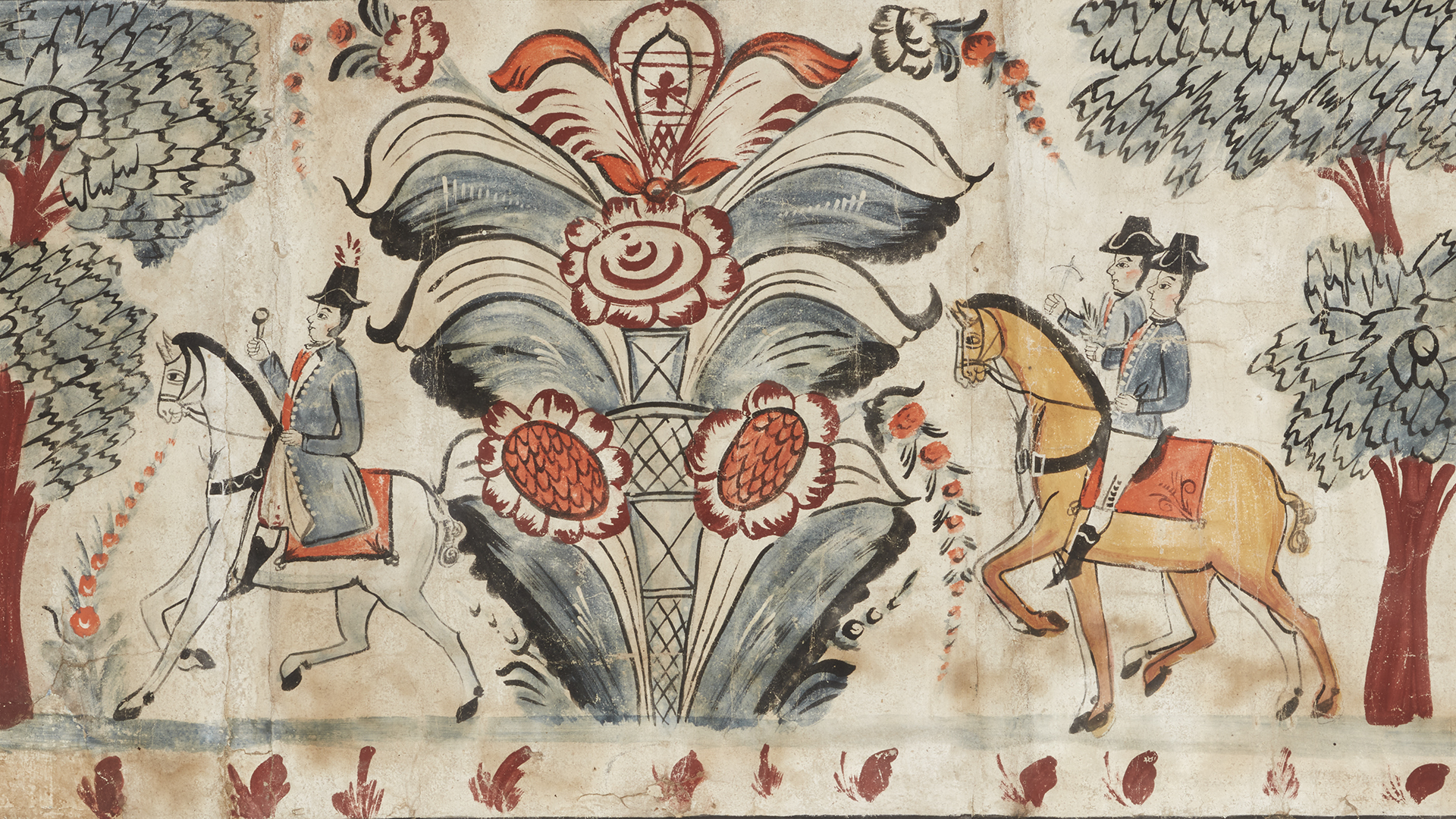
See the little red wooden horse on the left? It is typical of the Swedish province Dalarna (and nowadays a well-known Swedish souvenir found in almost any tourist shop all over the country). This little one lives on that shelf in my study all year round, but gets to stay for Christmas as well. Partly because of its size; but also as a reminder that its province of origin is also famous for old illustrations of Biblical stories painted in a very special style. Like the one below, of "the three wise men on their way to Bethlehem", by Back Olof Andersson (1797). He and others who made paintings like these knew the Biblical stories from listening to them in church, but had never been to those far-away places themselves, and pictured things very differently in their head...

Kurbitsmålning med tre män på hästar och en stor blomma i mitten.

...Which may in turn serve as a reminder that how we in our time picture things from the past may perhaps not always be all correct either... ;-) 

Friday, 15 April 2022

Easter Greetings from the Past


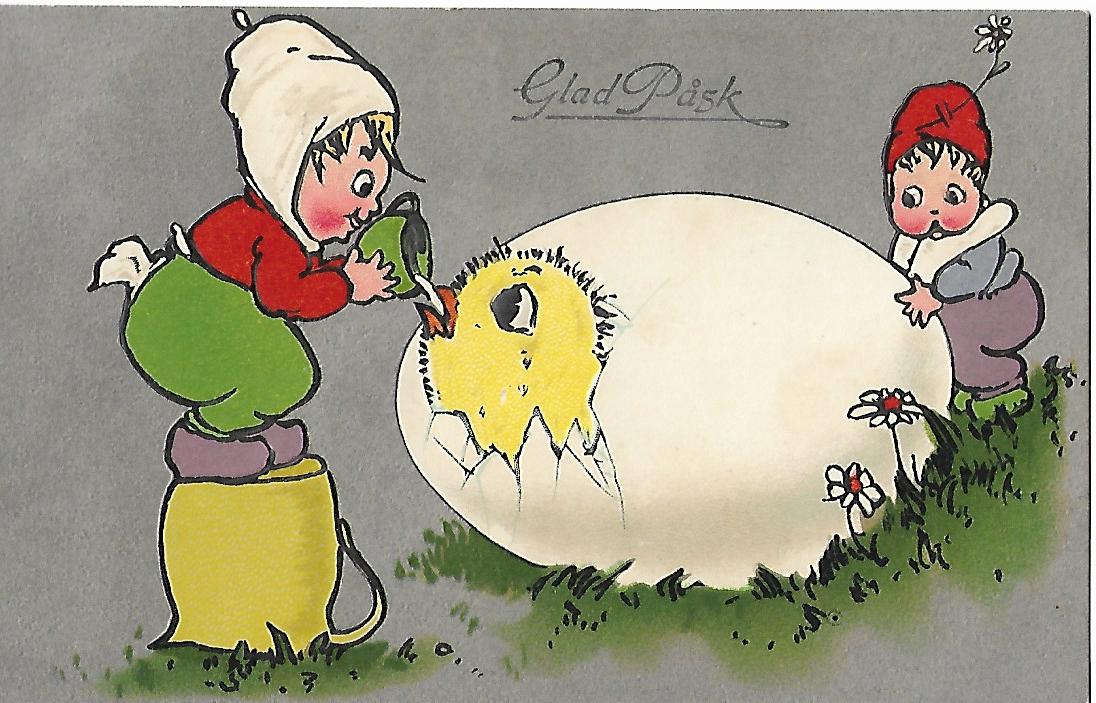
These Easter cards, copied from my great-uncle Gustaf's postcard collection, are all from around 1916-17. In my Greetings from the Past blog you'll find the same cards one by one, together with the messages written on the back (pretty standard "Happy Easter" greetings, most of them). 

Then I started to also play around with them in Picasa3, putting them together two and two in collages - and decided to share those here.

And if anyone is wondering what witches have to do with Easter, here is the background:

In Sweden and Finland, there were old superstitions about witches flying on their brooms to Blockula (Blåkulla) on the Thursday before Easter (Maundy Thursday / Skärtorsdagen), to meet with the Devil. When this was no longer taken too seriously, children would dress up as witches or old ladies (or old men) and go door to door distributing Easter greetings, and receiving treats in return - rather similar to British/ American Halloween traditions. There also used to be fires and fireworks on Easter Eve (originally to keep witches or evil spirits away). 

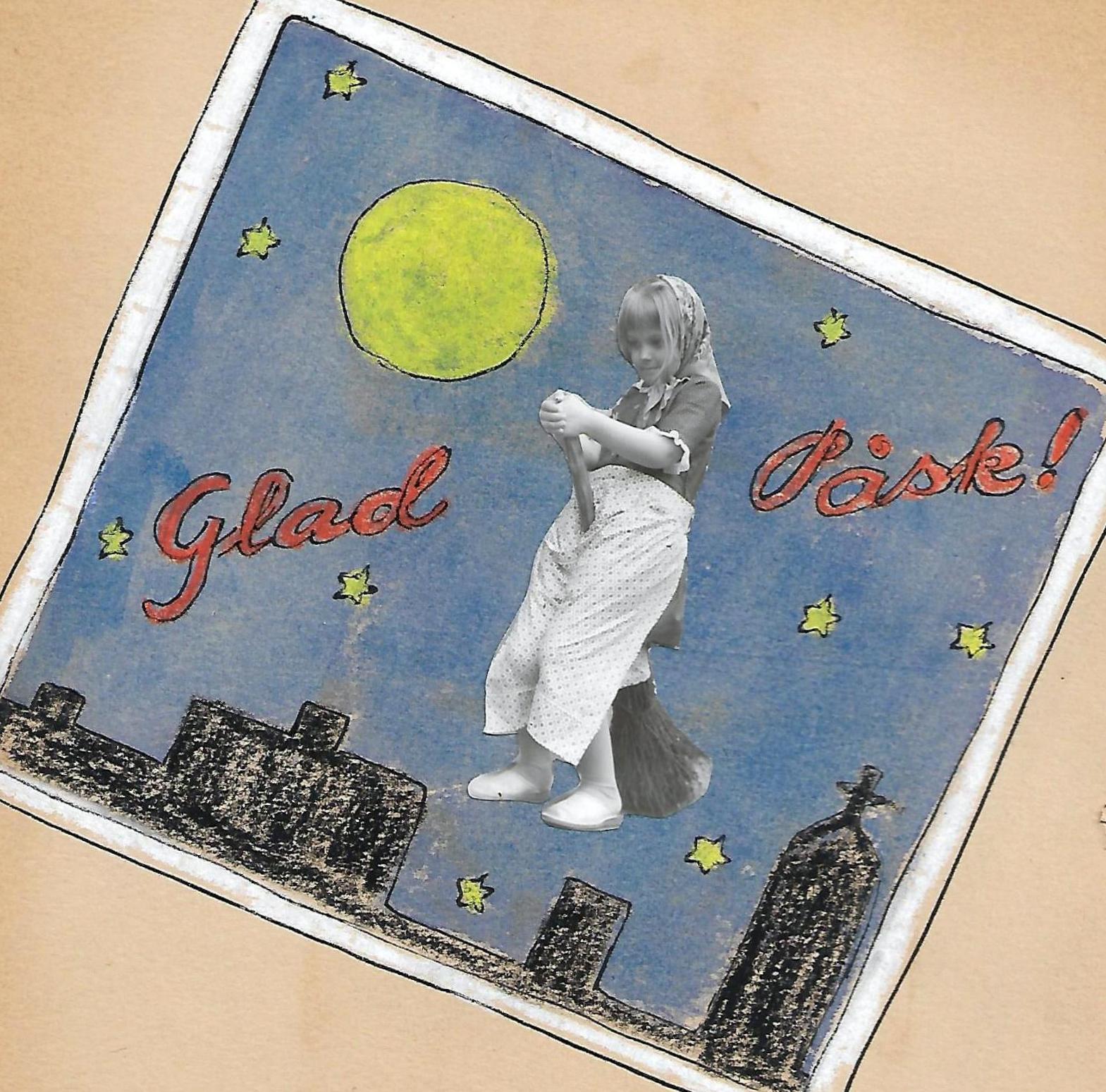
Back in my childhood (not quite 100 years ago - but 60!), visiting my grandmother at Easter, I'd sometimes dress up as a Witch as well. Or at least I did once! 

Photo by my dad or granddad; background drawing by my mum:

(If you think you've seen this before, you're probably right.)

On Easter Eve, after dark, my dad also used to set off a few fireworks in my grandparents' large garden. Traditions change, however, and nowadays, around here, bonfires are more common on Walpurgis night (30th April), and fireworks on New Year's Eve. I also don't usually see children dressed up as Easter witches now - except sometimes when the city has arranged a special Easter parade in the town square in the afternoon of Easter Eve.

I can't remember dressing up for Easter at home in the village where I lived with my parents - but that might be because we usually spent the Easter weekend with my grandparents. I do remember making "Easter drawings" at home though, and dropping those anonymously in the postboxes at friends' houses. (I had some playmates and classmates living along the same street.) I probably also received some. Those Easter drawings were always folded as triangles - no envelopes needed.

Wednesday, 8 December 2021

Gingerbread Season


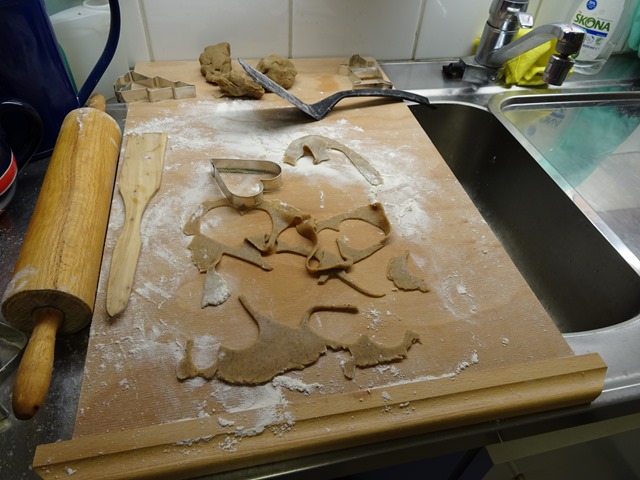
Yesterday was a good day for staying in and baking some Christmas gingerbread biscuits! (I'd prepared the dough in my food processor the day before.)

Do you bake these for Christmas? My recipe is one I came up with back in my youth, I think it was a mix between my mum's recipe and one from my first cookery book. Mum used to have ginger, cinnamon and clove in hers. In mine, I also have cardamom. (I love cardamom...)

There have been years in my life when I've not felt up to this kind of baking because of problems with neck-shoulder-arm. I'm happy I've been able to pick up the tradition again in more recent years. I've adjusted my recipe to only a third of the original, though. (In the past, I also used to have more friends over to share the calories...)

Friday, 13 December 2019

December 13 - Friday - St Lucy's Day


From Lund Cathedral (Skåne, Sweden)

On 13th December here in Scandiavia we celebrate Lucia or St. Lucy's Day; a festival of light which in the past coincided with the Winter Solstice.

Lucia is celebrated in both private and public contexts. In most towns in Sweden, an official Lucia with a number of maids are elected at the beginning of December. They then spend 2-3 weeks visiting public places like hospitals and nursing homes, singing traditional Lucia songs and Christmas carols. Churches and schools and workplaces etc often have their own Lucia celebrations on the 13th of December as well.

 Lucia
Classic Lucia illustration by Jenny Nyström (1854-1946)
(God Jul = Merry Christmas)

St Lucy was a 3rd century martyr in Rome. According to legend she brought food and aid to persecuted Christians hiding in the catacombs, wearing a candle-lit wreath to light her way and leaving her hands free to carry as much food as possible. Nowadays she brings coffee and saffron buns and ginger biscuits - early in the morning while it is still dark.

(If you write Lucia into the search box on top of my blog, it will bring up more Lucia posts of mine from years gone by.)

Friday, 3 May 2019

Greeting Spring on April 30th

In Sweden, 30th April, Valborgsmässoafton (Walpurgis Night) - marks the arrival of spring, and is traditionally celebrated with bonfires, choral singing, and (in some places) students' carnival parades.

This year, we had an absolutely lovely day for spring celebrations - even if capricious Nature then chose to start the month of May with a backlash to cold showers again (even including frost and snow today, brrr!)


Today, through my window...
Yep, the white stuff is snow!!

But on Tuesday, we were still in a magic spell of early summer...

I went into town in the afternoon to a music school violin orchestra concert in the old church. After that, a stroll around town and in the park; and an ice cream enjoyed on a park bench in the sunshine. And then another session of music + traditional spring songs sung acappella by a men's choir in the square.

Photos taken with my phone:


I also recorded one of the songs sung by the choir. I was hoping to be able to upload the video here too but that did not go as planned... (Maybe I have to do it via YouTube. I'll give it a try another day.)


 SkyWatch Friday 


Sunday, 28 April 2019

From My Photo Album, 45 Years Ago

Meike, Librarian of the blog From My Mental Library, has posted a few times about the Hornblowers of Ripon, Yorkshire. This always rings a bell with me (or blows a horn, perhaps?), because I do recall that once upon a time, on some family holiday trip in Britain back in the 1970s, we did visit a city with a horn blower. I may even have checked my photo albums about it before - but as I could not remember now if I ever actually got round to that (or just thought about it), I decided to do a proper job of it this time, and check again - and post about it if I found it. 

So, "for the record" (and for Meike and her horn blowing friends):
I have once seen (and heard) the Hornblower of  Ripon; and it was on 27th June 1974, at 9 p.m.


The text on the Town Hall says
Except Ye Lord Keep Ye Cittie Ye Wakeman Waketh In Vain


The horn blowing tradition in Ripon is said to go all the way back to 886, when king Alfred the Great decided to grant a Royal Charter to the settlement there. A watchman was appointed to patrol the settlement from dusk till dawn; and to sound the horn at the four corners of the market cross each evening at 9pm to let the people know that the watch was set. And the tradition is said to have been kept up ever since - i.e. over 1100 years.

In Meike's recent post (linked to above), you can read about the first female Hornblower, appointed in 2017!

---

Linking to Sepia Saturday 467
which happens to include the inspiration prompt "men standing like statues"...

Sepia Saturday


Monday, 22 April 2019

Easter Eve Parade

At Noon on Easter Saturday, there was a sort of parade for young children (and parents) in the city, ending at the Easter Tree in the main square, where there were also some singing and dancing games around the tree - and then some candy for the children at the end (Easter Eggs, I suppose! although I did not stick around to watch that part).


This may look like some kind of strange religious worship of the Tree... But it's just an old singing game involving imitating certain movements (connected with everyday tasks - although some of them feel kind of outdated now by modern standard... like washing clothes by hand...). 

 
I looked up the game to check its origin and found that it's actually originally British, and then called "Here we go round a mulberry bush". I think in Swedish we use a slightly different melody, and we say "juniper bush" - but on this occasion, they had replaced it with "Easter tree"!  

In old traditions here, Easter Eve was a night to watch out for witches and other evil forces at work... (being the night before Christ rose from the dead). From that has also sprung traditions to light bonfires and fireworks at night to keep evil away; and (more playfully) for children to dress up as witches. No doubt the traditions still vary throughout our oblong country. But they also change with time. In my childhood, and in this part of Sweden, bonfires and fireworks were still common at Easter. From early childhood, I remember dressing up as Easter witch at my paternal grandparents' house, and dad also lighted a few fireworks in their garden at night. Nowadays, the big fireworks night is New Year's Eve, and bonfire night is Walpurgis Night (April 30th). But you may still see a few little witches - and other strange creatures! - around at Easter... 


Have to say this chicken (leading the dance games) looked a lot scarier to me than the cute little witches that could also be spotted here and there in the crowd...


Sunday, 9 December 2018

Gingerbread

2018-12 pepparkakor

A Swedish Wiki article informs me that the history of gingerbread may go as far back as to around 1700 B.C. (!) in Mesopotamia – i.e. long before the first Christmas. The same article also says that Roman soldiers used to carry them as provision, because they kept well and did not get mouldy. In Sweden, ginger biscuits were probably “imported” from Germany back in the 1300s. (Swedish: pepparkakor / German: Pfefferkuchen,  because the original recipes had pepper in them.) Recipes began to spread here via cookery-books in the 1700s; and in the 1800s they came to be associated especially with Christmas.

During my lifetime, home made ginger biscuits have always been part of the Advent/Christmas traditions, both in my own family and with a lot of friends. I think I started baking my own the same year I moved into my first flat that had an oven. (The first year away from home I lived in a small student’s flat without a proper kitchen.) There were a number of years in between when neck/arm problems stopped me from baking; but a few years ago I decided to try it again, but now with smaller batches.

This year’s bake proved to be somewhat of a challenge - again - probably because I forgot to add the treacle when I made the dough… (It’s in the recipe and I did take the bottle down from the cupboard before I started, but…)  As a result, the dough got a bit too dry and crumbly, and the biscuits definitely not my best batch ever. I also had to take a long break to rest between my “workout” sessions at the baking board! But hey, the biscuits didn’t break, and less sugar = healthier, right??

Do you make gingerbread biscuits/cookies – and if so, what spices do you use? My mum’s were different from those made by her mother (who died when I was only six years old, but taste is a rather strong bearer of memories!). And mine in turn are a bit different from my mum’s. I recall my grandma’s gingerbread as having a stronger taste of ginger and being of a lighter colour than mum’s. Mum had ginger, cinnamon and clove in hers. I too have those three but also cardamom in mine.

I may have told the story before, but reading about the Roman soldiers above (keeping gingerbread as provision) reminds me: When clearing out my parents’ house, I found some left-over gingerbread biscuits in a jar in a kitchen cupboard. Not sure now how long after mum’s death this was, if in the same year or later (she died in May 2009 and we didn’t sell the house until 2014; but I probably went through the kitchen cupboards a few times in between.) Anyway, the biscuits were still hard and with a strong spicy smell, awaking memories of Christmases past... I didn’t eat them but took a few home with me and kept in a small tin jar. I never ate them, just opened the jar every now and then to smell them. I think I actually kept them for a another few years before finally throwing them away. But even then I suspect they would probably still have been okay to eat!


Thursday, 7 December 2017

An Indoors Thursday in December

2017-12 pepparkakor

Stormy and rainy outside today… I’ve been mostly ignoring the weather, though - staying in, and making gingerbread biscuits/cookies…

DSC02502

DSC02506

Back in my working years (in a previous life century) I often used to take a day off this time of year to bake for Christmas. Then followed a lot of years when, because of my neck/arm pains, I had to avoid all recipes involving manual kneading and tucking of dough, and lifting of heavy baking-plates.  I think it wasn’t until last year that I had a go at making my own gingerbread biscuits again. But then I managed to successfully adjust my recipe for a smaller batch; and so I decided to try it again this year. Feeling quite pleased with myself at the end of the day. There’s really nothing like the smell of freshly baked bread/cake/biscuits to cheer up a rainy winter day! ; )

DSC02492


Through My Lens

Saturday, 2 December 2017

Postcards for the Weekend: Special Deliveries

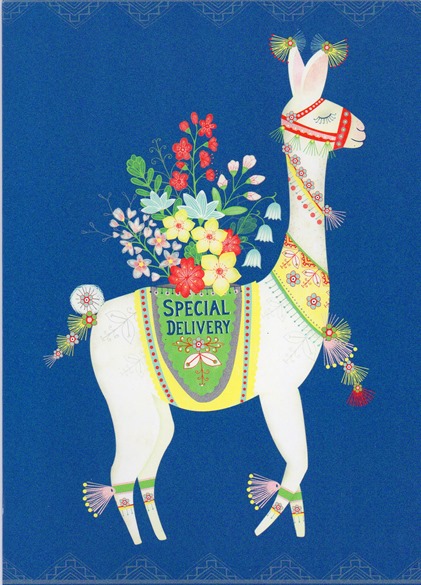
Maria’s generous theme for this week is “Anything You Wish”, which suits me to a tee, as some cards landing on my doormat this week were reminders of holiday traditions in other countries – from American Thanksgiving, to Dutch “Sinterklaas”.

171121-171127-2 from Ginny 1725

A llama came trotting from Ginny in the U.S. with a ‘special delivery’ and note of thanks.

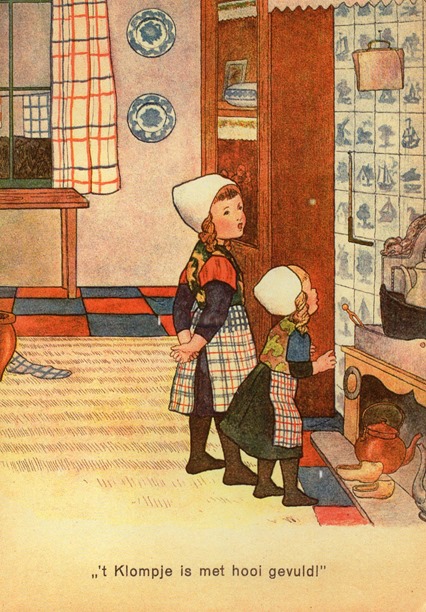
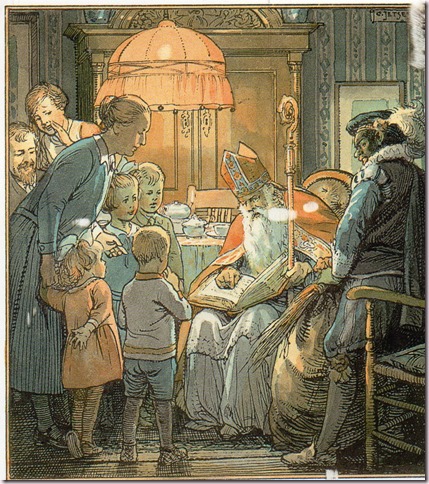
And from Jarina in the NL came a couple of cards to do with the Dutch tradition of celebrating the arrival of St Nicholas already in mid November (See Wikipedia article: Sinterklaas), leading up to gift-giving celebrations on 5th/6th December (St Nicholas Eve/Day) rather than on Christmas Eve (the 24th, as in Sweden) or Christmas Day (as in Britain or the U.S.).

Well –  I always did have a sneaking suspicion that it must be stressful for Santa/Tomten to make it all happen in just one night, all over the earth... So quite relieved, really (for his sake) to learn that evidently, he’s always been sensible enough to spread the traditions out a bit.

From what I now understand, he comes by steam boat from Spain to the Netherlands. Then he goes around that neighbourhood of Europe on horseback. I’m not sure how he then prefers to travel up to the North Pole to collect his flying reindeer… (Here in southern Sweden, he often comes on foot!) But I guess if he’s managed before, he’ll probably pull it off it this year as well.

Any information you may have on the topic may be given in comments below!

171123-171127-1 from Jarina 0067

In the Netherlands, they leave hay for Santa’s horse in a shoe by the fireplace.

171123-171127-2A from Jarina 0068

And here Sinterklaas is checking the famous Book, to see all you said and did over the past year. (Possibly, he now just uses Facebook instead. What do you think?)

171120 Christmas card from Karen

I also received the first Christmas card, from a penpal in England who is always early with hers. With all those other red traditional uniforms in London, I guess Santa would blend in rather discreetly if he needed to do some extra shopping on his way up north…


Now for the next couple of weeks I’ll be pretty busy writing my own cards to get them sent off in time… Hm!


Weekend Linky Party:

Postcards for the Weekend 63: Anything You Wish

Friday, 5 May 2017

Postcards for the Weekend – Traditional Crafts

160329 RO-120653

Postcrossing card from Romania (RO-120653)
A 1st March tradition from Romania and Moldavia.
Giving this talisman to people is an old custom, and it is believed that the wearer will be strong and healthy for the year to come. It is also a symbol of the coming spring. [Wikipedia]

FI-2174953

Postcrossing card from Finland (FI-2174953)
National dress from middle Finland (Savo)

NL-2606813

Postcrossing card from the Netherlands
(NL-2606813)
Handpainted watercolour made by the sender (2014),
depicting the costume of Volendam.

RU-3060730

Postcrossing card from Russia (RU-3060730)
Russian nesting doll "Matryoshka”

Limmared VK_0002

A Swedish card that I bought some years ago at a glassworks museum in Limmared, Västergötland.
The glassworks was founded in 1740.

2017-068

A Swedish “Dalahäst” – Dalecarlian Horse.
Traditional carved, painted wooden horse from the Swedish province of Dalarna (Dalecarlia).
(A postcard that I sent to someone rather recently.)

Weekend Linky Party:

Postcards for the Weekend 36: Traditional Craft Work

Related Posts Plugin for WordPress, Blogger...