Showing posts with label fantasy. Show all posts

Monday, 15 April 2024

Eldoria, part 4: From Darkness to Light

My instructions to Copilot:
Please continue the story, starting from the end of the following summary: - The Wizard Alaric and the two fairies Thalia and Liora (descendant of Elara, and now guardian of Elara's magic toothbrush that was used in the past to defeat the monster Gargantooth) are exploring the castle of Eldoria. In the Vault of Virtues they found the Crystal of Coalescence, which according to Alaric "can amplify the power of the magic tooth-brush, but only a true descendant of Elara can wield it." They also found a scroll with a prophecy about "a time when Eldoria would face a darkness greater than Gargantooth, and only the combined strength of the wizard, the guardian fairies, and the Crystal of Coalescence could banish it forever." With the crystal's power now bound to Liora, they left the vault; the crystal secured and the prophecy etched in their hearts. -

Chapter 4 - The Shadows of Skotos *

* In Ancient Greek, “σκότος” (skótos) means darkness or gloom. It can refer to physical darkness, as well as metaphorical darkness like ignorance or deceit. The word has also been used in various forms in religious texts to denote moral darkness or the darkness of the netherworld.

As the trio emerged from the Vault of Virtues, the castle of Eldoria stood bathed in the golden hues of dusk. The Crystal of Coalescence, now bound to Liora, pulsed with a gentle light, its rhythm in sync with her heartbeat. Alaric, with his staff in hand, led Thalia and Liora through the winding corridors, the prophecy echoing in their minds. 


The Gathering Gloom


Night fell over Eldoria like a velvet cloak, and with it came a chill that seeped into the bones. The stars, usually a glittering tapestry above, were dimmed by an unseen force. Alaric's brow furrowed as he sensed the stirrings of dark magic. "The shadows of Skotos," he murmured, "the darkness the prophecy foretold."


Thalia, with her fairy sight, peered into the night. "The stars are hidden, not gone," she whispered. "We must find the source of this darkness and restore the light."


The Quest for Light

Liora clutched the crystal, feeling its power surge. "The Crystal of Coalescence," she said, "it can guide us to the darkness's heart."

Alaric nodded. "We must be swift. The longer the darkness lingers, the stronger it becomes." With a wave of his staff, a map of Eldoria materialized, glowing lines tracing a path to the forest of Fae'lyn, where the darkness seemed to originate.


The Forest of Fae'lyn


The forest of Fae'lyn was a place of ancient magic, where the trees whispered secrets and the air shimmered with enchantment. As they entered, the darkness grew palpable, a smothering blanket that threatened to extinguish their resolve.


Thalia's wings fluttered, scattering motes of light that pushed back the gloom. "We are not alone," she said, her voice barely above a whisper.
 

The Guardian of the Dark

From the shadows, a figure emerged, its form shifting and changing. "I am the Guardian of the Dark," it intoned, "and you shall not pass."

Alaric stepped forward, staff raised. "We seek only to banish the darkness, not to conquer it."

The Guardian's form solidified into that of an ancient tree, its branches creaking. "Then prove your worth," it challenged.


The Trial

The trial was one of wit, courage, and purity of heart. Riddles woven from the threads of time itself, creatures born of shadow and fear, and illusions that tested their very perception of reality.


With each challenge, the Crystal of Coalescence shone brighter, its light a beacon of hope. Liora's lineage, her connection to Elara, gave her the strength to wield the crystal's power, dispelling illusions and revealing truths.
 

The Heart of Darkness

At the heart of the forest, they found it—a vortex of shadow, the source of the darkness that threatened Eldoria. Alaric and Thalia stood by Liora as she raised the crystal high.

"By the light of Elara, we banish thee!" Liora declared. The crystal unleashed a torrent of light, piercing the vortex, shattering the darkness.

The Dawn of Hope

As the darkness dissipated, the stars reappeared, twinkling like diamonds on a canvas of night. The prophecy had been fulfilled, but the journey of our heroes was far from over. For now, Eldoria was safe, but the world beyond its borders beckoned, and with it, new adventures.

And so, with the dawn came hope, and with hope, the promise of tomorrow.

THE END
(...for now...)

All images created by feeding quotes from the text back to Microsoft Designer or Image Creator.

Sunday, 14 April 2024

Eldoria, part 3 - The Vault of Virtues

My instructions to Copilot:
Please continue the story with another chapter, starting from the end of following summary and quote: “Having listened to the wizard Alaric’s tale about how the fairy Elara had used her magic tooth-brush in the past to defeat the monster Gargantooth, the two fairies Liora (descendant of Elara) and Thalia felt a renewed sense of purpose. They knew that their journey was about more than just adventure; it was a quest to uphold the legacy of those who had protected Eldoria before them. - And so, with the tooth gleaming from its place in the castle's window, and the path ahead bathed in the stained glass’s kaleidoscopic light, they stepped forward, ready to face whatever mysteries awaited them in the heart of the castle. The kingdom of Eldoria, once buzzing with anticipation, now held its breath, waiting for the new chapter of its history to be written by the brave wizard and the two fairies, guardians of its past and hope for its future.”

The Echoes of Eldoria

As the last echoes of Alaric's tale faded into the hushed corridors of the castle, Liora and Thalia, with the wizard by their side, ventured deeper into the heart of Eldoria. The castle, a living testament to the ages, whispered secrets through its ancient stones, and the air was thick with the magic of yore.


The Enchanted Hallway


The trio entered a long, narrow hallway, its walls lined with portraits of Eldoria's past rulers, their eyes seeming to follow the fairies' every move. At the hallway's end stood a grand door, carved with runes that shimmered under Thalia's touch. "These are the ancient scripts of protection," Alaric murmured, his voice barely above a whisper. "They guard the entrance to the Vault of Virtues, where the most sacred relics of our kingdom are kept."

With a determined nod, Liora reached out, her fingers tracing the glowing symbols. The door responded, the runes dancing like fireflies before settling into a new pattern. The door creaked open, revealing a chamber bathed in a soft, golden light. 


The Vault of Virtues


Inside the vault, treasures of untold value gleamed, but it was the Crystal of Coalescence* that caught their eyes—a gem said to harmonize the energies of Eldoria. "This crystal," Alaric explained, "can amplify the power of the magic tooth-brush, but only a true descendant of Elara can wield it."

Liora, feeling the weight of her lineage, stepped forward. Her hand hovered over the crystal, and as her fingers made contact, a surge of energy coursed through the room. The crystal glowed brighter, its light enveloping her in an ethereal embrace.

*Coalescence = the joining or merging of elements to form one mass or whole. Some common synonyms of coalesce are amalgamate, blend, commingle, fuse, merge, mingle, and mix.


The Prophecy Revealed


As the light subsided, a scroll materialized before them, unfurling mid-air. Alaric caught it gently, his eyes widening as he read the ancient text. "It speaks of a prophecy," he said, his voice trembling with excitement. "A time when Eldoria would face a darkness greater than Gargantooth, and only the combined strength of the wizard, the guardian fairies, and the Crystal of Coalescence could banish it forever."

The revelation hung heavy in the air, a destiny foretold now resting on their shoulders. They knew what they had to do. With the crystal's power now bound to Liora, and Thalia's unwavering spirit, they were ready to face the coming storm.

Together, they turned to leave the vault, the crystal secured and the prophecy etched in their hearts. The kingdom of Eldoria, once silent in anticipation, now thrummed with a newfound energy, its fate intertwined with the courage of its guardians.

And so, the journey continued, not just a quest for adventure, but a mission to fulfill a destiny written in the stars, to protect the realm and ensure that the light of Eldoria would never fade. 

 * * * * * * *

Would you have been able to stop here, without pursuing it further? I could not; so the story will go on with one more chapter. Then I'll try to at least take a break from it for a while! ;-)  


Saturday, 13 April 2024

AI and the mysterious "Eldoria"


The readiness of Microsoft's Copilot and Designer to introduce me to the fantasy kingdom of Eldoria (cf my previous two posts) rather took me by surprise. It seemed like a whole fantasy world by that name already exsisted "out there" and was just waiting to be explored further - rather like a computer game.

Before going on, I decided to ask Google what they knew about Eldoria. Now I was in for another surprise, because even though I can't recall ever having come across it before, it seems that 'Eldoria' is all over the internet, in all kinds of confusing and contradictory versions... There are lots of books written about it, but by different authors. And there are computer games, and images, and YouTube video clips, and websites I'm not even sure exactly what they do (I'd probably have to create an account to find out). And also people wondering in various kinds of forums why 'chatGPT' always seems to lead to Eldoria whenever they try to create something in the fantasy genre... (Which was also what I had started to suspect myself.)

Still finding it hard to quite make sense of it all, I returned to Copilot and asked straight out:

Me: Is the Eldoria used by Copilot the same as other Eldorias on the web?

Copilot's answer:

The term “Eldoria” can refer to different concepts and creations across various platforms and media, and it’s not exclusive to any single use. The Eldoria I mentioned earlier, such as the one in Roblox or on World Anvil, are independent creations that share the name but are not necessarily related to each other or to any version that might be used by Copilot.

Each Eldoria has its own unique context and content, created by different individuals or groups for specific purposes, like gaming, storytelling, or worldbuilding. The common thread is the name “Eldoria,” which seems to evoke a sense of fantasy and adventure, but beyond that, they are distinct from one another.

If you’re asking whether there’s a specific “Eldoria” that Copilot uses as a reference or a base for responses, the answer is no. Copilot does not use a singular Eldoria but can provide information or create content based on the various interpretations of Eldoria available on the web, as long as it aligns with the guidelines and capabilities I have as an AI. 

Thanks, Copilot. Knowing that, I think I feel a bit better about continuing to explore a bit more...

(At least one more episode already prepared, and will be coming up soon. I'll just give my readers as well as myself time to digest the above for a bit first...) 

(PS. It was raining all day yesterday as well... LOL)


Friday, 12 April 2024

Eldoria, Chapter 2

Another dreary rainy day outside, and nothing special on my agenda; so why not continue exploring the mystical land of Eldoria, that Bing Copilot introduced me to yesterday...

Fellow blogger Sandra also encouraged me with the idea of in turn using quotes from the AI created story to create more images, and so on... So I decided to take my experiment a bit further, and see if I could get Copilot to continue the story where he left off yesterday, but also include answers to the things I thought he had ignored in the original image. So in the instructions I gave, I again included the same image, and repeated the last few paragraphs from yesterday, but also added what I expected the continuation to include:

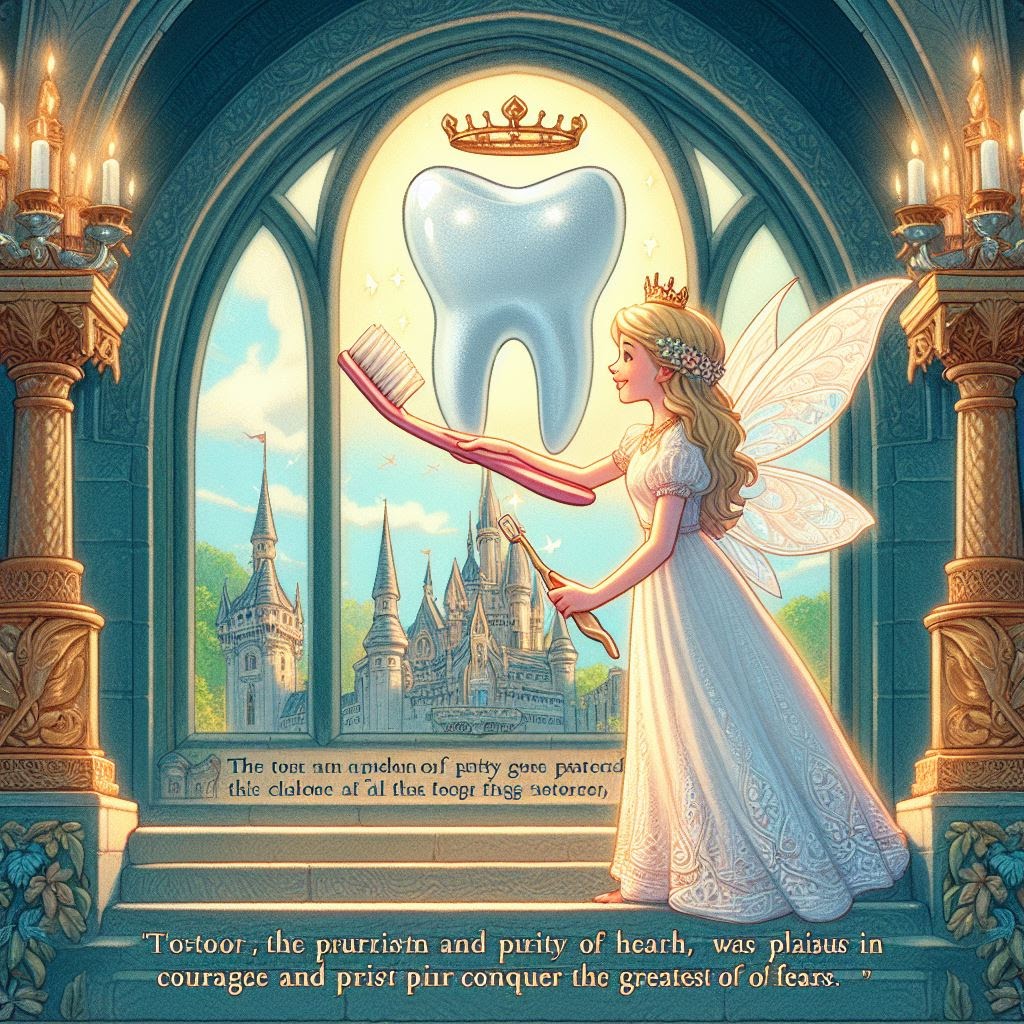
Me to Copilot: Please continue the story from the quote and image below. The continuation should include an explanation of why there is a big tooth in the window above the door to the castle, and why the fairy on the stairs to the castle is holding a tootbrush instead of a wand.

"The wizard Alaric whispered an incantation, and the keys glowed with an ethereal light. The door creaked open, revealing a world within that was both wondrous and strange. Lush green plants and vibrant mushrooms lined the path, leading them deeper into the castle’s heart. As they ventured forth, the stained glass windows above cast warm, colorful patterns on the stone floor, guiding their way. The air was filled with the scent of ancient spells and the promise of discovery. And so, Liora and Thalia embarked on their journey, their spirits high and their minds open to the endless possibilities that lay before them. The kingdom of Eldoria buzzed with anticipation..."


Copilot obliged, and produced the following tale - bits of which I then in turn used to ask Image Creator for further illustrations...

Chapter 2

As the trio delved deeper into the castle, the story of the tooth and the toothbrush began to unfold. Alaric, with a voice as deep as the castle’s foundations, recounted the tale:


"In the earliest days of Eldoria, when magic was young and untamed, a great beast roamed the land. This creature, known as the Gargantooth, was born from the earth’s hidden energies and the people’s collective fears. Its massive tooth, a relic of its power, was said to be indestructible and was the source of its strength.
The Gargantooth ravaged the kingdom, its presence a constant shadow over the land.


It was then that a fairy, unlike any other, emerged. Her name was Elara, and she wielded not a wand but an enchanted toothbrush, a gift from the wise witch of the western woods. With this toothbrush, Elara did what no spell or sword could—she cleansed the Gargantooth’s tooth, purifying it from within.


As the bristles of her enchanted brush swept over the tooth, the Gargantooth’s power waned, and it retreated into the depths of the earth, never to be seen again. The tooth, now a symbol of purity and protection, was placed in the highest window of the castle, a reminder to all that courage and purity of heart can conquer the greatest of fears.


Liora, the fairy you see on the steps, is a descendant of Elara. She holds the toothbrush, not as a weapon, but as a symbol of her lineage and her duty. Each day, she polishes the tooth, ensuring that its magic remains strong, safeguarding Eldoria from the darkness that once threatened its very existence."


With Alaric’s tale echoing in their ears, Liora and Thalia felt a renewed sense of purpose. They knew that their journey was about more than just adventure; it was a quest to uphold the legacy of those who had protected Eldoria before them.


And so, with the tooth gleaming above and the path ahead bathed in the stained glass’s kaleidoscopic light, they stepped forward, ready to face whatever mysteries awaited them in the heart of the castle. The kingdom of Eldoria, once buzzing with anticipation, now held its breath, waiting for the new chapter of its history to be written by the brave wizard and the two fairies, guardians of its past and hope for its future."


Monday, 18 February 2019

Audiobook Review: The House with a Clock in Its Walls

The House with a Clock in Its Walls
by John Bellairs

Unabridged Audiobook (4 hrs 33 min)
Narrated by George Guidall
(1973/2018)

This was an audiobook I bought (cheap) because I was intrigued by the title. I had never heard of the author before. When I look him up now, I find that he was an American author (1938-1991) who wrote quite a few ”gothic mystery novels for young adults”.

This one was written in 1973. Lewis, an orphan after his parents died in a car crash, comes to live with his Uncle Jonathan, whom he has never met before. He soon learns that Jonathan is a magician, and his next-door neighbor and friend, Mrs. Zimmermann, is also a witch. As the book title indicates, the story also involves a mystery clock, hidden somewhere within the walls of Jonathan's house, which was previously owned by an evil wizard.

While the book starts out as a rather innocent encounter with magic illusions, it grows a lot darker when Lewis seeks to impress a boy from school by trying to resurrect an anonymous dead person in the local cemetery at Halloween. This only succeeds ”sort of”, but with dire consequences... (Think gothic ghost story!)

Some review of the book that I read before I bought it introduced it as ”Before Harry Potter, there was Lewis Barnavelt”. Yes, there are a number of obvious (and classic) common ingredients, like an orphan child hero with certain flaws, weird old house, magic that runs in the family, ghosts and graveyards, good vs evil, one or more objects that must be found and destroyed to save the world etc. (I'd not be surprised to find it among Rowling's sources of inspiration.) But compared to the Potter world, the setting in this book is very narrow, with only a handful of important characters, and mostly make-it-up-as-you-go-along kind of magic – but also mixed with some dark stuff, which at Hogwarts would have been kept in the restricted section of the library. On the whole I found the story ”uneven”. 

There was a film based on the book made as late as in 2018. This seems to have got mixed reviews as well – ranging from entertaining to too scary (for a family movie) to plain boring. (And that's pretty much how I felt about the book, too...)


Sunday, 25 June 2017

What I listened to in April (Short Reviews)


Norse Mythology Audiobook

Norse Mythology

  • Written by: Neil Gaiman
  • Narrated by: Neil Gaiman
  • Length: 6 hrs and 29 mins 

Publisher's Summary

Neil Gaiman has long been inspired by ancient mythology in creating the fantastical realms of his fiction. Now he turns his attention back to the source, presenting a bravura rendition of the great northern tales. In Norse Mythology, Gaiman fashions primeval stories into a novelistic arc that begins with the genesis of the legendary nine worlds; delves into the exploits of the deities, dwarves, and giants; and culminates in Ragnarok, the twilight of the gods and the rebirth of a new time and people. Gaiman stays true to the myths while vividly reincarnating Odin, the highest of the high, wise, daring, and cunning; Thor, Odin's son, incredibly strong yet not the wisest of gods; and Loki, the son of a giant, a trickster and unsurpassable manipulator. From Gaiman's deft and witty prose emerge the gods with their fiercely competitive natures, their susceptibility to being duped and to duping others, and their tendency to let passion ignite their actions, making these long-ago myths breathe pungent life again.

- - -

I enjoyed listening to Gaiman's reconstruction of the stories from the old Norse mythology, performed by the author himself. Some of the characters and elements of the story/stories are more or less  familiar to me ever since childhood. I don't really remember how much we were introduced to them in my own school days back in the 1960s. In my memory, my main source of familiarity with them is an old school reader that belonged to my paternal grandfather back in his school years - printed in 1910. I still have that book: 


 Around ten years ago, I refreshed my memory a bit by reading a modern translation and interpretation of some of the old texts (and their context) by a Scandinavian expert on old runes (Lars Magnar Enoksen, Fornnordisk Mytologi).

I think Gaiman's book is worth reading if you like fantasy, fairy tale and mythology; not least because so many other authors through the centuries have borrowed a lot from these old tales. However, Gaiman pretty much keeps to reviving the stories as such, as readable fantasy for our time, rather than going into analysis.

- - -

Alice in Wonderland Audiobook 

Alice in Wonderland

  • Written by: Lewis Carroll
  • Narrated by: B.J. Harrison
  • Length: 2 hrs and 42 mins 

Publisher's Summary

Alice begins her fantastic journey by following an unprecedented White Rabbit with a pocket watch. While in the topsy turvy world of Wonderland, Alice takes advice from a caterpillar and attends a mad tea party. She meets the Mock Turtle and the Gryphon, and participates in a ludicrous courtroom scene. Each character has its own charming voice, as B. J. Harrison delivers one of his most whimsical performances.

 Through the Looking Glass Audiobook

Through the Looking Glass

  • Written by: Lewis Carroll
  • Narrated by: B.J. Harrison
  • Length: 3 hrs and 5 mins 
Publisher's Summary

Alice sees the other side of the Looking Glass, and enters another world of whimsical enchantment. She encounters argumentative chessmen, Jabberwocky monsters, Tweedledum and Tweedledee, and some very insolent flowers. Carroll continues the development of his Wonderland in this second, and many feel richer, adventure of Alice.
 
I listened to these two Alice books in close connection with also buying the second Alice film with Johnny Depp (Alice Through the Looking Glass). Before I watched that one, I also watched the first Alice in Wonderland film again. If you know the classic books, you should be aware that the first film mixes a lot of elements from both books. And knowing that, you must also be prepared that the second film sort of takes things "even further"...
 
I'm not sure when I first read Alice in childhood. I only have a very vague memory of reading it, or trying to read it, but at that age (whenever that was) finding it too weird. I don't think I ever had my own copy of it in Swedish, so if I did read it, it was probably borrowed from the library. What I do know is that I did not really begin to appreciate it until I read it in English many years later (well into my twenties, at least). I do suspect that a lot of the wordplay (which is really so very essential in that book) probably gets lost in translation. 
 
My copy of The Complete Illustrated Works of Lewis Carroll is from 1985. I have returned to Alice a few times since then.

I also have to say I like the first Burton/Depp Alice film (2010), even if it makes its own mix of the story. I think I may have to watch the Looking Glass one again to quite make up my mind about that. (But I do think it may be worth while to do so.)

Actually, I think that's probably why I decided to also listen to the originals as audio books in between. (The audios were cheap buys.) Alice is probably best read in print though - again because of all the wordplay that you may want to stop and ponder about. (But also the original illustrations.)
 
 - - -
 
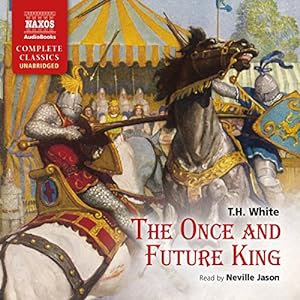
The Once and Future King Audiobook 
 

The Once and Future King

  • Written by: T. H. White
  • Narrated by: Neville Jason
  • Length: 33 hrs and 3 mins 

Publisher's Summary

The complete "box set" of T. H. White's epic fantasy novel of the Arthurian legend. The novel is made up of five parts: "The Sword in the Stone", "The Witch in the Wood", "The Ill-Made Knight", "The Candle in the Wind", and "The Book of Merlyn".

Merlyn instructs the Wart (Arthur) and his brother, Sir Kay, in the ways of the world. One of them will need it: the king has died, leaving no heir, and a rightful one must be found by pulling a sword from an anvil resting on a stone. In the second and third parts of the novel, Arthur has become king and the kingdom is threatened from the north. In the final two books, the ageing king faces his greatest challenge, when his own son threatens to overthrow him. In "The Book of Merlyn", Arthur's tutor Merlyn reappears and teaches him that, even in the face of apparent ruin, there is hope.

What the Critics Say

  • AudioFile Earphones Award, 2009
"For those who have never read these five books, prepare to be surprised by their adultness, their laugh-out-loud humor and tongue-in-cheek commentary on modern life; for those who know them well, prepare to be delighted with Neville Jason's transcendent reading. The lovely timbre of his narrative voice, his rhythmic, easy pacing and host of individual characterizations transport listeners into White's weird and wonderful otherworld as quickly as Alice slipped through the looking glass. This long production is so entrancing that one wishes it would never end." (AudioFile)
 
I have not read this series before. (The books were originally published between 1938 and 1977). I did buy them (or the first four) condensed in a paperback some years ago (before Kindle), but as the print is very small, and as my eyesight began to deteriorate in that respect, I never got round to reading it. So took my chance when I found it on audio book sale now. Neville Jason's narration is good, and just as the "critics" review above says, I was also rather surprised at (and amused by) the author's tounge-in-cheek humour in many passages - like, every now and then sort of stepping out of time-period he's writing about, and comparing it to later periods in history, which might be more familiar to his readers. He also puts a different focus and twist on the love story between Lancelot and Guinevere than I recall from other versions of the Arthurian tales that I have read.

However, I think I still feel that among the Arthurian books I read/listened to recently, The Mists of Avalon made even more of an impression. But even though they both go into depth with the story, they are rather different in style from each other.

The first version of the Arthurian tales to enthrall me in the past, by the way, was Mary Stewart's Merlin trilogy from the 1970s: The Crystal Cave (1970), The Hollow Hills (1973) and The Last Enchantment (1979). I read the first two back in my upper teens, probably in Swedish translation the first time. (My English paperback copy of the Crystal Cave was printed in 1977.) I have reread those more than once over the years.


Saturday, 24 June 2017

Postcards for the Weekend - Iconic Person


Gandalf
from J.R.R. Tolkien's "The Lord of the Rings"

Postcrossing card from Russia, April 2017
(Illustration by Andrei Arinouchkine)


Hagrid
from J.K. Rowling's "Harry Potter"
(played by actor Robbie Coltrane in the films)
Postcrossing card from Japan, May 2017
 

Searching only among this year's Postcrossing cards, I come up with these two iconic fictional characters who have become famous all over the world and loved by people of all ages - even though neither of them is even the main character in the story they appear in.


Monday, 27 February 2017

Finished At Last

Rise of the Dragons (Kings and Sorcerers--Book 1) by [Rice, Morgan]El Despertar de los Dragones (Reyes y Hechiceros-Libro 1) (Spanish Edition) by [Rice, Morgan]

Rise of the Dragons by Morgan Rice*

At last I’ve reached the end of this book that’s taken me 8 months to read – on average, one chapter per week. But then I’ve read each chapter twice: first in Spanish (which I only started learning in May last year), and then the same chapter in English to pick up what I might have missed, before going on to the next chapter. As I’ve never read a book in that way before, I suppose one might call it a novel experience (haha)

I did of course miss details here and there, and my poor knowledge of grammar also occasionally made me “reverse” meanings (like who hit whom with what). On the whole, I usually got the gist of the story from the Spanish (and feel rather proud of myself for that). But at the same time I doubt I’d have made it all the way without having the English version as well.

It probably wasn’t a bad book for the purpose. Even in Spanish I noticed a lot of repetition – like the exact same phrases often used over and over again. When learning a new language, that can be useful. From a strictly literary point of view, however, it tends to get a bit… well… repetitious!

I think I can imagine the book perhaps appealing more to younger readers. Not too young though, as some of the scenes involve a lot of violence.

The setting is kind of unspecified medieval fantasy (as in no modern transportation or technology; but with trolls and giants and dragons).

The main character is Kyra, a young girl on the verge of becoming a woman, but dreaming of becoming a warrior like her father. Her mother died when Kyra was young; and she grew up being the only girl in a fort full of boys and men.

When Kyra comes of age (15), her father wants to wed her off to the lord of the region (to save her from a fate possibly worse, as according to his own laws the lord has the “right” to take whoever he wants anyway). Kyra refuses, and in the midst of midwinter, she wanders off alone into the woods, where she encounters a wounded dragon — a meeting that turns out important, but also raises a lot of questions. Kyra also learns that there is some mystery connected to her own background and birth, that no one wants to tell her about.

There are a couple of more storylines involving other characters (and further threats to the kingdom) as well. All the storylines do not come together within the span of this book – but I was prepared for that, as I knew from start that it was the first in a series.

Alas (or perhaps somewhat to my relief!) I can’t say that I feel immediately tempted to jump straight on to the next book to find out what happens. On the other hand, I do suspect that “images” from this book may stay in my mind for a quite a while; and not all to do with the double language experience. Because if a book without illustrations, and read primarily in Spanish (a language I’d only just started learning when I began reading the book) can leave me with lingering visual impressions of scenery and events (rather as if I’d seen it on film) – then surely some of the credit for that must go to the author.

Trying to consider the story from a “young adult” reader’s perspective (easier said than done at my age), I think I would say that its main strength is probably a young female heroine fighting her own way in a world of men – and seeking/finding her inner strength along the way. Apart from that I find the characters rather  shallow and “either black or white” – and in my opinion (as already indicated above) too much focus on physical fighting and killing. (But to be fair, I suppose the same thing can too often be said about the real world as well!)

* PS. Morgan Rice, it seems, is a highly productive writer of  self-published fantasy novels.

Sunday, 15 February 2015

Book Review: At the Back of the North Wind (1871)

George MacDonald 1860s.jpg

George MacDonald (1824-1905) was a Scottish author, poet and preacher; a mentor of fellow writer Lewis Carroll, and some of his works of fantasy have become classics in the genre, and inspired other authors, like C.S. Lewis.


At the Back of the North Wind was first serialized in the children's magazine Good Words for the Young in 1868, and published in book form in 1871.

I have a Swedish translation printed in 1990; but realised recently that I hardly remembered the story at all, so decided to reread it in English.

At the centre of the story is a small boy named Diamond, son of a poor coachman – who also has a horse with the same name. The boy Diamond sleeps in the loft over the stable (right over the stall of Diamond the horse); and in the wall by his bed there is a knothole, through which the North Wind blows. In Diamond’s dreams (or is it more than just dreams?), the North Wind takes the shape of a beautiful woman with long hair – sometimes small like a fairy, sometimes huge and awe-inspiring like a mighty storm – sweeping Diamond away on nightly adventures, both in his own town and to a distant land, “at the back of the north wind”.

Diamond is at the same time a mystery and a joy to the people around him. Kind and helpful and trusting, and making friends whereever he goes - but also going his own ways, showing both practical initiative, and surprising people by fanciful ideas, rhymes and dreams.  He’s naive in some ways, and yet also wise and philosphical far beyond his age. Some think he’s not quite right in his head; but he never takes offense.

It is not a book easy to categorize. Take the basic setting (including poor little boy) from a novel by Charles Dickens; put it down a rabbit hole (as in Alice in Wonderland - 1865); add a good portion of classic fairy tale and fable; mix in some serious theodicy questions and answers; and serve with a sprinkle of nursery rhymes on top. It’s very much up to the reader’s taste to decide what to make of it!

I suspect that one reason I did not remember much about it (from 25 years ago) may well be that I found it somewhat “difficult”. The story also makes a lot of deviations along the way (like long nursery rhymes and whole fairy tales told within the story).

This time I also tried listening to some parts as audio, but when I got to the end I found I needed to go back and reread some parts (that I probably missed by drifting off into dreams of my own!). Some of the details deserve more attention than one might think at first. For example, there are plenty of parallells between the ‘reality’ vs. stories and dreams within the book.

It’s not a book I’d recommend as a must-read for everyone, but if (like me) you are interested in classic children’s literature and fantasy, you might find that you recognise themes and ideas also used by other authors within those genres.

- - -

PS. I’ve blogged about MacDonald before, back in 2012 – a post entitled Once Upon A Time.

- - -

Linking to Musing Mondays

Sunday, 8 June 2014

Gollum and the Sparrows

2014-06-08 Ramnaparken, Norrby

In a park I’m not sure I ever visited before, I came across this Gollum-like creature today. It’s called Viskarn ~ “The Whisperer” ~ and was created by by Swedish artist Christian Partos in 1999.

CIMG0149-001


I just had to check the dates when I got home. Please note: The Lord of the Rings’ promotional trailer was first released on 27 April 2000…

Well, we always wanted to be Avantgarde here in Borås!

By the way, the river flowing through town is called Viskan (without the ‘r’). Was the sculpture given its name on purpose or by coincidence? I have no idea!

Anyway, the birds seem unconcerned about all that stuff. They regard the fountain as their bath tub, and never mind the creepy creature watching them.

CIMG0153-001

CIMG0152-001

I think these must be Eurasian Tree Sparrows (Passer Montanus) (Swedish: pilfink) rather than common sparrows, because of their brown heads.

Friday, 10 January 2014

Book Review: The Book of Nonsense

The Book of Nonsense (Sacred Books 1)
by David Michael Slater
****

The Book of Nonsense is the first book in a Young Adults fantasy series by David Michael Slater. (It was temporarily free for Kindle when I downloaded it.)

Daphna and Dex Wax are twins, but very different from each other. Daphna takes after their father, Milton, who is a book scout; i.e. he travels the world in search of rare books, and sells them on to others with the same interest. Dex does not share their interest in books. (We learn more about the reasons further into the story.)

On the day before the twins’ 13th birthday, Milton comes home from one of his journeys, bringing a very old and tattered book. Daphna meets him full of enthusiasm: a new Antiquarian Book Center (ABC) has recently opened in town. It is a really amazing place, and she is eager to show it to her father.

The ABC is run by a very old man, with a young and weird-looking assistant. When Milton goes to meet the shop-owner, Daphna follows him (to the middle of the labyrinth of bookshelves in the shop). The conversation between her father and the shopowner that she overhears puzzles her, as it does not at all follow the usual routine when her father tries to sell books…

From the very first page, we get right into the action in this story, and the fast pace is kept up all the way. I found it to be a page-turner, hard to put down. However, it is a story with a limited set of characters. There are vivid descriptions of details, but the background remains hazy, and the action takes place within just a couple of days (around the twins’ 13th birthday). Within that time, they do also learn some things about the past, though – and I suppose further explanations might follow in the sequels.

My spontanteous feeling at the end was that this book could have been made into a really good stand-alone fantasy novel. The fact that it is the first in a series makes me hesitate. I’m not sure if I’m really interested enough to invest (time and money) in the next one as well (and the next, and the next, and…) I’ll let the decision rest for a while. Time will tell whether the story will linger enough in my mind to tempt me to follow Daphna and Dex on more adventures. (There are three more books in the series published so far, I think.)

If I had fantasty-loving young teens in the family, though, I think I might consider the Sacred Books one of the better series of its kind to recommend (based on the first one).

Thursday, 23 May 2013

BTT: Childhood vs. Adult

btt buttonfrom Deb at http://btt2.wordpress.com/

Have your reading habits changed since you were a child? (I mean, I’m assuming you have less time to read now, but …) Did you devour and absorb books when you were 10 and only just lightly read them now? Did you re-read frequently as a child but now only read new books? How about types of books? Do you find yourself still attracted to the kinds of books you read when you were a kid?

It’s a long time since I was a child… :)

I’d say my reading habits have gone through changes both back and forth and across since I first learned to read (over 50 years ago). I did devour books when I was about 10, I think I borrowed piles from the library almost every week back then – like The Famous Five and Nancy Drew and Anne of Green Gables and Cherry Ames (and similar kinds of books by Swedish authors). I’m sure I read many of those more than once – especially the few I owned myself, but also some borrowed repeatedly from the library.

It still happens that I return to classics like Anne of Green Gables, while other childhood favourites were gradually replaced from my teens onwards by more grown-up mysteries and detective stories and romance novels and whatever.

I still like to go back and reread certain favourites from time to time – and that includes all genres I think (and also to watch favourite TV-series over again on DVD). Stories are much like friends in that way… Spending time with old friends is comfortable, but it’s also stimulating and challenging to meet new ones. (And sometimes you discover new things about old friends, too!)

Thinking back, one thing that strikes me is that there were certain children’s books that I did not read in childhood but which I came to love later on – like the Narnia books by C.S. Lewis. (First published 1950-1956 but I did not come across them until in the late 1970’s when I was in my 20’s.) I don’t recall reading a lot of fantasy and fairy tale kind of books back in my childhood. One reason may be that my mum (who no doubt influenced much of my early reading) was never much into that kind of stories. She preferred books closer to reality. Another reason may be “the spirit of the era”… Correct me if I’m wrong, but my impression is that the fantasy genre was not very big in the 1960s. Especially not the witches and wizards kind. I think there was a bit of a revival for authors like Jules Verne and H.G. Wells though. (After all, the 1960’s was – among other things - the decade of moon landings… More science fiction, and turning towards the future rather than seeking roots in old legend.)

There were some children’s books that stretched imagination without being neither magical nor scientific though, like The Borrowers by Mary Norton (the first four written between 1952-1961), which are among my favourites that I’ve kept returning to. A couple of years ago I read them for the first time in English (in my childhood it was of course the Swedish translations that I had), all in one volume together with the fifth book written much later (1982).

Out of curiosity I just checked the bibliography of Astrid Lindgren, probably the internationally best know Swedish author of children’s books, some fantasy and some not. In the 1960’s she too kept to down-to-earth kind of stories, with the border-line exception of two sequels to Karlsson-on-the-Roof (1st book 1955, the sequels 1962 and 1968).

I guess I made up for a certain lack of magic in my 1960’s childhood by becoming a Harry Potter fan in my late 40’s (onwards)… :D

I still like to read a mix of genres, and a mix of old and new. Since I bought my Kindle last autumn I’ve been exploring both some classic children’s books (for example some by Edith Nesbit) and various authors of contemporary fiction for adults that I’d never heard of before.

Saturday, 9 February 2013

More Magic (Psammead Trilogy 2+3)

The Phoenix and the Carpet
by Edith Nesbit
(1904)

1st edition

1st edition cover (Wikipedia)

Sequel to Five Children and It.
In this book the children are left alone (in the care of servants) quite a lot in their London home, while their parents are off on various business and trips. Their mother buys a second hand carpet for the nursery. The children find an egg rolled into it, which hatches in the fire into a talking Phoenix. Much the same sort of adventures as in the first book continue to happen, as the carpet can also grant wishes. The Psammead (sand-fairy) from the first book does not appear “in person” in this one, but is referred to.

I found this book as entertaining as the first one, and also interesting from historical point of view (London in the early 20th century). Among the places the children visit is the Phoenix Fire Insurance Company (which the Phoenix assumes to be his Temple).

Fire is a theme throughout the book… There is of course a fireplace in the nursery – no central heating back in those days! I have to admit that had I had children, and read this book with them, I might have got a bit paranoid about locking away all matches and lighters safely out of reach… But since no children, I don’t need to dwell too much on that aspect :)

Quotes:

‘The people who decide what the weather is to be, and put its orders down for it in the newspapers every morning, said afterwards that it was the hottest day there had been for years. They had ordered it to be “warmer—some showers,” and warmer it certainly was. In fact it was so busy being warmer that it had no time to attend to the order about showers, so there weren’t any.

It is very difficult to remember things in the dark, unless you have matches with you, and then of course it is quite different, even if you don’t strike one.

The sound of a bell is quite different, somehow, when there is someone inside the house who hears it. I can’t tell you why this is—but so it is.

Robert stuck steadily to his point. One great point about Robert is the steadiness with which he can stick.

‘I do know a lot of French,’ whispered Robert, indignantly; ‘but it’s all about the pencil of the gardener’s son and the penknife of the baker’s niece---nothing that anyone ever wants to say.’

‘You should always speak politely to people when you want them to do things, and especially when it’s going away that you want them to do.’

Don’t trample on its feelings just because it’s only a carpet.

That is one of the most annoying things about stories, you cannot tell all the different parts of them at the same time.

‘But it’s true,’ said Jane. ‘Of course it is, but it’s not true enough for grown-up people to believe it,’ said Anthea.


The Story of the Amulet
by Edith Nesbit
(1906)

TheStoryOfTheAmulet.jpg

1st Edition cover (Wikipedia)

The Story of the Amulet is the third book in the Psammead trilogy.

In this book the four older children are separated from their parents and their baby brother for a longer period of time. Father is off abroad working, and Mother, with the baby, is away on Madeira recuperating after an illness.  The children are staying with an old nurse who has a boarding house near the British Museum. While the children are staying she only has one other boarder, an old learned man who is an Egyptologist.

The children miss the country house where they spent last summer (and where they first found the Psammead, a sandfairy who can grant wishes). However, they decide to make the most of all the things there are to see in London for free (or almost).

They start by exploring some markets and shops in the neighbourhood, and there they happen to find first the Psammead in a pet shop, and then (half) an old Egyptian amulet. The Psammead can no longer grant wishes to the children (only to other people), but the amulet turns out to to be new gateway to adventures for them, as through it they can travel to other times and places where the amulet has at some point been. The Psammead goes with them, and the learned Egyptologist gentleman gets involved as well (but he of course keeps thinking that he is only dreaming…) Besides Egypt they also visit ancient Babylonia, Atlantis and the Phoenician city of Tyre. They also meet Julius Ceasar before he invades Britain, and even manage a trip into a utopian future.

Comparing this book to the first and second in the series, there is a definite development towards more and more complex fantasy-adventures.

It got obvious to me during the reading of this last book especially, how strongly influenced by this story that C.S. Lewis must have been when writing his Chronicles of Narnia. And I’ll dare a bet that J.K. Rowling read it as well!

Edith Nesbit dedicated The Story of the Amulet to Dr Wallis Budge, an English Egyptologist, Orientalist and philologist who worked for the Department of Egyptian and Assyrian Antiquities in the British Museum – “as a small token of gratitude for his unfailing kindness and help in the making of it”.

Quotes:

‘This isn’t tomorrow!’ ‘Is it still yesterday?’ asked Jane. ‘No, it’s today. The same as it’s always been. It wouldn’t do to go mixing up the present and the Past, and cutting bits out of one to fit into the other.’ ‘Then all that adventure took no time at all?’ ‘You can call it that if you  like,’ said the Psammead. ‘It took none of the modern time, anyhow.’

‘The present’s the present and the past’s the past.’ ‘Not always,’ said Cyril. ‘When we were in the Past the present was the future.’

The Past’s as full of different times as—as the sea is of sand.


Besides enjoying the humour and language and story-telling in this trilogy I also found it interesting from historical and literary history perspective. I’m a little surprised that I’ve not heard more about it; but checking up on it, it seems only some of Edith Nesbit’s books were translated into Swedish at all, and I’m not sure this particular trilogy was available in Swedish in my childhood.

I’ll continue to read some more of her collected works in between other books. I have not yet decided which one to read next.

Saturday, 26 January 2013

Easily Amused

I just read a post by the MadSnapper Sandra, entitled: How to make a post out of Anything/ Everything/ NOTHING … And I wrote in my comment that I was just thinking of doing a post with the title Easily Amused. So now I have to.

Actually I was just going to do that anyway, so all that remains for me now is to try to explain. Which is the hard part, or I would already have done it by now.

The thing is, I’m still giggling on and off at a chapter in a children’s book that I read two days ago. At the age of 57, I’m not sure if that’s something one ought to admit.

But I just checked, and found that after all, Edith Nesbit (1858-1924) was 44 when she wrote it (or at least she was when it was published, in 1902). The book is Five Children and It, and the chapter that had me particularly amused was Ch 9, entitled Grown Up.

If I knew that you (dear readers) had all read the book, the explaining part might not be so difficult. Those who haven’t might need a little bit of background, though.

While playing in a gravel pit near their home, five children—two boys, two girls, and their baby brother, nicknamed “the Lamb”—uncover a rather grumpy sand-fairy known as the Psammead, who has the ability to grant wishes. (Only one per day and they only last for a day, at sunset all goes back to normal.)

Getting your wishes granted turns out more trouble than one might think,  as the Psammead tends to act on the very first “I wish” of the day that happens to come to mind for any of the children, whether they mean it as an actual wish or not.

One day, for example, one of them happens to wish that their (sometimes rather troublesome) little baby brother would “grow up”… Which, of course, he immediately does; and instead of being their baby brother, he becomes their grown up brother for a day. But as his brothers and sisters know he will suddenly turn back to a baby at sunset, they still can’t let him go off on his own. So they have to watch out for him, even though now it’s he who does not want their company.

That is not really the funny part though.
And neither is this, in itself:

The grown-up Lamb frowned. 'My dear Anthea,' he said, 'how often am I to tell you that my name is Hilary or St Maur or Devereux? - any of my baptismal names are free to my little brothers and
sisters, but NOT "Lamb" …

What set me giggling, and still does, is how the author treats that name-issue throughout the rest of the chapter (these are just some examples):

The grown-up Lamb (or Hilary, as I suppose one must now call him) fixed his pump and blew up the tyre.

Quietly but persistently the miserable four took it in turns to try to persuade the Lamb (or St Maur) to spend the rest of the day in the woods.

'He doesn't know who he is. He's something very different from what you think he is.'
'What do you mean?' asked the lady not unnaturally, while Devereux (as I must term the grown-up Lamb) tried vainly to push Anthea away.

[Anthea] caught the Lamb (I suppose I ought to say
Hilary) by the arm.

'Who are these very dirty children?' she asked the grown-up Lamb (sometimes called St Maur in these pages).

Again and again the Lamb (Devereux, I mean) had tried to stop Jane's eloquence, but…

If anyone would like to read the whole chapter you can find it here (Click on Part 3 and scroll down to Ch. 9).

And then you may shake your head at me, if you wish. (Just remember to be careful what you wish for.)


Related Posts Plugin for WordPress, Blogger...