Thursday, 29 January 2015

Book Review – Orlando: A Biography

Orlando: A Biography
by Virginia Woolf (1928)

I decided to read this classic because of the personal name Orlando, as well as references to Woolf's novel, being used by Robert Galbraith alias J.K. Rowling in The Silkworm. In The Silkworm, Orlando is a female character – but although a grown woman, in some ways more like a child. In my own head however the name is (or was) a male one (think Orlando Bloom). So that for a start called for some research (especially since I know from before that Rowling tends to put a lot of meaning into the choice of names for her characters).

The first brief introduction to Woolf's novel that I found only informed me that …

Orlando tells the story of an individual named Orlando, born as a biological male in England during the reign of Elizabeth I. Orlando lives for more than 300 years and, at around 30 years of age, mysteriously changes biological sex to female.”

At the same time though, it’s also described as being

“a semi-biographical novel based in part on the life of Woolf's presumed lover Vita Sackville-West”

Together, this sounded rather strange to me… but tickled my curiosity to have a closer look at. And to satisfy such urges is easy enough these days, when a Kindle edition of Woolf's Complete Works  can be downloaded in an instant at less than $4!

I turned to the first chapter of Orlando and started reading; and soon found myself hooked. Actually Orlando's journey through the time and shifting cultures of three centuries, and even the transition from one sex to another, turned out to make a lot more sense than the summary quoted above.

While the plot does have some strange time twists, I found those to be written with a twinkle in the eye; and I did not have any trouble picking up the subtext as the experience of a Reader and a Writer; as well as growing from Child to Woman (with some confusion perhaps in the middle) - and at the same time conveying quite a clever analysis of the shifting position of women (and not least women writers) in the context of society during those three centuries (from the Elizabethan age until 1928); and also the general explosion of literature during the same period:

While she had been sitting in Hyde Park the bookseller had delivered her order, and the house was crammed – there were parcels slipping down the staircase – with the whole of Victorian literature done up in grey paper and neatly tied with string. She carried as many of these packets as she could to her room, ordered footmen to bring the others, and, rapidly cutting innumerable strings, was soon surrounded by innumerable volumes. Accustomed to the little litteratures of the sixteenth, seventeenth, and eighteenth centuries, Orlando was appalled by the consequences of her order. --- Orlando’s reverence for print had a tough job set before it …

I have to confess that this quote reminds me a lot of my own experience with the Kindle… (LOL)

Anyway – I really enjoyed this book, and feel that I also learned quite a lot from it.  (For one thing – just to relate to my latest read – it did make me understand better how Rowling weaved the theme of gender issues into The Silkworm in various ways, both in the case plot and in the relationships of the background characters.)

Tuesday, 27 January 2015

Teaser Tuesday (Jan 27)

TeaserTuesdays2014e

• Grab your current read
• Open to a random page
• Share two (2) “teaser” sentences from somewhere on that page

“She found it absolutely necessary to speak to him instantly. She did not care in the least what nonsense it might make, or what dislocation it might inflict on the narrative.”

Virginia Woolf – Orlando: A Biography

I’m enjoying this classic a lot more than I thought I would. Not very far to go to finish it now (35 minutes or so, my Kindle suggests).

(Because I’m reading on Kindle, I pick the teaser from just about where I am in the book, rather than open it to a ‘random’ page.)

Sunday, 25 January 2015

The Art of Keeping the Balance

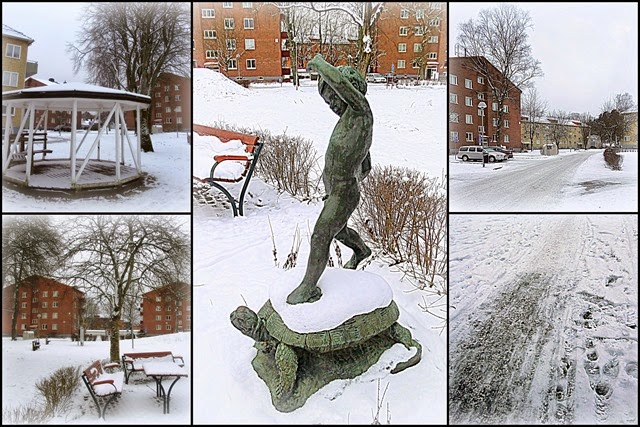
2015-01-23 snow

The weather situation around here has been pretty much “stuck” lately: Temperatures shifting a few deegres up or down around freezing point – with snow one day, rain and thaw the next; then freezing again and dangerously slippery; more snow on top, and then back to rain and thaw and ice again etc…  

The collage was made from photos taken a couple of days ago near where I live.

The balancing position of the boy on the turtle is not unlike the art of walking on icy streets…

… which means I haven’t been going very far!

Linking to Mosaic Monday @ Lavender Cottage

Tuesday, 20 January 2015

Teaser Tuesday

TeaserTuesdays2014e

• Grab your current read
• Open to a random page
• Share two (2) “teaser” sentences from somewhere on that page

. . .

   ‘It was dark and she was two door doors down, so what she actually saw was…?’
  
‘Silhouette of a tall figure in a cloak, carrying a holdall.’

Robert Galbraith (J.K. Rowling) – The Silkworm

. . .

One day he was adding a line or two with enormous labour to ‘The Oak Tree, A Poem’, when a shadow crossed the tail of his eye. It was no shadow, he soon saw, but the figure of a very tall lady in riding hood and mantle crossing the quadrangle on which his room looked out.”

Virginia Woolf – Orlando: A Biography

. . .

… As I mentioned yesterday, I’m reading Orlando because it was referred to in The Silkworm (recently finished) …

Monday, 19 January 2015

Book Review: The Silkworm

The Silkworm (published in 2014) is the second crime fiction novel written by J.K. Rowling under the pseudonym of Robert Galbraith, and ‘starring’ private investigator Cormoran Strike and his (female) assistant Robin Ellacott. (The first was The Cuckoo’s Calling, 2013 –  link goes to my review from back then).

The Silkworm is set in the publishing world. A middle-aged woman, Leonora, comes to Strike’s office to ask for help to track down her husband, Owen Quine; a semi-famous writer, who seems to have disappeared. He’s been known to go off on his own before, but this time he’s been away for ten days without getting in touch. The family situation is getting difficult (they also have a daughter with some problems) and his wife wants him found. Leonora does not seem overly worried that something might have happened to him – she assumes he has probably just gone off on some kind of writer’s retreat, but she does not know where, and she has not been able to find out herself, as her phone calls to people in the publishing world who might know have not been returned. She also mentions, more or less in passing, that there have been some recent unpleasant incidents adding to her distress – someone putting dog excrements through their letter box at night, a strange woman turning up on their doorstep leaving a mysterious message, and another woman following her in the street… Strike decides to take on the case.

One problem with this novel, from reader’s point of view, is that during the first 1/3 or so of the novel, nothing much seems to “happen”; except for Strike arduously limping around a dreary wintry London (he lost half a leg in the Afghan war), meeting various people in the publishing world, and slowly finding out bits and pieces about Quine - all mixed with bits and pieces from Strike’s and Robin’s personal lives, where various developments are also going on. As for the gossip that Strike is gathering from Quine’s acquaintances, it is hard to make out how much is true or false, and what might be important or not.

Then Strike manages to get hold of one of Owen’s previously published novels, and also a secret copy of his last, yet unpublished work. The book proves to have a tedious and gruesome plot full of allegorical names and gory details of a kind I always find it rather tempting to speed-read rather than pay much attention to… In retrospect, though, I must advise readers of this particular book not to skip too hastily through all that, if you want a chance of understanding the rest.

Another piece of advise is not to skip the quotes at the beginning of each chapter. If you take the trouble to look up some of those authors and titles (if you don’t know them already), there are clues there too. (The connecting theme will also be spelled out later within the context of the story, though.)

As I was aware from before, Rowling is also in the habit of hiding clues and hints in the names of characters. In this novel, we’re dealing with double and sometimes even triple layers of that kind, as she lets her fictional writers within the book use similar tactics; although in the more obviously allegorical way, like it was often done back in the 1600s.

At the end, I have to confess I still had difficulties piecing everything together. Even though I did guess at some things, I also realised I had “missed” a lot. But when I went back and reread the first 1/3 of the book again – and especially the parts that I was tempted to just skim the first time – of course the details were there, hidden in all the chitter-chatter that at the time did not seem all that important…

Because of the complexity of this story, with its double or triple plots, and references to old plays using the same techniques – I think this is one novel that could benefit (just like a play) from having a list of characters at the beginning (or at the end). I did not check out the Wikipedia article until after I’d finished the book – to avoid spoilers – but it seems this idea occurred to the authors of that page as well (because they did compile such a list of characters).

I still find myself hesitating when it comes to rating the total reading experience on a 1-5 scale – my problem being that I can’t really say I ‘love’ the whole story as such; but at the same time I do recognise that it is cleverly constructed and did give me a lot to think about. I guess as a compromise I’ll give it four stars.

* * * *

MusingMondays5

As an extra teaser I might add that one result of reading The Silkworm was that I ended up buying the complete works of Virginia Woolf for Kindle (as the complete works did not cost much more than buying one single novel separately!) and am currently reading Woolf’s Orlando: A biography – finding it not only enlightning in relation to The Silkworm, but also (so far = two chapters) a lot more enjoyable than I expected from first looking up the Wikipedia summary…

THIS WEEK’S RANDOM QUESTION:
How many books, approximately, do you think you have in your personal collection?

I’d say about 700 printed + about 500 e-books + perhaps 100 audio…? (having to admit myself surprised at the number of e-books, even if most of them are free classics!)

Related Posts Plugin for WordPress, Blogger...