Showing posts with label classics. Show all posts

Saturday, 29 January 2022

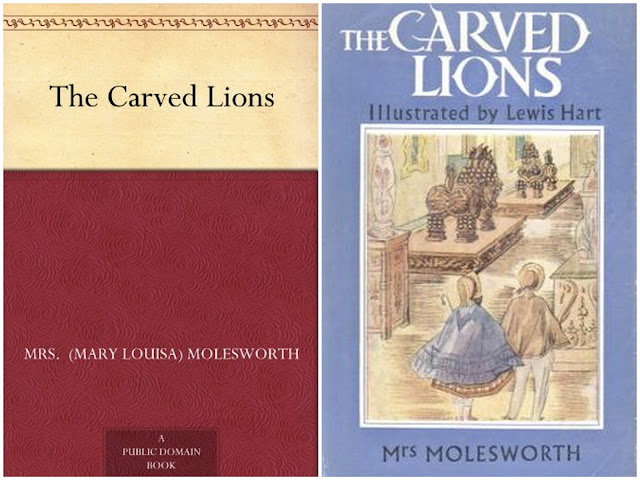
The Carved Lions (Book Review)


The Carved Lions
by Mrs. (Mary Louisa) Molesworth - 1895
(79 pages)

Recently, Meike (Librarian) blogged about another title - Christmas Tree Land - by Mrs Molesworth (1839-1921) - a classic English author of children's stories, previously unknown to me. Meike's review of that book made me wonder a bit if maybe her works could have inspired C.S. Lewis when writing his Narnia series. So I looked up some more of her titles, among which I found The Carved Lions (in the public domain and free for Kindle). Having read it, I'm still wondering... If C.S. Lewis did read this book in his childhood (and he could have - he was born in 1898), I suspect he may have felt (like I do) that there were elements in it that could have made it a good fantasy book - but weren't (in that respect) quite used to their full potential...

Reading it 125+ years after it was written, and as an adult, to me the the story feels "uneven". The narrator in the book is an old woman looking back on her childhood (so the events meant to have occurred in the early 19th century rather than towards the end of the same century). Geraldine and her brother were quite happy living with their parents in a village. They were not exactly poor, but also not rich. ("It never entered my head that there was anything to be ashamed of in living in a small house and having only two servants.") Her brother (a couple of years older) went to school but Geraldine was home-schooled by her mother. Sometimes she wished she could go to school to.

One of both children's favourite things was to accompany their mother when she had some errands in the village. At the entrance of one shop there were two huge carved lions, looking very life-like. Geraldine and her brother used to imagine (or pretend) that these could come alive, and carry them off on adventures.

"A little way in from the front entrance to the shop --- stood a pair of huge lions carved in very dark, almost black, wood. They were nearly, if not quite, as large as life ---"

Then suddenly there is a big change in their lives. The children's father gets a job abroad (which it seems he has to take for financial reasons). His wife has to go with him; but for reasons to do with climate and whatever, they can't take the children. 

So the children are both sent to boarding schools - Geraldine to one for girls in the same village where they lived. Apart from her parents going away, she is actually kind of looking forward to this - hoping to make some new friends.  But the school turns out a huge disappointment to her. And here the story goes off into lengthy descriptions of the school, the teachers, and her growing unhappiness. Until one day she runs away, in the hope of finding someone who might be able to help her get news of her parents. It turns out she doesn't remember the streets of the village as well as she thought, so she gets lost - but eventually ends up at the shop with the lions, so exhausted that she falls asleep next to one of those. 

And then the lions come alive, and wonderful things start happening... Or... do they?
(Spoiler alert for the next paragraph)

Next thing, Geraldine wakes up, and finds herself in a strange bed, surrounded by faces she does not know. It turns out the owner of the shop found her sleeping next to the lion, and had taken her in. She has contracted a bad cold from being out in bad weather, and has to stay in bed for a while. However, it all turns out for the best. Various misunderstandings get sorted out, and she ends up not having to go back to the school, but gets to stay with nice people (including a girl her own age who also likes the carved lions); until eventually her parents come back from abroad.

The book is quite short (79 pages). It has been called the author's masterpiece by some; but as I already said, to me it feels uneven, with some parts of it full of details, but others only very hastily sketched, and the fantasy parts not allowed to mix too much with "reality".

The idea of the carved lions coming alive and letting the children ride on their backs to a faraway place still reminds me of Narnia, though. ;-) 

(Remains to be seen how well I'll remember the book in a couple of years or so - that's usually the best way to tell the quality of a story in the long run!)


Wednesday, 3 April 2019

Book Review: The Stranger Diaries


The Stranger Diaries by Elly Griffiths (2019)

Read on Kindle + Audible (10 h 30 min)

Elly Griffiths is perhaps best known as the author of the Ruth Galloway series – and mentioned by me a number of times before, including a recent review of The Stone Circle, the 11th book in that series. (Ruth is a forensic archaeologist with a tendency to get mixed up in mysterious modern-day deaths as well as really ancient ones.)

The Stranger Diaries, however, is a stand-alone, 'modern Gothic' mystery novel.

Clare Cassidy is an English teacher specializing in classic Gothic literature (like the books by Wilkie Collins, author of The Moonstone and The Woman in White, and several others). Clare is especially interested in another writer of the same genre and time-period, with a connection to the school where she is teaching – 'R.M. Holland' (a fictional character). She is doing research to write a book about him. But when a colleague and close friend of Clare's is found dead, horror fiction and 'real life' begin to get mixed up in a way that is just as spooky and scary as the classics. In particular, certain clues seem to point to a short story by Holland entitled The Stranger. (This 'story within the story', written in the classic Gothic horror story tradition, is frequently quoted and referred to, but also included in its entirety in the novel.)

The narrative perspective shifts throughout the book (reminding of Wilkie Collins). In between excerpts from The Stranger, we get to take part of events as shared by Clare (who also keeps a diary), her teenage daughter Georgie (who, as so many teenagers, leads a kind of double life – not sharing every detail of her 'private' life with her mum any more...), and the female police detective investigating the murder of Clare's colleague. (This may sound confusing, but it's made clear by chapter headings who is the narrator in each chapter. And in the audio book, four different actors are reading the different parts.)

I enjoyed the book, and as I had it on both Kindle and Audible, it kept me in its spell the whole weekend (allowing me to shift between reading with my eyes vs ears)... I guess it helped a bit that I did read both The Moonstone and The Woman in White only a few years ago – even if I don't recall every detail, at least I get the references to the genre as such. Shakespeare's Macbeth and The Tempest are also referred to. I read Macbeth back in my university days (English lit), but I don't think I ever read The Tempest. I may have to remedy that! (On the other hand, it's easy nowadays to find summaries of old classics online.)

I was also reminded of Edgar Allan Poe, but I don't think his name was actually mentioned anywhere within the book.

Anyway, I do tend to like books that make me want to read, reread and research other books as well (and old classics in particular)... 

Tuesday, 31 January 2017

Reread in January: Middlemarch

During January, I re-read another classic novel from my English literature university courses (30+ years ago): Middlemarch by George Eliot. It’s one of my favourite classics, and I have reread it a few times. It’s a long one: My old Penguin paperback has around 900 pages. This time I listened to it as audio book from Audible, read by Juliet Stevenson: 35 hours 40 minutes.’'

Middlemarch Audiobook Middlemarch 1.jpg

Subtitled A Study of Provincial Life, the novel was first published in eight instalments (volumes) during 1871–2. It is set in the fictitious town of Middlemarch during 1829–32 (there are references in it to some real historical events), and weaves together several intersecting stories and quite a large cast of characters. Important themes include the status of women and the nature of marriage; but also for example religion, politics, science and education.

The main character Dorothea Brooke is 17 when the story begins, and is living with her sister Celia under the guardianship of their uncle, Mr Brooke. Dorothea is a very pious young woman; interested both in literature, and in welfare projects like the renovation of housing for tenant farmers. She is courted by Sir James Chettam, a young man close to her own age, but is instead (to everyone else’s consternation) attracted to the Reverend Edward Casaubon, much older than herself. Dorothea accepts his proposal of marriage, in the hope of being able to help to him in his research and writing of a book on spiritual matters.  Chettam instead turns his attention to her younger sister Celia.

On Casaubon’s and Dorothea’s honeymoon in Italy, they encounter Casaubon’s younger cousin Will Ladislaw, an artist. Dorothea and Will come to spend quite a lot of time together, as Casaubon is busy with his research project. Will is attracted to Dorothea, but they remain just friends. Later on, with Casaubon’s health declining, and Will coming to stay in Middlemarch and renewing the acquaintance there, Casaubon gets jealous – which causes problems…

One of the other main characters is a young doctor, Tertius Lydgate, new in Middlemarch and trying to make a career for himself. At the same time he is more idealistic than prosperous. He gets married to a young girl of good education but no money (but with high expectations of her husband’s career);  and manages to get himself into serious financial trouble. 

Several more characters and minor story lines are involved too.

As I already said, it is one of my favourite English classics. I think it probably gives a good idea of small town life in England in that period of time; and not least, perhaps, for young women like the character Dorothea, who wanted something more out of life than just a conventional marriage and family life.

George Eliot’s real name was Mary Ann Evans (1819-1880). (I have to confess I keep forgetting her real name…) Better known by her pen name,  she was an English novelist, poet, journalist, translator and one of the leading writers of the Victorian era. She used a male pen name, she said, to ensure that her works would be taken seriously. Female authors were published under their own names during Eliot's life, but she wanted to escape the stereotype of women writing only lighthearted romances.

She did not have much formal education as a  young girl, but as her father was the manager of a big estate, she was allowed access to the library there; and obviously made good use of that. Her frequent visits to the estate also allowed her to compare the wealth of the local landowner with the lives of much poorer people. Her mother died when Mary Ann was 16, and when she was 21 she and her father moved to a place near Coventry, where she kept house for him until he died (when she was 30); but also made new friends who became important for her later writing career.

After her father’s death she went abroad for a while, and then moved to London and became assistant manager of a literary magazine, The Westminster Review. She met the philosopher and critic George Henry Lewes. They lived together from 1854 until his death in 1878. (He was already married when they met and unable to get a divorce.) In May 1880, she legally married John Cross, a man twenty years her junior. Seven months later, she died from a kidney disease, at age 61.

(For more details, follow the links to the Wikipedia articles.)

Thursday, 3 November 2016

Body & Soul (4 More Book Reviews)

With many old classics, once you’ve downloaded the Kindle book for free, an Audible version is also often offered at low price. I always keep a lookout for that, as I love the Whispersync feature that allows me to alternate smoothly between reading with my eyes, and listening. (It means I can keep on reading even when my eyes and/or neck are too tired…)

The first two books below belong in that category. The third was not free, but cheap. The fourth I had in paperback since before, but recently bought the audio book. 

Bildresultat för ethan frome 

Ethan Frome by Edith Wharton (1911 - but new to me)
(Audio narration by C.M. Hebert)

The impression that remains with me from this book is of a rather gloomy love story, set in snowy winter time in a small American town, and among rather poor people. Ethan’s wife Zeena is sickly, her cousin Mattie comes to live with them and help out, and…

In some ways the atmosphere in the story reminds me of Emily Brontë’s Wuthering Heights; and also  of Thomas Hardy’s The Mayor of Casterbridge.

I can’t say I exactly loved it, but it did leave an imprint.

From Wikipedia:
“Some critics have read the novel as a veiled autobiography where they have interpreted the likeness between Ethan's situation with his wife in the novel to Wharton's unhappy marriage to her husband ---“


Bleak House (Centaur Classics) [The 100 greatest novels of all time - #49] by [Dickens, Charles]

Bleak House by Charles Dickens (1852/53)
(Audio narration by Sean Barret and Teresa Gallagher)

This is an old favourite of mine – I’ve read it more than once before (the first time in my English class at university) and also watched a TV series based on it a few years ago. This time I listened to most of it as audio book (but also read some chapters).

The narrative shifts between a neutral narrator and one of the main characters in the story (Esther); and having the audio book read by two different voices as well I think was a good choice.

The background story is a long-drawn court case (Jarndyce vs. Jarndyce) passed on from one generation to another, controlling the lives of the possible heirs involved, and giving them hopes of one day perhaps coming into a fortune. Two young wards of this court case, cousins Richard and Ada, are taken into care by an older relative, Mr. Jarndyce of Bleak House – kind and wise, but at the same time also hardened by years of tiresome experience of the futility of the court procedures. As female companion for Ada he also takes in Esther, who (for all she knows herself) is an orphan. Many other characters are involved in the story as well, both wealthy and very poor. Altogether, Dickens weaves a long and intricate tapestry of events and mysteries, romance and friendships in this novel. It is also known as the first, or one of the first, detective stories in British literature – as it also involves a murder, and a police inspector investigating it.

It remains my favourite of all the Dickens novels that I’ve read (quite a few over the years, starting with Oliver Twist back in my early teens). My old Penguin Classics copy of Bleak House has 950+ pages in rather small print; and the audio book lasts 35 hours 15 min. But I could read it again (and if I get a long enough life, I might well do so).


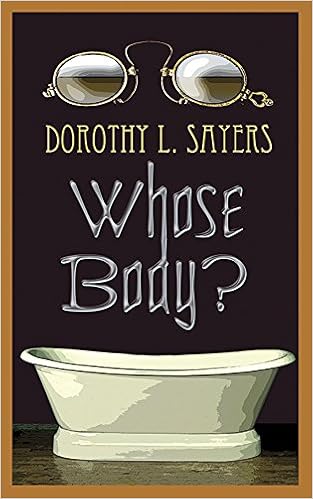
Whose Body? by Dorothy Sayers (1923)
(Audio narration by Roe Kendall)

This is the first of the Lord Peter Wimsey mystery novels. I think I’ve read most of them in the past (and also BBC radio plays and TV series) – but not in the order they were written.

Reading this one now (Kindle+Audible), I kept in mind the fact that it is the first. Personally I would not rate it as one of the best. I think the characters (besides Lord Peter himself, also a few more who reappear in the following books) get more interestingly developed in the later novels; in a way that has since been adopted (and even further developed) by countless other writers of crime fiction. (While Agatha Christie, for example, never really did that with her detectives. With Poirot or Miss Marple, I never found it made much difference in which order I read them.)

I happened to find the whole Lord Peter series (15 books) at bargain price for Kindle a couple of years ago, and bought the whole bundle in the hope of somehow also finding the time to reread them, in chronological order. (Hmmm…)


Image

Till We Have Faces: A Myth Retold by C.S. Lewis (1956)
(Audio narration by Nadia May)

When I first read this novel, way back in my pre-internet youth, I never felt I fully understood it – partly perhaps because I was not familiar enough with the story from Roman mythology that it’s based on.

Recently finding it as Audible audio book, I decided it was time to give it another go. And this time, I also did a bit more background research. (So much easier these days!)

The novel is based on the myth of Cupid and Psyche, as told in the /very/ old classic The Golden Ass (or Metamorphoses) by Apuleius (c. 124-170 AD).

Actually it dawned on me that I also had Apuleius’s book in my bookcase, in Swedish – and have had for a very long time –but don’t think I ever read it. Now I took it out, though, and read the part involving the Cupid and Psyche myth. (Don’t worry – you can also find the myth retold in Wikipedia.)

To summarize very briefly: Psyche (representing the soul) was a young princess, so beautiful that even the goddess Venus became jealous of her beauty. So Venus sent Cupid (also known as Amor or Eros) to cause her trouble. But instead, Cupid himself fell in love with Psyche, and took her to live with him in his palace. However, she was not allowed to look at his face, so they only came together in the dark of the night. Psyche’s sisters came to visit her, got jealous, and persuaded her that her husband must be a monster as she was not allowed to see him. So Psyche began to doubt, and one night, after Cupid had gone to sleep, she lit a lamp to look at him. But she spilled some hot oil on him, which woke him up. He fled; and Psyche set off on a long journey to try and find him again, encountering many different difficult tasks on the way.

What Lewis basically does is to retell the story from the point of view of one of Psyche’s sisters, whom in the novel is called Orual. It is she who is the narrator in the novel; and she sets out to accuse the gods, both of having misled Psyche, and of having totally twisted the legend. Because Orual, to begin with, sees it all in a very different light – she claims she was never jealous at all, but only ever had Psyche’s best interest in mind. And so she sets out to write down her own version of what really happened.

However, later on in the book, there is another twist, when Orual is forced to question even her own story: “Memory, once waked, will play the tyrant…”

I’ll not go into detail about how it all ends, or how it might be interpreted. But thinking about it now, I think I see thematic similarities between this novel and the last of the Narnia Chronicles – The Last Battle – which was published the same year (1956). And I would say that one recurring theme in both books is how people can look at the same thing, but perceive it very differently.

It’s like with optical illusions…

(If you’re on Facebook, you’re likely to come across at least one every day - usually with the exhortation “share if you see it”, and claiming that if you do see it, you’re among a rare 3% or so of the world’s population. I’m frequently surprised at how many of my friends seem to belong to that elite!)

Sunday, 1 November 2015

Turning Leaves Through October

CIMG6694

Besides Havana Sleeping by Martin Davies (which I thought deserved a book review of its own), I also in the month of October read/listened to the first two (out of six) ‘Chronicles of Barsetshire’ by Anthony Trollope – The Warden (1855) and Barchester Towers (1857).

CIMG6721

As far as I can recall, I have not previously read anything by Trollope, even though I’ve often seen references to him, and this series especially.

CIMG6799

Being old classics, these books can nowadays be found for free on the internet.  Back in my pre-internet university days, it was a very different story (here in Sweden) to get hold of English classics that weren’t on the prescribed list of study course literature…

CIMG6775

Which means that ever since I got the Kindle (I can hardly believe that was only three years ago – it feels like I’ve had it much longer!), I’ve been on a constant happy free-shopping-spree, downloading just about every old classic, read or unread, that has happened to come to mind for me. No doubt more of them than I will ever in reality find the time to read…

CIMG6824

The Barsetshire Chronicles were actually among the first lot of classics that I downloaded just after I bought the Kindle back in the autumn of 2012. What made me decide to read these just now was that more recently I also happened to notice that ‘whispersync’ audio versions of them were also available at reduced price (about 3$ per book).

CIMG6828

I really love that possibility of being able to switch back and forth between reading and listening – especially with lengthy books, because it means I can keep reading even when I need to rest my eyes, but I can also go back and check things (which is very hard to do if one only has the audio version), or read some chapters the usual way if I’m in the mood for that.

CIMG6860

I still find it harder to write reviews of audio books, because one does not pick up details in the same way as when seeing the text.

CIMG6866

And as I’ve mostly listened to these two, I’ll just say that I found them enjoyable. Not all easy to keep up with all the various titles and finer nuances of the mid 1800s ecclesiastical, aristocratic and social hierarchy – which is pretty much what the author is mocking in these books, and also spinning his plots around – but even without looking up every detail of all that, one soon gets the drift. Society may have changed a bit over the last 150 years, but the ways we relate to other people really haven’t changed as much as we might like to think… (Prestige, envy, gossip etc.)

CIMG6899-001

I really loved the poor honest warden’s struggles with his conscience in the first book (receiving very little or no credit for all his efforts to be just and fair); and all the misunderstandings in the second arising from people just assuming what’s going on in the minds of others, without really bothering to ask – for example!

CIMG6948

I’ll continue reading/listening to the rest of this series. I find they make excellent “bedstories” as in the midst of all the intrigue they’re still kind of peaceful…

CIMG6947

 [And in between reading, I have been out walking a lot in fine autumn weather! The photos in this post were taken on different occasions from the beginning of October to about a week ago.]

Wednesday, 19 August 2015

Reading By Ear

This summer most of my reading has been in the form of audio books – of which quite a few have been old favourites revisited.

At bedtime, for example, I often prefer a familiar story that doesn’t require too much concentration…

One of the many things I appreciate with Amazon’s Kindle/ Audible is that with many free Kindle classics, it’s also often possible to find Audible recordings of them quite cheap. At best they are even synced so that (if you’re on wifi) you don’t even have to remember yourself which device you last used to read or listen… The next one you pick up will check it for you and ask if you want to go to the furthest read location.

On my re-reading/listening list this summer have been the classic novels by Jane Austen: Mansfield Park, Emma, Pride & Prejudice, Sense & Sensibility, Northanger Abbey (listening to that now) and Persuasion (downloaded, but remains to listen to).

I think Northanger Abbey may still be my favourite, because of the way she makes fun of the whole Gothic Horror Romance genre that was popular at the time. (Finding it even more amusing now, after actually reading Anne Radcliffe’s The Mysteries of Udolpho some years ago – which is frequently referred to in NA.) A strong contender is Emma, though, because in that one too, Austen manages (and in a more subtle way) to present an ‘imperfect’ heroine.

In between the Austen re-reads I’ve been listening to some other audio books as well, though.

Last week, for example, I was held captive by a new  biography about Joy Davidman, the woman that C.S. Lewis married rather late in life. This I bought only as audio (not finding any “package” deal).

Joy: Poet, Seeker, and the Woman Who Captivated C. S. Lewis | [Abigail Santamaria]

Joy: Poet, Seeker and the Woman Who Captivated C.S. Lewis – by Abigail Santamaria

Some of you may know a bit about their love story from the film Shadowlands (1993). It’s been a good while since I last saw or read Shadowlands (I think I shall have to return to both book and film for comparison). But my impression is that this biography gives a fuller portrait both of Joy’s early life (including her first marriage), and of the complexity of the relationship that grew between her and Lewis. And one thing I did not know or did not remember from before was that besides being Jewish and having been (for a while) a member of the Communist party in America, Joy was also (for a while) a follower of L.R. Hubbard (the founder of Scientology) and a practiser of Dianetics. (I suppose I may have read this before, without paying much attention – but as it happened now, by pure coincidence, only a week or two before I bought this biography I had watched a TV documentary about Scientology, from which I learned a lot more details about that movement than I ever knew before.)

I found Joy: Poet, Seeker… (etc) a very interesting read, easy to follow and with facts well presented. I also found the audio narration by Bernadette Dunne quite excellent and easy to listen to. (I have to confess I sometimes find it harder to listen to audio books in American accent –being more used to British English myself – but in this case it was no problem; and as Joy was American, it also ‘felt right’.)

Tuesday, 17 February 2015

Book Review: The Man Who Was Thursday (1908)

 Gilbert Chesterton.jpg

Gilbert Keith (G.K.) Chesterton (1874-1936)

is perhaps best known for his detective stories about Father Brown, a Roman-Catholic priest. However, Chesterton was also a poet, philosopher, dramatist, journalist, orator, literary and art critic, biographer, lay theologian and Christian apologist; and another one of those authors that influenced and was highly praised by C.S. Lewis.

I have read the Father Brown stories in the past – and last year also watched an enjoyable BBC drama series based on them (set in the 1950s, although the original stories were written 1911-1935).

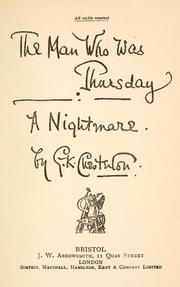
Now I decided to have a go at a novel from 1908 with the intriguing title

The Man Who Was Thursday: A Nightmare

Image result for the man who was thursday summary 

Just like my last read, this book too turned out to be one of those not easy to categorize. I knew very little of it beforehand; and as I think that is really the best way to read it, I in turn don’t want to reveal too much. So rather than give away plot details, I shall try to just share how I felt about it. 

Right from the start it struck me as a rather creepily up-to-date read from the aspect that one of the major themes has to do with anarchism/ terrorism and a bomb threat to a major European city.  It also crossed my mind quite early on (from a certain scene), that this might well be another one of all the books from which J.K. Rowling picked some inspiration for Harry Potter. Anyway, in spite of the serious (and indeed, as the title suggests, nightmarish) background, and some deeply moral and philosophical discussions – this story does not only keep up a high degree of suspense, but it also includes a lot of unexpected twists and turns and a good deal of humour. (Sometimes I even laughed out loud.) I found it very hard to put down – I just wanted to keep on reading to see what happened!

A quote for Teaser Tuesday

“They were a balconyful of gentlemen overlooking a bright and busy square; but he felt no more safe with them than if they had been a boatful of armed pirates overlooking an empty sea.” (p. 66)

Sunday, 15 February 2015

Book Review: At the Back of the North Wind (1871)

George MacDonald 1860s.jpg

George MacDonald (1824-1905) was a Scottish author, poet and preacher; a mentor of fellow writer Lewis Carroll, and some of his works of fantasy have become classics in the genre, and inspired other authors, like C.S. Lewis.


At the Back of the North Wind was first serialized in the children's magazine Good Words for the Young in 1868, and published in book form in 1871.

I have a Swedish translation printed in 1990; but realised recently that I hardly remembered the story at all, so decided to reread it in English.

At the centre of the story is a small boy named Diamond, son of a poor coachman – who also has a horse with the same name. The boy Diamond sleeps in the loft over the stable (right over the stall of Diamond the horse); and in the wall by his bed there is a knothole, through which the North Wind blows. In Diamond’s dreams (or is it more than just dreams?), the North Wind takes the shape of a beautiful woman with long hair – sometimes small like a fairy, sometimes huge and awe-inspiring like a mighty storm – sweeping Diamond away on nightly adventures, both in his own town and to a distant land, “at the back of the north wind”.

Diamond is at the same time a mystery and a joy to the people around him. Kind and helpful and trusting, and making friends whereever he goes - but also going his own ways, showing both practical initiative, and surprising people by fanciful ideas, rhymes and dreams.  He’s naive in some ways, and yet also wise and philosphical far beyond his age. Some think he’s not quite right in his head; but he never takes offense.

It is not a book easy to categorize. Take the basic setting (including poor little boy) from a novel by Charles Dickens; put it down a rabbit hole (as in Alice in Wonderland - 1865); add a good portion of classic fairy tale and fable; mix in some serious theodicy questions and answers; and serve with a sprinkle of nursery rhymes on top. It’s very much up to the reader’s taste to decide what to make of it!

I suspect that one reason I did not remember much about it (from 25 years ago) may well be that I found it somewhat “difficult”. The story also makes a lot of deviations along the way (like long nursery rhymes and whole fairy tales told within the story).

This time I also tried listening to some parts as audio, but when I got to the end I found I needed to go back and reread some parts (that I probably missed by drifting off into dreams of my own!). Some of the details deserve more attention than one might think at first. For example, there are plenty of parallells between the ‘reality’ vs. stories and dreams within the book.

It’s not a book I’d recommend as a must-read for everyone, but if (like me) you are interested in classic children’s literature and fantasy, you might find that you recognise themes and ideas also used by other authors within those genres.

- - -

PS. I’ve blogged about MacDonald before, back in 2012 – a post entitled Once Upon A Time.

- - -

Linking to Musing Mondays

Thursday, 29 January 2015

Book Review – Orlando: A Biography

Orlando: A Biography
by Virginia Woolf (1928)

I decided to read this classic because of the personal name Orlando, as well as references to Woolf's novel, being used by Robert Galbraith alias J.K. Rowling in The Silkworm. In The Silkworm, Orlando is a female character – but although a grown woman, in some ways more like a child. In my own head however the name is (or was) a male one (think Orlando Bloom). So that for a start called for some research (especially since I know from before that Rowling tends to put a lot of meaning into the choice of names for her characters).

The first brief introduction to Woolf's novel that I found only informed me that …

Orlando tells the story of an individual named Orlando, born as a biological male in England during the reign of Elizabeth I. Orlando lives for more than 300 years and, at around 30 years of age, mysteriously changes biological sex to female.”

At the same time though, it’s also described as being

“a semi-biographical novel based in part on the life of Woolf's presumed lover Vita Sackville-West”

Together, this sounded rather strange to me… but tickled my curiosity to have a closer look at. And to satisfy such urges is easy enough these days, when a Kindle edition of Woolf's Complete Works  can be downloaded in an instant at less than $4!

I turned to the first chapter of Orlando and started reading; and soon found myself hooked. Actually Orlando's journey through the time and shifting cultures of three centuries, and even the transition from one sex to another, turned out to make a lot more sense than the summary quoted above.

While the plot does have some strange time twists, I found those to be written with a twinkle in the eye; and I did not have any trouble picking up the subtext as the experience of a Reader and a Writer; as well as growing from Child to Woman (with some confusion perhaps in the middle) - and at the same time conveying quite a clever analysis of the shifting position of women (and not least women writers) in the context of society during those three centuries (from the Elizabethan age until 1928); and also the general explosion of literature during the same period:

While she had been sitting in Hyde Park the bookseller had delivered her order, and the house was crammed – there were parcels slipping down the staircase – with the whole of Victorian literature done up in grey paper and neatly tied with string. She carried as many of these packets as she could to her room, ordered footmen to bring the others, and, rapidly cutting innumerable strings, was soon surrounded by innumerable volumes. Accustomed to the little litteratures of the sixteenth, seventeenth, and eighteenth centuries, Orlando was appalled by the consequences of her order. --- Orlando’s reverence for print had a tough job set before it …

I have to confess that this quote reminds me a lot of my own experience with the Kindle… (LOL)

Anyway – I really enjoyed this book, and feel that I also learned quite a lot from it.  (For one thing – just to relate to my latest read – it did make me understand better how Rowling weaved the theme of gender issues into The Silkworm in various ways, both in the case plot and in the relationships of the background characters.)

Sunday, 16 February 2014

Classic Book Review: Madame Bovary

Madame Bovary by Gustave Flaubert (1857)
English translation by Eleanor Marx Aveling (1886)

It came to mind for me just recently to reread one of the great French classics, Madame Bovary by Gustave Flaubert. That is – although I had only vague memories of the story (if any at all), I would have sworn that this was one of the classic novels I read way back in my teens. I even have an image in my mind of a rather thin green volume with gold print on the back, and almost exactly where in the town library it stood… (Or…?)

As this is a book from 1857, with the first English translation published in 1886, it is of course availabe as free for Kindle; so nothing to lose by downloading it.

Nothing to lose but faith in my own memory, that is!

Because after finishing my “re”read of it, I think I must rewrite my personal reading history, and say that I probably never did read it before. I now suspect I may somehow have been confusing it in my mind with The Lady of the Camellias by Alexandre Dumas (fils) (1848) – even if I was convinced that I had read both. (Now if I could just find out what kind of covers those two books had in my home town library 40 years ago…)

To begin with, I found it a little difficult to get into the story. Hard to say whether this was because it was a different story from what I expected, or to do with a case or two of strange word order early on in the book which set me wondering whether perhaps it would turn out to be a bad translation throughout. It got better, however. (I did not look up the translator until after I had finished the book, but then learned that it was Eleanor Marx Aveling; daughter of Karl Marx.) Perhaps there are later translations easier for a modern reader to get into, though. What soon becomes evident is that Flaubert has a very detailed writing style, that may take a while to get used to. He uses words to paint images in the reader’s mind; it just gets a little blurry when you don’t actually know the words! – for example different kinds of horse-drawn carriages, or all the little details of fashion worn in those days.

Basically it’s the story of a marriage, and how their life together in a small village appears totally different to husband vs wife. Charles is a doctor, not terribly successful, but striving on and doing his best; and also feeling more or less content in his marriage and family life. Emma (Madame Bovary), on the other hand, is constantly wishing for “more” to her life than what she has, in every respect – something which repeatedly tempts her to walk down dangerous paths, both with relationships and with money matters.

In town, with the noise of the streets, the buzz of the theatres and the lights of the ballroom, they were living lives where the heart expands, the senses bourgeon out. But she – her life was cold as a garret whose dormer window looks on the north, and ennui, the silent spider, was weaving its web in the darkness in every corner of her heart.
(Chapter 7)

Interestingly, in spite of all the changes in social life that have taken place between the mid 1850’s and today, I found this novel to deal with some very fundamental aspects of human nature which probably have not changed as much as we might like to think in 150+ years.

In Sweden we have a TV show called Lyxfällan, ‘The Luxury Trap’. (I’d be surprised if there aren’t similar shows in the US and Britain.) In this show, financial experts help individuals and families to sort out the mess that an astonishing amount of people today tend to get tangled up in just by using too many credit cards and expensive loans to buy stuff they don’t actually need, without ever sitting down to add up the real costs and compare them to their real income. And with couples it seems there is also usually an added element of not being able to communicate with each other.

To sum up: Emma Bovary would have been a perfect candidate for a combined Luxury Trap and ‘Dr Phil’ show!

If you want to know what life was like in the ‘good old days’, long before there were stern TV talk show hosts to stare you in the eye and ask “What were you thinking?” and “How is that working for you?” – then you should read Madame Bovary.

Monday, 14 October 2013

Classics Book Review: The Railway Children

The Railway Children
by Edith Nesbit (1905)

The Railway Children (book).jpg

I’m working my way through the books by Edith Nesbit on my Kindle :) – the book cover here was copied from Wikipedia.

This story is about two brothers and two sisters who are suddenly uprooted from their previous comfortable life in a town house with both their parents, to go and live with only their mother in the countryside, under much poorer circumstances than before. Their father has suddenly had to go away; but the children get no real explanation of why or whereto or for how long, until near the end of the book. They soon understand that Mother prefers not to talk about it, and learn not to ask questions. Mother is also suddenly very busy writing stories for publication; which means that the children are often left to amuse themselves best they can on their own.

As their house is close to the railway, this becomes their main source of adventures. They make friends with the staff at the railway station, and they also get in the habit of waving to the people on a special train that goes by daily – especially to one old gentleman; with whom they later on get closer acquainted, to their mutual advantage.

Perhaps needless to say, after certain complications all ends well, and at the end mysteries are explained and questions answered, to the satisfaction of all involved.

I’d say that in many ways this is a rather typical children’s book for its time. Personally I enjoyed Nesbit’s  ‘Psammead’ series more, as those books offer the reader more of an intriguing interpretation challenge, balancing between children’s imagination and “real” magic – and with a lot of humour, too.

From historical point of view, The Railway Children bears witness about the impact of the railway back in those days, though.

According to Wikipedia, the book has been dramatised several times (between 1951 and 2000) for radio, TV and film.

Amusingly, when googling the book title, one of the results that came up was an article from The Telegraph 11 July 2013, stating that:

After more than 40 years, the board responsible for classifying films in Britain receives its first complaint about classic film The Railway Children. [from 1970]

A viewer raised concerns with the BBFC about the danger of depicting children playing on railway tracks, in what was the first complaint received by the BBFC since the Railway Children was classified U in 1970, a rating which means it is generally suitable for children aged four and over.

David Cooke, director of the BBFC said the film had "always been a U on every platform." In the board's annual report it said it judged that as the Railway Children is set in the Edwardian period, access to trains was very different from today, and also the film showed the “potential harm to children if proper care is not taken” near railways.

Sunday, 24 March 2013

Book Review: The Camera Fiend

Some time ago, Librarian posted a review of a book My Lord Duke by E.W. Hornung (1866-1921) – an author perhaps better known for his stories about a ‘gentleman thief’ by name of Raffles. At least that was the only ones in the bibliography that rang a little bell with me. I was also interested to learn that Hornung was brother-in-law to Sir Arthur Conan Doyle.

I went to browse titles by this author free for Kindle, and came across The Camera Fiend (from 1911). 

There’s just no getting away from those early 20th century cameras and photographers lately!!


This photo was used as prompt for Sepia Saturday this week.
http://www.flickr.com/photos/library_of_congress/5890411469/

They also seem to turn up in every other book I read:
The House of Arden. The Secret Keeper. The Year After.

The intriguing thing about The Camera Fiend (besides the title) was that there was no introduction to it on Amazon (just a paragraph about the author) and not a single review. The only way to find out was to read.

So I did (this weekend). A little hesitant through the first chapter or two, not really having any clue at all what kind of book it was supposed to be. My first guess was to place it in the genre of humour, but soon the story started taking unexpected twists and turns, and that rather fast. Actually a lot of the charm lies in the surprise elements, and not knowing where it may be going next… So I don’t want to give away too much. But the further I read the more the plot thickened and I found it harder and harder to put the book down. (Today I just kept reading, except for a cold windy walk to the supermarket, and lunch.)

The main character is an asthmatic young man (the word teenager was not yet invented) by name of Tony “Pocket” Upton, on leave from boarding school for a couple of days to go into London to see a specialist doctor about his asthma medication. His intention to stay the night with friends does not turn out quite as planned… and trouble escalates in ways he’d never been able to imagine. Let it be enough to say that the story also involves a suspicious death or two, a professor interested in photography and spiritualism, a young girl, and a private investigator with assistant.

It was an entertaining read, and I think I’ll try more titles by this author.

Quotes:

You cannot sit up half your nights with asthma and be an average boy.

Pocket was not one of nature’s heroes, but he had an overwhelming desire to behave like one.

That is the worst of your conscientious ass; he takes his decision like a man; he means to stick to it like a sportsman; but he cannot help wondering whether he has decided for the best, and what would have happened if he had decided otherwise, and what the world will say about him as it is.

“I think that Dr [---] has the strangest power of any human being I ever heard of; he can make you do anything he likes, whether you like it yourself or not.”

Sunday, 17 February 2013

The Great Gatsby Revisited

The Great Gatsby by F. Scott Fitzgerald (1925)

Gatsby 1925 jacket.gif

Cover of the first edition, 1925 (Wikipedia)

Going back to a book you read once in a distant past, like 35-40 years ago, can be like revisiting a place you haven’t seen since then. It can appear familiar and very different all in one.

As is often the case for me with classics read long ago, my memory of it consisted only of vague images and a certain lingering “atmosphere”, rather than details of the plot.

So my memories just involved this rich guy living alone in a big house and throwing extravagant parties; and the story being told by his neighbour, who was more of a regular guy; and an overall impression of rather sad 1920’s decadance – people trying to be happy but not succeeding very well. And that was about it.

What made me reread it now was a wish to update my memory and try to grasp why (besides the title) it is considered one of The Great. I also never read it in the original language – my old falling-apart paperback copy of it was a Swedish translation. (Falling apart not by frequent reading but from age and bad glue.) So I bought it for my Kindle. (The book is not yet so old that it’s available for free, but it is avaiblable cheap).

I’ll not bother about a synopsis of the plot because you can easily find that elsewhere on the internet if you wish; and if you’re like me, it’s re-discovering it for yourself that you will enjoy.

Be it enough to say that there were more layers to the plot than I remembered. Personally, I also find myself thinking much more now about aspects like narrative perspective, and how the author uses language. In those respects I do think The Great Gatsby scores high. I also still find it a rather sadly convincing reflection of its time. (The story takes place in 1922. Fitzgerald started planning the novel in the same year and picked inspiration from Long Island New York where he himself lived at the time.)

****

Wikipedia says about the cover art of the first edition:

A little-known artist named Francis Cugat was commissioned to illustrate the book while Fitzgerald was in the midst of writing it. The cover was completed before the novel, with Fitzgerald so enamored of it that he told his publisher he had "written it into" the novel.

There are a couple of different possible interpretations as to what he meant by that.

****

Quotes

She smiled slowly and walking through her husband as if he were a ghost …

I was within and without, simultaneously enchanted and repelled by the inexhaustible variety of life.

Every Friday five crates of oranges and lemons arrived from a fruiterer in New York – every Monday these same oranges and lemons left his back door in a pyramid of pulpless halves. There was a machine in the kitchen which could extract the juice of two hundred oranges in half an hour, if a little button was pressed two hundred times by a butler’s thumb.

“I like large parties. They’re so intimate. At small parties there isn’t any privacy.”

Every one suspects himself of at least one of the cardinal virtues, and this is mine: I am one of the few honest people that I have ever known.

The truth was that Jay Gatsby, of West Egg, Long Island, sprang from his Platonic conception of himself.

Sunday, 20 January 2013

Reading Classics, Not a Waste of Time

Yesterday evening, after I had just published my post/book review on The Vicar of Wakefield, I was having a glance at my daily newspaper. There I happened to find a short notice which caught my interest, entitled Poetry is good for the brain. Today I managed to find the longer article which was referred to. Here’s an excerpt + a link to the whole.

Excerpts from an article in The Telegraph, 13 January 2013
(by Julie Henry, Education Correspondent)

Shakespeare and Wordsworth boost the brain, new research reveals

Scientists, psychologists and English academics at Liverpool University have found that reading the works of Shakespeare and other classical writers has a beneficial effect on the mind, catches the reader’s attention and triggers moments of self-reflection.

Using scanners, they monitored the brain activity of volunteers as they read works by William Shakespeare, William Wordsworth, T.S Eliot and others.

They then “translated” the texts into more “straightforward”, modern language and again monitored the readers’ brains as they read the words.

Scans showed that the more “challenging” prose and poetry set off far more electrical activity in the brain than the more pedestrian versions.

Scans of brain activity during reading show heightened electrical activity when faced with 'challenging' texts by great writers

The brain shows minimal activity when the text is translated into 'modern' prose

Scientists were able to study the brain activity as it responded to each word and record how it “lit up” as the readers encountered unusual words, surprising phrases or difficult sentence structure.

The research also found that reading poetry, in particular, increases activity in the right hemisphere of the brain, an area concerned with “autobiographical memory”, helping the reader to reflect on and reappraise their own experiences in light of what they have read. The academics said this meant the classics were more useful than self-help books.

Philip Davis, an English professor who has worked on the study: “Serious literature acts like a rocket-booster to the brain. The research shows the power of literature to shift mental pathways, to create new thoughts, shapes and connections”

Saturday, 19 January 2013

The Vicar of Wakefield (Book Review)

The Vicar of Wakefield by Oliver Goldsmith, first published in 1766, is an English classic so classic that it’s frequently mentioned in other classics. It’s been referred to by prominent authors such as Jane Austen, George Eliot, Charles Dickens, Charlotte Brontë and Louisa Alcott. I’ve probably been familiar with the title ever since my early teens; but I never actually read the book until now.

Just having struggled through it, I have to say I don’t blame my English professors at (Swedish) University for not including it in the course reading. I’d lie if I said I found it an easy read. The vocabulary as well as the ideas seem rather antiquated to a modern reader – even when not unused to reading other classics.

I did find it enlightening in the sense that I now finally have a better idea of the style and content of the book, and how it may have influenced other authors. I’m not quite sure what I expected, but I think on the whole I imagined it to be more on the quiet side. While it starts out that way, there’s actually quite a lot of action and twist and turns in the story before the end. In my eyes the quality as well as the “pace” of it is a bit uneven. It’s also not easy, as a modern reader, to quite determine how much it is meant to be taken seriously or as satire.

The narrator of the story is the vicar himself, Reverend Dr Charles Primrose, telling the story in retrospection. At the beginning he is quite a wealthy man, living off an inherited fortune. He’s a good man of firm principles, but charitable, and taking pride in being a good husband to his wife, a father of six children – four of them nearly grown up, and two little ones – and a good friend and generous neighbour. There is one religious thesis that is a bit of an obession with him though, and that is the idea of strict monogamy. (Meaning that while he warmly encourages marriage and family life, he does not believe anyone should remarry even if their partner dies.) As might be expected, his convictions are sort of put to the test in the course of the story.

The family’s luck begins to turn quite early on in the story, when he loses his fortune, and they’re forced to a humbler way of life than they’ve been used to. In fact, as the story goes on, it becomes rather obvious to me that the storyline is roughly based on the book of Job in the Bible, even if I don’t think Job is ever referred to ‘in so many words’. But if you have some idea of the story of Job, he was a righteous man who was put through a great deal of trials, losing one thing after another, except his faith – although even that was shaken about a bit before the end. And there is a similar thread in this novel, even if the parallels with Job are not quite so obvious that every twist and turn in the story is predictable.

There are some rather tedious parts with long speeches etc. But there are also other parts where quite a lot happens in a short time.

I’m not sure it serves much point to “rate” a classic like this. It was not an easy read but then I did not expect it to be. What I found helpful was that besides the free Kindle ebook it was also available as cheap Whispersync Audible book ($3.44). I read some chapters and listened to some, and when I lost concentration with one method of reading I could switch to the other. As it did not cost more I found it well worth the investment in this case.

File:William Powell Frith Measuring Heights 1863.jpg

Measuring Heights: A scene from Oliver Goldsmith's "The Vicar of Wakefield". W.P.Frith.1863. Oil on canvas, 53.5 x 68 cm (Wikimedia Commons) (A scene from Chapter 16: Olivia Primrose and Squire Thornhill standing back to back, so that Mrs. Primrose can determine who is taller.)

The author, Oliver Goldsmith (1730 – 1774), was an Anglo-Irish novelist, playwright and poet. No doubt the novel has some foundation in his own experiences. His own father and grandfather were clergymen and he grew up in a parsonage. He went away to university but was not successful neither in his studies nor in finding a profession. After a walking tour in Europe, “living by his wits (busking with his flute)” he settled in London in 1756, where he briefly held various odd jobs. He became friends with Dr Samuel Johnson, and it was Johnson who helped Goldsmith to get his novel sold, to settle a debt to his landlady.

A few quotes to give you a taste of the style:

when any one of our relations was found to be a person of very bad character, a troublesome guest, or one we desired to get rid of, upon his leaving my house, I ever took care to lend him a riding coat, or a pair of boots, or sometimes an horse of small value, and I always had the satisfaction of finding he never came back to return them. By this the house was cleared of such as we did not like; but never was the family of Wakefield known to turn the traveller or the poor dependent out of doors.

---

Unequal combinations are always disadvantageous to the weaker side: the rich having the pleasure, and the poor the inconveniences that result from them.

---

The pain which conscience gives the man who has already done wrong, is soon got over. Conscience is a coward, and those faults it has not strength enough to prevent, it seldom has justice enough to accuse.

Related Posts Plugin for WordPress, Blogger...