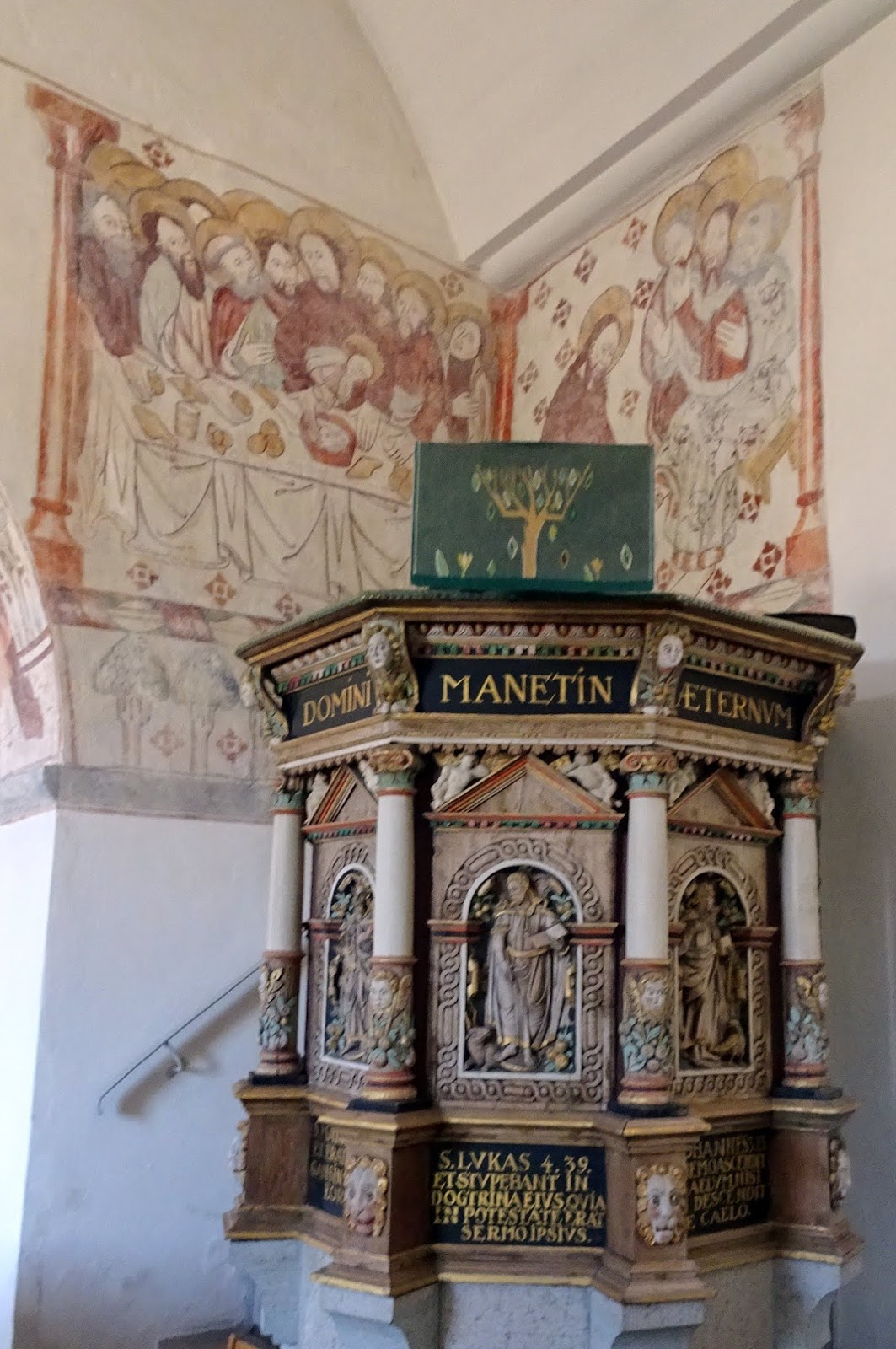
The church at Västra (West) Vemmerlöv in the province of Skåne, Sweden (diocese of Lund) dates back to the late 12th century. It was originally built in Romanesque style; but had some major renovations done in the 1850s. Around 1950, some old mural paintings inside the church were found again and were restored. Paintings in the ceiling and on the walls were common back in medieval times when most of the people visiting the church services were not able to read.
Besides Biblical motifs, this church also has some interesting paintings at the west end of the church (near the entrance) that refer to old fables and folk tales. Some of them involve foxes and geese. Symbolically, the geese represent credulousness, while the fox represents cunning. The purpose of these paintings was to remind people that sometimes the devil appears in disguise to deceive us. One image (on the left in the last photo above) also shows a pelican feeding its own blood to its young ones. In medieval art, this is a symbol of Christ.
Across the road from this church there is a café. It was closed in the morning when we first visited the church; but on our way back in the afternoon (to our hotel in Lund), we happened to be passing by the same road again - and then the café was conveniently open so that we could have our afternoon tea/coffee there, overlooking the church that had been our first stop the same morning.
(Map - see the post The Fourth Day from July.)
In the café garden there I also found a goose and goose-herd. (Domesticated geese are somewhat of a symbol for the province of Skåne. I'm not sure about nowadays, but at least in the past they were common on the farms there.)
Inspired Sunday #334

'Have you an umbrella in your house?'
'I think so.'
'I wish you would bring it out here, and walk up and down with it,
and look up every now and then, and say "Tut-tut, it looks like rain."
Winnie-the-Pooh

Once in a while I wake up with the feeling that I have dreamed a whole intricate fantasy novel during the night; and if I could only get it down on paper, I'd be the next J.K. Rowling...
So far, I have always failed miserably on the last bit.
A couple of mornings ago, still only half-awake, I did make an attempt to scribble down a few clues before my last impressions of the dream faded away. I scribbled in Swedish (except for the last sentence, which for some reason I wrote in English) - but it goes something like this:
Family travels by train. Children discover mysterious things aboard. Train car full of books gets emptied during the journey. "Staff" wear belts with jewels. Something about language and keys to that language. Evidence removed during the journey.
Feeling in a generous mood today, I decided to give away the idea for free - with the only condition that I get to read the full story before it goes to print!
The image shows a Jacquard machine at our Textile Museum. This is a device fitted to a loom to simplify the process of manufacturing textiles with complex patterns. Invented in 1804 by a man named Jacquard, the mechanism is controlled by a chain of punched cards laced together into a continuous sequence. It is also considered an important step in the history of computing hardware.
"We sleep, but the loom of life never stops, and the pattern which was weaving when the sun went down is weaving when it comes up in the morning." ~ Henry Ward Beecher
"Oh what a tangled web we weave, when first we practice to deceive." ~ Sir Walter Scott
The weather is getting more and more autumn-like, and I'm beginning to feel the need to change the contents of my wardrobes from light summer dresses to warm woolly cardigans...
Living in a textile-focused city, every now and then I read/hear about various clothes swapping events; but as far as I can remember, I haven't yet really taken part in one. (I have handed in a few items for one or two such events - primarily wanting to get rid of them! - but I can't recall finding anything I wanted in return.)
Luckily, I have my own private clothes-swapping system, though - which means that every spring and autumn I shift some clothes between the wardrobes in my flat, and my basement storage room - and forget about the ones in storage for a while! Yesterday, in connection with washing day, I felt it was time to start the autumn swap. In particular, there was a certain long cardigan and a pair of "winter" trousers that I wanted, and did remember that I had put away. However, when I got down to the storage room, I discovered several more items of winter clothing that I had totally forgotten about! (Or at least had not been missing them yet...) Probably a good idea both in autumn and in spring to check my own storage spaces before I'm tempted to go out and buy something new (only to come back home with something and then later discover that I already had something very similar - which I have to confess has happened... As I do tend to feel drawn towards certain styles and colours!)
As for the photos above, I may possibly have blogged these before - but I'm pretty sure they're not from my own wardrobe...! ;) (They are from a fashion exhibition at the Textile Museum last summer, 2018.)
Lund Cathedral (previously also shown/mentioned here in a post from the Third Day of my summer road trip in July this year) dates back to the early 12th century (and there was probably a cathedral in the same spot even earlier). Back in those days the province of Skåne was Danish; and before the Reformation the churches and cathedrals were of course Catholic. (Nowadays it belongs to the Church of Sweden.) Lund was an important cultural and religious city in the Middle Ages and back in those days there were also several monasteries etc.
Because of fires and whatever other reasons, various changes were made to the cathedral over the years. Only the apse has remained unchanged (i.e. the rounded part where the altar is).
Around 1425, an astronomical clock was installed. It has had to be renovated several times over the years (last in 2010), but is still (or again) working. I promised in my earlier post that I would get back to this clock more in detail some time - and now it's Time!
In Latin the clock is called Horologium mirabile Lundense.
The
upper board of the clock shows, among
other things, the different phases of the Moon and where the Sun sets.The lower board is a calendar, with the help of which
one can calculate things like when mobile religious
holidays (like Easter) will fall, or the weekday of a certain date. The man in the middle of the calendar is the Patron Saint of the cathedral, St Lawrence (St Lars in Swedish).
The present calendar board is for 1923-2123 (after that, it will have to be replaced with a new one).
On top of the clock there are two knights who mark the hours by coming out to fight each other.
Twice a day (weekdays at noon and at 3 pm, Sundays at 1 pm and at 3 pm) the clock plays a tune (In Dulci Jubilo), and things happen with the figures in the middle of the clock:
The two guardians lift their horns, the door on the left opens, a procession of six figures present gifts to the holy Virgin and Child sitting on the throne in the middle, and then disappear back into the clock through the door to the right.
My brother and I first visited the cathedral earlier in the morning, before 10 am - but decided to go back for the "clock show" at 12. I'm glad we did, as it was a rare experience. (As it was the tourist season, there were a lot of people gathered then, and a guide to explain what was going to happen, both in Swedish and in English.)
Inspired Sunday #333