Showing posts with label cathedral. Show all posts

Wednesday, 20 August 2025

Road Trip 2025 (4) - Linköping: Garden Park, Cathedral and Castle

In Linköping, we stayed two nights at Hotel Ekoxen ("The Stag Beetle"), situated right by a big park in the central parts of the city. The park goes by the Swedish name of Trädgårdsföreningen (= The Garden Society); as the park was created by such a society formed back in 1859. Here, I've chosen to call it the Garden Park


This is the hotel. Its layout inside is somewhat confusing, as it consists of two buildings joined together by a portal across the street. To get to our rooms, we had to first take one lift (or the stairs) up one floor, walk through that middle part across the street, and then take another lift. My room actually overlooked the hotel entrance!


The entrance to the Garden Park was literally just round the corner of the main building, though, so perfect for us to just go for a  first short "introductory" evening walk there after we had installed ourselves in our rooms. 

Sunday, 10 August

The next morning after breakfast we went out again to explore the park a bit further; and now walked up to the highest point of the park (which is also the 2nd highest view over the city). There is an observation tower up there, known as the Belvedere. Looking up the name afterwards, I learned that this is Italian, and means "beautiful view". It was built in 1881. 


We happened to run into a foreign tourist up there, asking us for the way to the city centre. Being tourists ourselves, all we could do was really to point out the direction for her - towards the tower of the cathedral (which we know since a previous visit to be pretty much in the centre). Not of much help to the girl, as she deemed it to be too far away for her - but as thanks, she offered to take a photo of the two of us by the tower (using my phone):

On our way down from the hill, we noticed some dead tree trunks that had been carved into wooden sculptures. (Later, we came across the info somewhere that quite a few trees in the park had died of elm tree disease.)


These buildings from the 1740s were moved to the park in 1913.

Someone commented yesterday on my post from "Linköping Old Town" that the colour red seems to be very popular for old buildings here. As you'll be seeing plenty more examples of that in my photos from this trip, I'll repeat my answer to that remark here:

Red wooden houses are very common in Sweden, and this is related to a special kind of paint produced from byproducts of copper mining - Falun Red, named after the town with the copper mine where they developed it. It's been used since the 16th century, and has a special quality of also impregnating wood to better preserve it in our cold climate. At first it was mostly used by wealthy people as it was expensive, but in the 19th century, with industrial production etc, it became more common and increasingly popular. And it's still much used.

At noon, we met our aunt and uncle (our mum's sister and her husband) for lunch at the Garden Park Café. I had suggested that as I know they often go there, and it's on "the right side of town" for them (and with us staying at the hotel so close, it was of course very convenient for us as well). They're 89 and 88 now, so it was not to be taken for granted that our plan to meet up on a specific day would work out - but luckily, it did. :) And the garden café itself turned out well worth a visit, too. It has an exotic outdoors atmosphere even though it's indoors; and the food was good as well. 

Later in the afternoon, my brother and I walked into the city centre, which also wasn't  very far from our hotel. Last time we were in Linköping, three years ago, we visited the Cathedral, and also had a good look inside. (If you like, you can see my photos from 2022 here.) This time it was not open, and a large part of the outside was clad in scaffolding, so obviously there were some major repairs going on. I only managed to get two photos from the outside (leaving out the scaffolding), and they do not really give justice to the whole impressive building: 


Linköping Cathedral is one of the largest Gothic cathedrals in Scandinavia. It is situated opposite Linköping Castle, on a site that has been in use as a church since the 11th century. The oldest parts of the present building date back to the 13th century. (Wikipedia)

As we could not go into the cathedral, we continued to the Castle, where we managed a quick tour of the Castle & Cathedral Museum before they too closed for the day.  

 The Castle courtyard. (Difficult to get a good photo with the sun right behind it...)


▲ Old liturgical vestments on display in the museum.▼


Model of the Cathedral back in 1300. 
A lot of scaffolding on it back then, too! ;-)


The sign beside this lion said we were allowed to pet it, but not ride on it!
 
(There is a lion in Linköping's city arms.) 


Tuesday, 24 December 2019

December 24 - Christmas Eve

~ Merry Christmas, Everyone! ~  


Closeup details from the astronomical clock in Lund Cathedral

 - - -

"It did seem to me there was a quality about time
which had nothing whatever to do with clocks or calendars."

Quote from the novel Miss Hargreaves by Frank Baker (1940).

---

This is the last of my prescheduled "Advent Calendar" posts.

Sunday, 22 December 2019

December 22 - 4th Advent Sunday


Seven-branched candlestick in Lund Cathedral.  

The seven-branched candlestick is to remind of the Menorah in the Temple in Jerusalem. The one in Lund Cathedral is from the 15th century and made of bronze. It was made in Hamburg and was transported to Lund in three parts.


The four figures at the bottom are the traditional symbols of the four evangelists in the New Testament: Angel (Matthew), Lion (Mark), Ox (Luke) and Eagle (John).

In the Old Testament, the prophet Ezekiel describes a vision of four living creatures, each of which had four faces (and wings): "Their faces looked like this: Each of the four had the face of a human being, and on the right side each had the face of a lion, and on the left the face of an ox; each also had the face of an eagle." (Ez 1:10)

A similar scene is described in the Book of Revelation in the New Testament: "In the center, around the throne, were four living creatures ... The first living creature was like a lion, the second was like an ox, the third had a face like a man, the fourth was like a flying eagle." (Revelation 4:6-8)


Very early on in Christian tradition, these creatures became symbols of the authors of the four gospels in the New Testament.

 InSPIREd Sunday
 

Friday, 13 December 2019

December 13 - Friday - St Lucy's Day


From Lund Cathedral (Skåne, Sweden)

On 13th December here in Scandiavia we celebrate Lucia or St. Lucy's Day; a festival of light which in the past coincided with the Winter Solstice.

Lucia is celebrated in both private and public contexts. In most towns in Sweden, an official Lucia with a number of maids are elected at the beginning of December. They then spend 2-3 weeks visiting public places like hospitals and nursing homes, singing traditional Lucia songs and Christmas carols. Churches and schools and workplaces etc often have their own Lucia celebrations on the 13th of December as well.

 Lucia
Classic Lucia illustration by Jenny Nyström (1854-1946)
(God Jul = Merry Christmas)

St Lucy was a 3rd century martyr in Rome. According to legend she brought food and aid to persecuted Christians hiding in the catacombs, wearing a candle-lit wreath to light her way and leaving her hands free to carry as much food as possible. Nowadays she brings coffee and saffron buns and ginger biscuits - early in the morning while it is still dark.

(If you write Lucia into the search box on top of my blog, it will bring up more Lucia posts of mine from years gone by.)

Tuesday, 10 December 2019

December 10 - Tuesday

A side entrance to Lund Cathedral, Skåne, Sweden

(A rather grand archway for a narrow door...)

Sunday, 15 September 2019

Lund Cathedral and Astronomical Clock


Lund Cathedral (previously also shown/mentioned here in a post from the Third Day of my summer road trip in July this year) dates back to the early 12th century (and there was probably a cathedral in the same spot even earlier). Back in those days the province of Skåne was Danish; and before the Reformation the churches and cathedrals were of course Catholic. (Nowadays it belongs to the Evangelical Lutheran Church of Sweden.) Lund was an important cultural and religious city in the Middle Ages and back in those days there were also several monasteries etc.

Because of fires and whatever other reasons, various changes were made to the cathedral over the years. Only the apse has remained unchanged (i.e. the rounded part where the altar is). 

Around 1425, an astronomical clock was installed. It has had to be renovated several times over the years (last in 2010), but is still (or again) working. I promised in my earlier post that I would get back to this clock more in detail some time - and now it's Time!


In Latin the clock is called Horologium mirabile Lundense


The upper board of the clock shows, among other things, the different phases of the Moon and where the Sun sets.The lower board is a calendar, with the help of which one can calculate things like when mobile religious holidays (like Easter) will fall, or the weekday of a certain date. The man in the middle of the calendar is the Patron Saint of the cathedral, St Lawrence (St Lars in Swedish).

The present calendar board is for 1923-2123 (after that, it will have to be replaced with a new one).


On top of the clock there are two knights who mark the hours by coming out to fight each other.

 
Twice a day (weekdays at noon and at 3 pm, Sundays at 1 pm and at 3 pm) the clock plays a tune (In Dulci Jubilo), and things happen with the figures in the middle of the clock:


The two guardians lift their horns, the door on the left opens, a procession of six figures present gifts to the holy Virgin and Child sitting on the throne in the middle, and then disappear back into the clock through the door to the right.


My brother and I first visited the cathedral earlier in the morning, before 10 am - but decided to go back for the "clock show" at 12. I'm glad we did, as it was a rare experience. (As it was the tourist season, there were a lot of people gathered then, and a guide to explain what was going to happen, both in Swedish and in English.)


Inspired Sunday #333


InSPIREd Sunday

Tuesday, 25 December 2018

December 25 – Christmas Day

Dec 25

“Normal” Advent calendars only have 24 windows/doors to open (at least in Sweden, where our main day of celebration – including opening of presents – is Christmas Eve). But I decided to continue with these daily images on my blog all December, until the New Year.

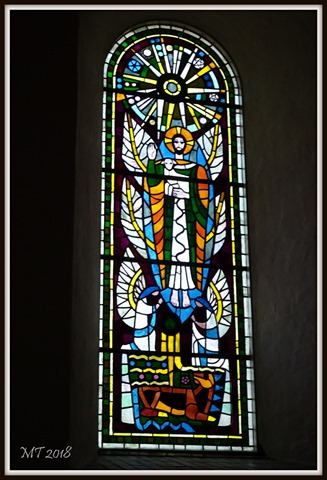
Today’s photo is a stained glass window in Växjö Cathedral.

Merry Christmas to all of you around the world who have Christmas Day as your main day of celebration!

Tuesday, 9 October 2018

Kalmar – City Wall & Cathedral

Road Trip 2018, Part 20 (19th July)

DSC04284

In Kalmar, we stayed three nights at this hotel on the outskirts of the city, rather close to the Öland bridge (but not so close that you actually see the bridge from there). It’s part of the university campus and serves a conference hotel during most of the year; but also as a convenient B&B for tourists in the summer. The accommodation is in a different building than the reception and restaurant; but in the hot dry weather we were having, that was not a problem. For us, the location was good because we wanted one full day over on Öland, and another day in the city of Kalmar; and it was kind of relaxing not to have to start every morning with packing all our stuff again.

After breakfast on Thursday, we drove into the city of Kalmar, and found a parking lot within reasonable walking distance from the places we inteded to visit before lunch. The parking was close to an old city wall with a walkpath on top, of which we made use to get an overview of the surroundings.


DSC04074

DSC04077

DSC04076

DSC04075

Somewhere around here we got down from the wall and went off in a different direction.

DSC04078

DSC04079

DSC04080

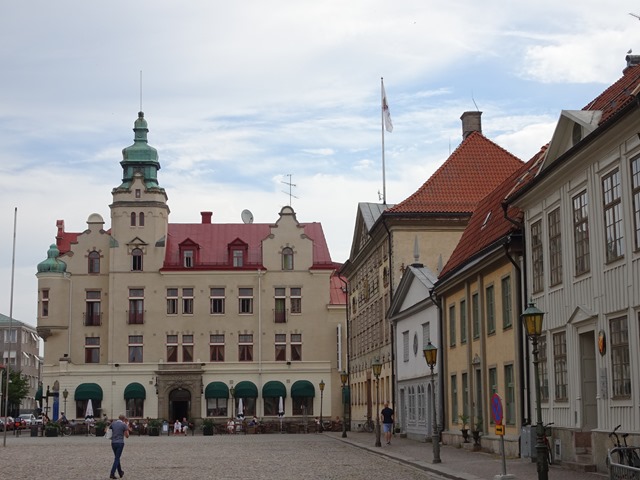
There are a lot of picturesque old houses in Kalmar and I kept snapping photos without really knowing what I was looking at most of the time.

2018-07-19-02 Kalmar staty

DSC04084

DSC04088

DSC04108

DSC04086

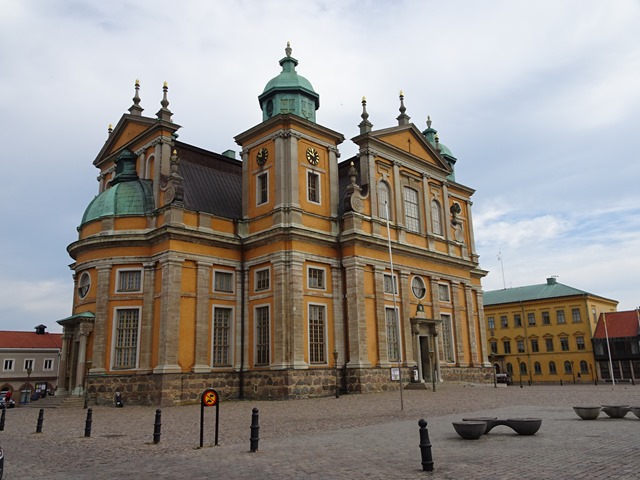
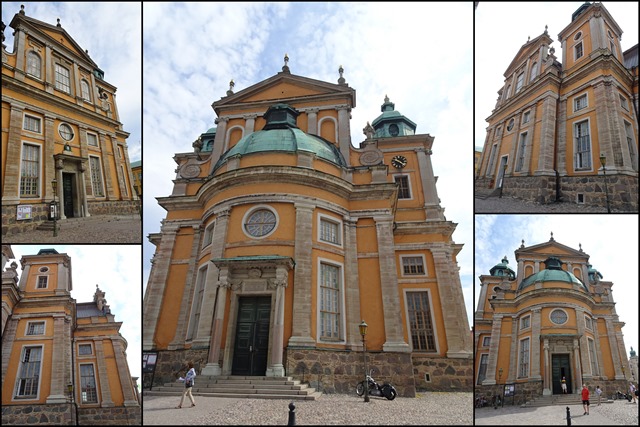
The 17th century Cathedral stands out a bit extra though – although I have to confess that if I hadn’t known what I was looking for, “cathedral” might not have been my first guess for this building – looking more like some kind of compact baroque palace.

2018-07-19-02 Kalmar Domkyrka1

When reading up on the history of Kalmar afterwards, I learn that the cathedral (and also the city wall) belongs to the ‘new’ fortified city of Kalmar, built in the mid-17th century. Before that, there was/is an even older Old Town, closer to the Castle (which we’ll be visiting in another post). The ‘new’ town was planned according to Renaissance ideals, with church and town hall across from one another in the town square. The cathedral was designed by the Swedish architect Nicodemus Tessin the Elder and is one of the foremost examples of classical baroque architecture in Sweden. The construction began in 1660, but was interrupted on several occasions, including a war. The cathedral was finally finished in 1703.

DSC04095-002

2018-07-19-02 Kalmar Domkyrka2

DSC04092

DSC04093

DSC04094

2018-07-19-02 Kalmar Domkyrka4

2018-07-19-02 Kalmar Domkyrka5

I have no details about the interior of the church, but while the main decorations may still be original baroque, there are definitely also a few items of later design. I did not go up front to take close-up photos, because there was a clergyman sitting there talking to a couple about some ceremony. (The stone baptismal font shaped like a ship was at the back of the church, or in a side aisle. I think they also had another one up front.)


Related Posts Plugin for WordPress, Blogger...