Friday, 31 January 2014

Leading Lines (FMTSO)

CIMG6563-001

August 2013: 150th anniversary of the railway between Borås and Herrljunga. Steam train meeting a modern train at Fristad.

CIMG6565-001

(For more pictures from the railway anniversary, see the post Steam Train Nostalgia - September 1, 2013)

CIMG4247-001

Can’t resist including a Swenglish pun: “Livsfarlig ledning”  = “lethal [power] line”, as in high voltage. But “ledning” can also mean “lead[ing]”…

CIMG4234-001

Wooden footbridge, and shadows (May 2013)

CIMG4235-001 CIMG4216-001

The tall birch trees form lines leading upwards.

CIMG4233-001

The lake beach in spring, before it’s been cleaned up for the summer season. Lines in the sand shaped by the water.

Friday My Town: Leading Lines

Monday, 27 January 2014

Book Review: Entry Island by Peter May

Entry Island by Peter May (2014)
*****

If you liked Peter May’s Lewis Trilogy (The Blackhouse, The Lewis Man and The Chessmen), I think you will most probably enjoy Entry Island as well. This too is a detective novel, but with different characters, and set mainly on another island, in another part of the world: Entry Island, belonging to the Madeleine Islands in the French-speaking province of Quebec in Canada. However, the population on Entry Island (less than 130 people) forms an isolated English-speaking community.

File:Magdalen Islands.png

Which is why, when a murder takes place on Entry Island, the police team sent there from Quebec, includes Sime Mackenzie (Sime pronounced Sheem; a Scottish variety of the name Simon), fluent in both languages: English as well as French. One of the other members of the team is his ex-wife, Marie-Ange.

The murder victim is a man named Cowell, who lived on the island; and one of the main suspects is his wife Kirsty. When Sime first meets her, he is struck by a weird feeling of recognition, for which he can’t find any logical explanation.

Sime suffers from insomnia since his divorce, and the few hours he manages to doze off at all are filled with weird dreams. On Entry Island, not only does Kirsty Cowell pursue him even into his dreams, but the dreams also become mixed up with memories of stories he was told in his childhood, about his ancestor who emigrated to Canada from the Hebredian Isle of Lewis in the mid 1800s.

Throughout the novel, the perspective shifts between the contemporary murder investigation, and a diary kept by Simes ancestor (by the same name), who grew up on the Isle of Lewis as the son of a crofter.

While I loved the double or triple layers of mystery as such, to begin with I found myself questioning the old diary entries. Did they not seem a bit too detailed and modern in narrative style?

Then I remembered Daniel Defoe, Jane Austen, the Brontë sisters and Charles Dickens; and decided to give up that line of criticism and just enjoy the story!

Reaching the end, I really could not find any reason to give this book any less than five stars. There is a depth to Peter May’s storytelling (in this novel as well as in the Lewis trilogy) that goes way past being just entertainment for the moment. These books leave me with a feeling of having “been somewhere”, rather than just having read about it.

Saturday, 25 January 2014

Snow from the Past

There’s still now much snow on the ground here this winter (just a sprinkle), but if you’d like to see some snowy pictures from the past, I just put in a snowy Sepia Saturday post in my family history blog Greetings from the Past.

snow_0002-001  snow_0003-001

Friday, 24 January 2014

Open Space (Friday My Town)

CIMG7350-001

Just behind where I live, there is a wide open space in the form of a football ground.

DSCN1379-4

The view from my kitchen window across one end of that same field is one of the reasons why I live where I live just now. (That view was one of the things I immediately loved about this flat when I first came to have a look at it; which will be six years ago in April.)

CIMG9230-003

On rare occasions in the summer, I’ve been able to see a full rainbow (or even a double one!) stretching from one end of that field to the other.  There a few things, I think, that give as much impression of “open space” as a full rainbow… (For the camera to do it justice is another matter!)

CIMG0995-002

Water and sky meeting is another of those “openings”  that make your mind stretch the usual boundaries. This is from the lake outside town near ‘the House’ (where my parents lived in their retirement years, and my grandparents before them, back in my childhood).

I have to confess though, that while I love looking at water and skies… I really prefer to have my feet on the ground, and civilisation just round the corner.

Friday My Town: Open Space

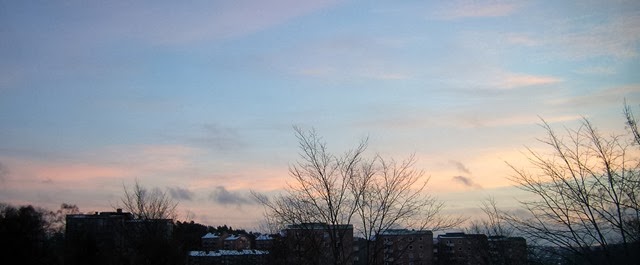
SkyWatch Friday

Weekend Reflections

Tuesday, 21 January 2014

Postcards: Castles of Eastern Europe

Two recently received postcrossing cards:

Castelul Bran

Bran Castle, Romania

Commonly known as "Dracula's Castle", this castle is marketed as the home of the titular character in Bram Stoker's Dracula (1897). The author never actually visited Romania, but is thought to have based Dracula’s castle on a description of Bran Castle that was available in turn-of-the-century Britain.

I was fascinated to receive this card and to look up and read a bit more about Bran castle, as I read the original novel by Bram Stoker only a few years ago, and found it a much better read than I had expected. (Not really being a big fan of vampire stories or movies otherwise.)

The original Bran castle was built ~ 1377-1388. The Castle was damaged and restored a number of times through the following centuries. Between 1888-1918, it was allowed to fall into decay, and was just used to house the region’s forestry staff.

After 1918, Transylvania became part of Greater Romania. The castle was restored by Queen Maria of Romania, and used as a residence of the royal family.

After WWII, the royal family was forced to leave the country by the communist regime, and the castle was turned into a museum.

In 2006, after several years of legal proceedings, the castle was returned to the heirs of Princess Ileana of Romania and Archduke Anton of Austria. In 2009, they opened the refurbished castle to the public as the first private museum of the country.

You can read more about its history here:
http://www.bran-castle.com/history.html


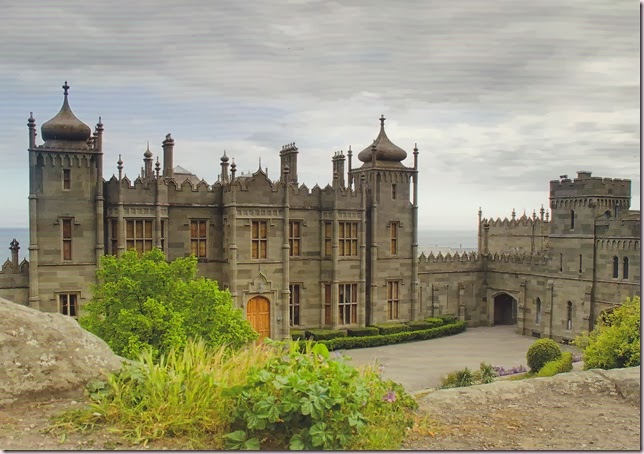
Vorontsov Palace

The Vorontsov Palace, Alupka, Ukraine

The Vorontsov Palace, or Alupka Palace, is situated at the foot of the Crimean Mountains in southern Ukraine, near the town of Alupka. It is one of the oldest and largest residential palaces in Crimea, and a popular tourist attraction. The palace was built 1828-1848 for Prince Mikhail Semyonovich Vorontsov for use as his personal summer residence.

The palace was designed in a loose interpretation of the English Renaissance revival style by English architect Edward Blore and his assistant William Hunt. Blore is particularly well known in the UK for completing the design of the Buckingham Palace in London.

Related Posts Plugin for WordPress, Blogger...