Thursday, 3 November 2016

Body & Soul (4 More Book Reviews)

With many old classics, once you’ve downloaded the Kindle book for free, an Audible version is also often offered at low price. I always keep a lookout for that, as I love the Whispersync feature that allows me to alternate smoothly between reading with my eyes, and listening. (It means I can keep on reading even when my eyes and/or neck are too tired…)

The first two books below belong in that category. The third was not free, but cheap. The fourth I had in paperback since before, but recently bought the audio book. 

Bildresultat för ethan frome 

Ethan Frome by Edith Wharton (1911 - but new to me)
(Audio narration by C.M. Hebert)

The impression that remains with me from this book is of a rather gloomy love story, set in snowy winter time in a small American town, and among rather poor people. Ethan’s wife Zeena is sickly, her cousin Mattie comes to live with them and help out, and…

In some ways the atmosphere in the story reminds me of Emily Brontë’s Wuthering Heights; and also  of Thomas Hardy’s The Mayor of Casterbridge.

I can’t say I exactly loved it, but it did leave an imprint.

From Wikipedia:
“Some critics have read the novel as a veiled autobiography where they have interpreted the likeness between Ethan's situation with his wife in the novel to Wharton's unhappy marriage to her husband ---“


Bleak House (Centaur Classics) [The 100 greatest novels of all time - #49] by [Dickens, Charles]

Bleak House by Charles Dickens (1852/53)
(Audio narration by Sean Barret and Teresa Gallagher)

This is an old favourite of mine – I’ve read it more than once before (the first time in my English class at university) and also watched a TV series based on it a few years ago. This time I listened to most of it as audio book (but also read some chapters).

The narrative shifts between a neutral narrator and one of the main characters in the story (Esther); and having the audio book read by two different voices as well I think was a good choice.
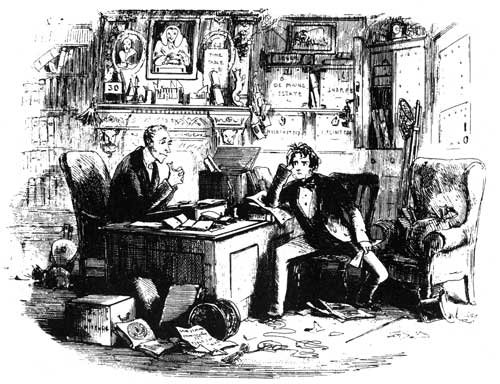
The background story is a long-drawn court case (Jarndyce vs. Jarndyce) passed on from one generation to another, controlling the lives of the possible heirs involved, and giving them hopes of one day perhaps coming into a fortune. Two young wards of this court case, cousins Richard and Ada, are taken into care by an older relative, Mr. Jarndyce of Bleak House – kind and wise, but at the same time also hardened by years of tiresome experience of the futility of the court procedures. As female companion for Ada he also takes in Esther, who (for all she knows herself) is an orphan. Many other characters are involved in the story as well, both wealthy and very poor. Altogether, Dickens weaves a long and intricate tapestry of events and mysteries, romance and friendships in this novel. It is also known as the first, or one of the first, detective stories in British literature – as it also involves a murder, and a police inspector investigating it.

It remains my favourite of all the Dickens novels that I’ve read (quite a few over the years, starting with Oliver Twist back in my early teens). My old Penguin Classics copy of Bleak House has 950+ pages in rather small print; and the audio book lasts 35 hours 15 min. But I could read it again (and if I get a long enough life, I might well do so).
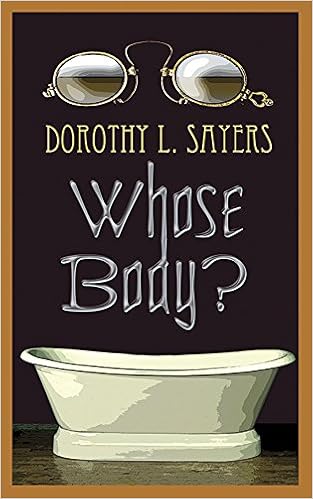
 

Whose Body? by Dorothy Sayers (1923)
(Audio narration by Roe Kendall)

This is the first of the Lord Peter Wimsey mystery novels. I think I’ve read most of them in the past (and also BBC radio plays and TV series) – but not in the order they were written.

Reading this one now (Kindle+Audible), I kept in mind the fact that it is the first. Personally I would not rate it as one of the best. I think the characters (besides Lord Peter himself, also a few more who reappear in the following books) get more interestingly developed in the later novels; in a way that has since been adopted (and even further developed) by countless other writers of crime fiction. (While Agatha Christie, for example, never really did that with her detectives. With Poirot or Miss Marple, I never found it made much difference in which order I read them.)

I happened to find the whole Lord Peter series (15 books) at bargain price for Kindle a couple of years ago, and bought the whole bundle in the hope of somehow also finding the time to reread them, in chronological order. (Hmmm…)


Image

Till We Have Faces: A Myth Retold by C.S. Lewis (1956)
(Audio narration by Nadia May)

When I first read this novel, way back in my pre-internet youth, I never felt I fully understood it – partly perhaps because I was not familiar enough with the story from Roman mythology that it’s based on.

Recently finding it as Audible audio book, I decided it was time to give it another go. And this time, I also did a bit more background research. (So much easier these days!)

The novel is based on the myth of Cupid and Psyche, as told in the /very/ old classic The Golden Ass (or Metamorphoses) by Apuleius (c. 124-170 AD).

Actually it dawned on me that I also had Apuleius’s book in my bookcase, in Swedish – and have had for a very long time –but don’t think I ever read it. Now I took it out, though, and read the part involving the Cupid and Psyche myth. (Don’t worry – you can also find the myth retold in Wikipedia.)

To summarize very briefly: Psyche (representing the soul) was a young princess, so beautiful that even the goddess Venus became jealous of her beauty. So Venus sent Cupid (also known as Amor or Eros) to cause her trouble. But instead, Cupid himself fell in love with Psyche, and took her to live with him in his palace. However, she was not allowed to look at his face, so they only came together in the dark of the night. Psyche’s sisters came to visit her, got jealous, and persuaded her that her husband must be a monster as she was not allowed to see him. So Psyche began to doubt, and one night, after Cupid had gone to sleep, she lit a lamp to look at him. But she spilled some hot oil on him, which woke him up. He fled; and Psyche set off on a long journey to try and find him again, encountering many different difficult tasks on the way.

What Lewis basically does is to retell the story from the point of view of one of Psyche’s sisters, whom in the novel is called Orual. It is she who is the narrator in the novel; and she sets out to accuse the gods, both of having misled Psyche, and of having totally twisted the legend. Because Orual, to begin with, sees it all in a very different light – she claims she was never jealous at all, but only ever had Psyche’s best interest in mind. And so she sets out to write down her own version of what really happened.

However, later on in the book, there is another twist, when Orual is forced to question even her own story: “Memory, once waked, will play the tyrant…”

I’ll not go into detail about how it all ends, or how it might be interpreted. But thinking about it now, I think I see thematic similarities between this novel and the last of the Narnia Chronicles – The Last Battle – which was published the same year (1956). And I would say that one recurring theme in both books is how people can look at the same thing, but perceive it very differently.

It’s like with optical illusions…

(If you’re on Facebook, you’re likely to come across at least one every day - usually with the exhortation “share if you see it”, and claiming that if you do see it, you’re among a rare 3% or so of the world’s population. I’m frequently surprised at how many of my friends seem to belong to that elite!)

Wednesday, 2 November 2016

Human Croquet & Hogwarts Revisited

Although I sometimes enjoy writing reviews, it’s not always that I find the time or the energy for it. That does not mean I’ve not been reading (and thinking)…

I’ve dropped the ambition to catch up with everything; but I thought I’d try a summary post with “mini” reviews from my reading over the last three months (August – October).

But of course, once I got started, I ended up writing more than I thought I would. So I’ve just decided to split the result into two posts. (As much for my readers’ sake as for my own!)

This post will be about some “contemporary” books.
In another I’ll be reporting from my reading of some classics.

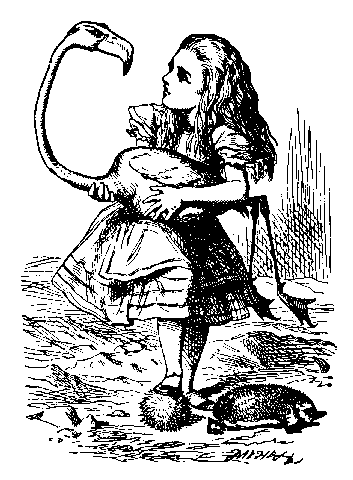
Bildresultat för alice in wonderland croquet
(Illustration from Alice in Wonderland, by John Tenniel)

Human Croquet by Kate Atkinson (1997)
I first read this book in May this year, on Kindle. I liked the introduction chapter; but the deeper I got into the book, the more confused I felt by the time warps and retakes and multiple alternatives. Quite possibly it’s all really frightfully clever (I did recognize references to the Bible, and Shakespeare, and Jane Eyre, and Alice in Wonderland, and…) – but personally, I have to say I felt sort of cheated at the end.

Still puzzled, I decided to give it a second chance a few months later, when also finding it as audio book from the library – but even after a that, I still felt I did not know how to review or rate it.

I also listened to two more books by the same author: Life After Life and A God in Ruins (those two in Swedish), but have to admit I found those equally confusing. I suppose I sort of get the idea (like, can there ever be a “true” version of a fictional story?) – but I think I still prefer it when authors make up their mind!

(If you are going to read them, I think I would recommend that you read them in text rather than listen to them as audio books. At least if like me, you listen in bed, and tend to fall asleep while listening… With an ever-changing story, it is very hard to find one’s way back the next day to where it last made sense!)

Bildresultat för harry potter and the cursed child

Harry Potter and the Cursed Child by  J.K. Rowling (2016)
The Special Rehearsal Edition Script was released in book form at the same time as the play opened on stage in London. (I was able to buy it the next day in the local book shop in my town.) I’m sure that seeing it on stage must be spectacular; but for a play, I also actually found it surprisingly readable. (I’m not sure why I say surprisingly; as people have been reading Shakespeare for centuries…) The story picks up right at the end of the epilogue in the last book, with Harry Potter’s younger son, Albus Severus, as the main character. I think Rowling quite cleverly manages to tell a “new” story, while at the same time also linking it to the past. I liked it, and I think the play also bears a message in its own right: about how we relate to history, and family, and finding ourselves, and the delicate balance between learning from the past vs. making our own way into the future. (I can also see why she chose this format for it. As a book all the flashbacks would be too repetitious; and as film I think would also feel weird with different actors than we’ve become used to seeing.)

A month later, three collections of short stories from J.K. Rowling’s website Pottermore were also released for Kindle. I think all the individual stories can also be found for free on that website; but as I’ve not been following that, I did not mind paying a few dollars to get them neatly collected in the Kindle format.

  • Short Stories from Hogwarts of
       Heroism, Hardship and Dangerous Hobbies
  • Short Stories from Hogwarts of
       Power, Politics and Pesky Poltergeists
  • Hogwarts: An Incomplete and Unreliable Guide

I enjoyed the extra background info about characters and objects and whatnots from the books. In short, JKR is one author who does like to stay in control of her creation. Winking smile Even though she too plays around a lot with time and memories and alternative solutions, and even adds magic into the mix, she still sets limits for how far experiments can be taken – even in the Wizarding World!
Bildresultat för raising steam terry pratchett

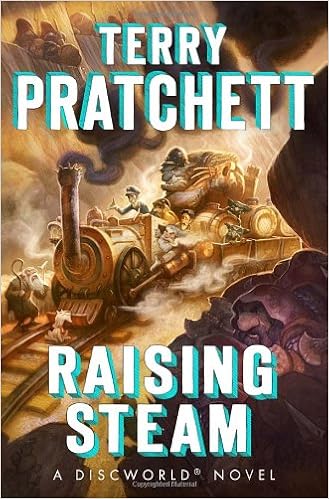
Raising Steam by Terry Pratchett (2013) 
(Audio narration by Tony Robinson).
This was the last book in Pratchett’s Discworld series to be published before the author’s death (2015). It features the introduction of railways and locomotives into the Discworld, and belongs in the subseries with the character Moist von Lipwig – who in a couple of previous books was also involved in sorting out the post office and banking system in Ankh-Morpork.

I have actually listened to all of the 40 Discworld novels as audio books – but never read any of them in print. It was my brother who first introduced me to the series, I think back around 2000/1 – and has kept feeding them to me…  This last one, I bought/downloaded myself from Audible, though. (One more book has been published posthumously, but I’ve not read that one yet.)

There is a complete Discworld bibliography at Wikipedia; helpful if you want to read the books in order, or according to sub-series.

Saturday, 29 October 2016

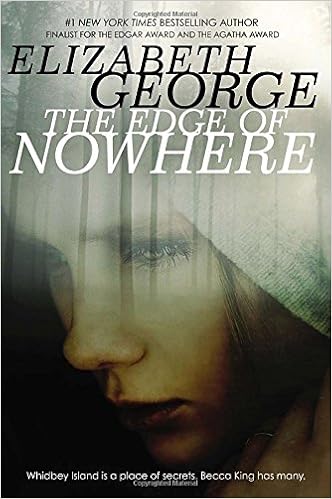
The Edge of Nowhere (Book Review)

The Edge of Nowhere by Elizabeth George
# 1 in the Whidbey Island Saga series

Audiobook: Narrated By Amy McFadden

With this book, Elizabeth George takes a step aside from her famous series of Inspector Lynley detective mysteries set in Britain, and enters into a rather different genre: Mystery for young adults, with a sprinkle of ‘paranormal’ on top. The story is also set in in the United States for a change; and more specifically Whidbey Island, Washington.

At the centre of the story we have a teenage girl with the (apparently inherited) ability to hear other people’s thoughts – or ‘whispers’, as she calls them. Not always enough to make out what it means: what she hears is more like what’s uppermost in someone’s mind, the things people keep saying to themselves (but not out loud, and not meant for others to hear).

As hearing everything that everyone is thinking is not always a blessing and can become rather tiresome, she is usually wearing a kind of reversed hearing aid device, providing her with a kind of white noise to help block out the thoughts coming from other people. When her stepfather finds out about her ability, he takes advantage of that for criminal purposes though; leading to a situation where the girl and her mother have to leave everything behind and flee from him, adapting new identities and names to make sure he does not find them. (All this is sketched rather briefly as background in the first chapter.)

Becca (as she now calls herself) is supposed to be staying for a while with an old friend of her mum’s, while the mother goes off to arrange a more permanent solution for them. Her mum puts her on the ferry to Whidbey Island, where the friend is supposed to meet her. However, no one is waiting for her; and when she tries to contact her mother on the cellphone, she gets no connection. So Becca is left entirely to her own devices when it comes to finding shelter and making friends in the new place.

One of the first people she makes acquaintance with is a boy or young man called Seth. He in turn puts her in contact with a woman named Debbie (with a somewhat obscure past), who runs a motel. She takes Becca in and lets her stay there in exchange for helping out a bit, in the motel and with looking after her grandchildren (of whom Debbie has the care). 

There is also another woman in the story who remains an even bigger mystery, because Becca never manages to pick up any of her thoughts/whispers at all. Another friend she makes is the adopted son of the town's deputy sheriff. He’s also mysterious, because from him Becca can only pick up one peculiar word, which he keeps repeating to himself over and over like a mantra (but it does not make any sense to Becca). And yet with this boy she feels a bond that seems to go deeper than with anyone else. And when he ends up in hospital in a coma, the mystery deepens. (Or at least is supposed to…)

Some of the mysteries get sorted out before the end; but not all. Presumably, some things are left intentionally as cliffhangers to keep readers hoping to find the answer in the next book. So far, three more books in the series have been published, but I have not read those – yet. (Whether I ever will, remains to be seen. Maybe if I happen to find those too at bargain price…)

In an afterword, Elizabeth George seems to be making a point of explaining that except for one or two slight alterations to suit her purposes, the setting of this novel is the real Whidbey Island, with a lot of research put into getting the details right. I have to say that to me (never having been there) those details matter very little; and there are other inconsistencies to the story that bother me a lot more.

While it may be easy enough to “see” the characters, events and environment play out in my mind (as in a film), I find the plot to be weak; and what there is, seems to be hanging too much on the thin thread of Becca’s ability to listen in on people’s thoughts – something which in itself does not seem to be very well developed. Moreover, we occasionally get to see events from for example Seth’s point of view instead of Becca’s. I think the story might (possibly) have felt more convincing if the narrative perspective had been kept consistent throughout.

Other reviews I read (after I had finished the book) also point out other weaknesses in the plot. For example, that it seems unlikely that no one at the school would have enquired further into Becca’s background (for a parent or legal guardian, for example!) before accepting her as a student.

Had this been a story by a new author, I may have been less critical (and more curious to read more to see if the story improved). But knowing this to be written by an already famous author of mysteries, I find it a bit disappointing. (And at the same time I’m also aware that with the Lynley series too, she does have a certain tendency to leave loose ends behind for the next book…)

Having listened to this book mostly as audio book, I have to say that I enjoyed Amy McFadden’s narration, though. While I’m more used to listening to British English, I appreciated the American accent with this one (because of the book being set in the US).

Weekend Reflections

CIMG9838

From a rainy day earlier in the week.
(The same maple tree reflected from different angles.)

CIMG9839

. . .

Weekend Reflections

Friday, 28 October 2016

Postcards for the Weekend – Anything You Wish

Oh, sorry… Did you say wish? I thought you said fish…
(Just kidding!! I kind of picked the first card more or less at random; and as it looked like the squirrels hadn’t caught a lot of fish, I went looking for some more…)

160728-160801 from John 186

Beatrix Potter - The Tale of Squirrel Nutkin (1903).
 
“… they caught seven fat minnows as a present for Old Brown.”
[from John in England, July 2016]

160121-160129 from Ginny

© Geoffrey Grisso
[from Ginny in the US, 2016]

RU-3536009

RU-3536009 – from Russia, April 2015
(The printed text on the back is in Russian, but the sender translates it:
“I wish you happiness! Magic, like a blue bird, and a fairy like goldfish!”
- and adds that these comparisons are taken from Russian folk tales.)

Weekend Linky Party:

Related Posts Plugin for WordPress, Blogger...