Saturday, 29 January 2022

The Carved Lions (Book Review)


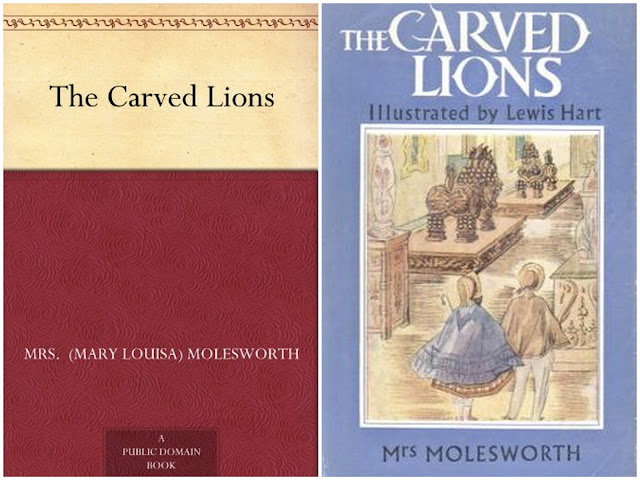
The Carved Lions
by Mrs. (Mary Louisa) Molesworth - 1895
(79 pages)

Recently, Meike (Librarian) blogged about another title - Christmas Tree Land - by Mrs Molesworth (1839-1921) - a classic English author of children's stories, previously unknown to me. Meike's review of that book made me wonder a bit if maybe her works could have inspired C.S. Lewis when writing his Narnia series. So I looked up some more of her titles, among which I found The Carved Lions (in the public domain and free for Kindle). Having read it, I'm still wondering... If C.S. Lewis did read this book in his childhood (and he could have - he was born in 1898), I suspect he may have felt (like I do) that there were elements in it that could have made it a good fantasy book - but weren't (in that respect) quite used to their full potential...

Reading it 125+ years after it was written, and as an adult, to me the the story feels "uneven". The narrator in the book is an old woman looking back on her childhood (so the events meant to have occurred in the early 19th century rather than towards the end of the same century). Geraldine and her brother were quite happy living with their parents in a village. They were not exactly poor, but also not rich. ("It never entered my head that there was anything to be ashamed of in living in a small house and having only two servants.") Her brother (a couple of years older) went to school but Geraldine was home-schooled by her mother. Sometimes she wished she could go to school to.

One of both children's favourite things was to accompany their mother when she had some errands in the village. At the entrance of one shop there were two huge carved lions, looking very life-like. Geraldine and her brother used to imagine (or pretend) that these could come alive, and carry them off on adventures.

"A little way in from the front entrance to the shop --- stood a pair of huge lions carved in very dark, almost black, wood. They were nearly, if not quite, as large as life ---"

Then suddenly there is a big change in their lives. The children's father gets a job abroad (which it seems he has to take for financial reasons). His wife has to go with him; but for reasons to do with climate and whatever, they can't take the children. 

So the children are both sent to boarding schools - Geraldine to one for girls in the same village where they lived. Apart from her parents going away, she is actually kind of looking forward to this - hoping to make some new friends.  But the school turns out a huge disappointment to her. And here the story goes off into lengthy descriptions of the school, the teachers, and her growing unhappiness. Until one day she runs away, in the hope of finding someone who might be able to help her get news of her parents. It turns out she doesn't remember the streets of the village as well as she thought, so she gets lost - but eventually ends up at the shop with the lions, so exhausted that she falls asleep next to one of those. 

And then the lions come alive, and wonderful things start happening... Or... do they?
(Spoiler alert for the next paragraph)

Next thing, Geraldine wakes up, and finds herself in a strange bed, surrounded by faces she does not know. It turns out the owner of the shop found her sleeping next to the lion, and had taken her in. She has contracted a bad cold from being out in bad weather, and has to stay in bed for a while. However, it all turns out for the best. Various misunderstandings get sorted out, and she ends up not having to go back to the school, but gets to stay with nice people (including a girl her own age who also likes the carved lions); until eventually her parents come back from abroad.

The book is quite short (79 pages). It has been called the author's masterpiece by some; but as I already said, to me it feels uneven, with some parts of it full of details, but others only very hastily sketched, and the fantasy parts not allowed to mix too much with "reality".

The idea of the carved lions coming alive and letting the children ride on their backs to a faraway place still reminds me of Narnia, though. ;-) 

(Remains to be seen how well I'll remember the book in a couple of years or so - that's usually the best way to tell the quality of a story in the long run!)

Friday, 28 January 2022

A Bookish Challenge

A friend posted a challenge on Facebook which I found quite amusing, so I thought I'd pass it on here, together with my answers. I don't know who originally came up with the questions. But it actually turned out easier than I thought to find answers to them among the titles of books I read or listened to during 2021 ;-)  

How about you? 


Can you answer the following questions
using the titles of books you read last year?

DESCRIBE YOURSELF
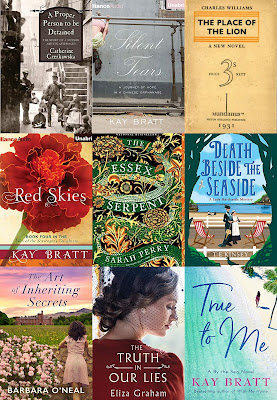
A Proper Person to be Detained (Catherine Czerkawska)

HOW ARE YOU?
Silent Tears (Kay Bratt)

DESCRIBE THE PLACE YOU LIVE IN
The Place of the Lion (Charles Williams)

IF YOU COULD GO ANYWHERE, WHERE WOULD IT BE?
A Promised Land (Barack Obama)

YOUR FAVOURITE MEANS OF TRANSPORT
The Joy and Light Bus Company (Alexander McCall Smith)

YOUR BEST FRIENDS
Remarkable Creatures (Tracey Chevalier)

WHAT IS THE WEATHER LIKE?
Bitter Winds (Kay Bratt)

WHAT IS YOUR FAVOURITE MOMENT OF THE DAY?
Red Skies (Kay Bratt)

WHAT IS LIFE FOR YOU?
The Art of Inheriting Secrets (Barbara O'Neal)

YOUR FEAR?
The Essex Serpent (Sarah Perry)

WHAT IS A PIECE OF ADVICE YOU HAVE BEEN GIVEN?
How to Raise an Elephant (Alexander McCall Smith)

THOUGHT FOR THE DAY?
The Truth in Our Lies (Eliza Graham)

HOW YOU WOULD WISH TO DIE?
Death Beside the Seaside (T.E. Kinsey)

THE CURRENT STATE OF YOUR SOUL?
True to Me (Kay Bratt)

YOUR DREAM?
Equal Rites (Terry Pratchett)


Thursday, 27 January 2022

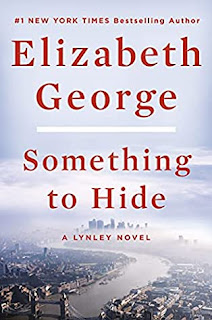
'Something to Hide' (Book Review)


Something to Hide – Inspector Lynley Book 21
by Elizabeth George  (published 11 January 2022) 

(Read on Kindle)

****

A black female police detective, Teo Bontempi, is found unconscious in her home. She is taken to hospital but her life cannot be saved. The autopsy reveals that she had been given a blow to the head, and a murder investigation is started. She had been working on a special task force to do with FGM – female genital mutilation (female circumcision). Acting Detective Superintendent Thomas Lynley is assigned to the case, together with Detective Sergeants Barbara Havers and Winston Nkata.

Parallel to the murder case, we're introduced to a Nigerian family, husband and wife (Monifa) with two children, a teenage boy (Tani) and a younger daughter (Simisola). The father wants to keep the old traditions from his native country, and against his son's wishes, he is making arrangements for him to marry a young girl in Nigeria. He also starts making similar arrangements for his own daughter, even though Simi is still just a child. Those arrangements include FGM – female genital mutilation (female circumcision). Husband and wife have some different opinions about this ritual though. Monifa can't really see a way to stop her husband's plans – but she has her own ideas about how deal with it. At the same time, Tani is prepared to do everything he can to protect his little sister - from both their parents...

Lynley's old friends Simon and Deborah St James (from several previous books in the series) manage to get involved in this case (or these cases) as well. Deborah is a photographer, and as such working on a film/photo project with an organization working against FGM and domestic violence. Through this project she gets to know both victims and helpers – some of whom might be involved (one way or another) in the murder case as well.

As usual, the detectives' personal lives play a role in the story too. We get to know a bit more about Nkata's background and family (I can't recall having heard all that much about his family before, but I may have forgotten). Lynley is (still) struggling in his relationship with Dairdre, and also still processing the loss of his wife Helen (who was murdered I forget how many books ago). Although his own life is vastly different from the case he is working on now, there are still certain parallels that can be drawn when it comes to relationships and what men/women expect from each other. As for Barbara Havers, she too is still struggling with what other people seem to expect from her.

There are a lot of loose ends to either untangle or tie together in this book; which takes the author some 700 pages to sort out. I did feel from time to time that there were a few too many repetitions, and that it could all have been wrapped up quicker. On the other hand, I suppose the length of the novel does reflect the complications involved: cultural differences, unclear identities, missing paperwork and evidence, wrong conclusions, need for secrecy vs bureaucracy, mistrust of authorities, etc.

All in all, the book deals with an important topic, and the plot is quite interesting. But I can't help getting the feeling that after 20+ books, the author has a bit of a struggle sometimes with how to proceed with the personal lives of the detectives...


Saturday, 22 January 2022

After The Storm - or Here We Go Again


This week we had a rain/snowstorm, resulting in very icy and slippery streets, causing problems for traffic on the big roads as well as pedestrians in town. Today at least the wind had calmed down a bit. One still has to watch one's steps though, as it's still icy here and there, and also lots of branches on the ground from the storm. 

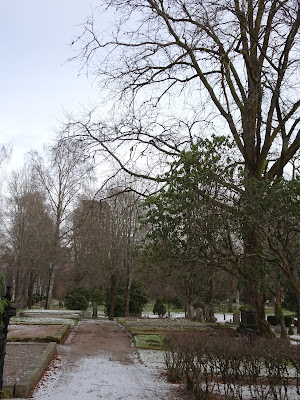
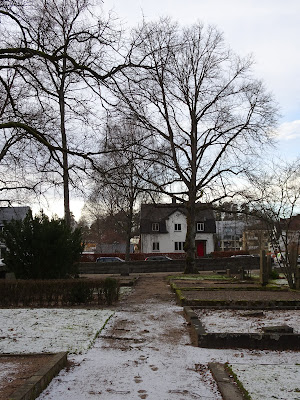
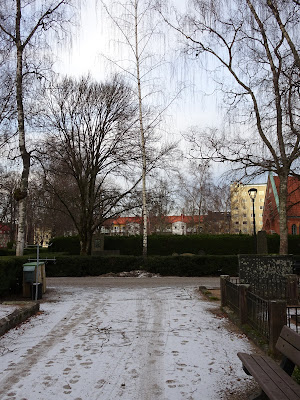
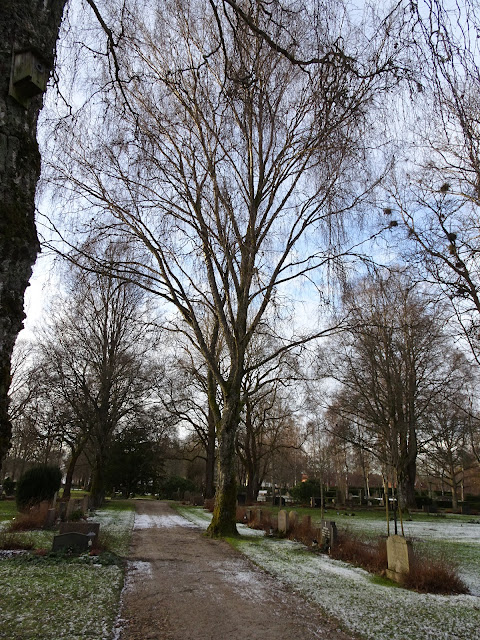
I went for a walk in the old cemetery nearby; keeping my eyes on the ground and watching my own feet carefully, but stopping here and there to look up and let the camera have a bit of exercise as well. I was reminded of Meike's post from a couple of days ago. Her hike was a much longer one and in more dramatic terrain - but I think she'll probably be able to guess the connection made in my head.

Starting with some photos taken from one and the same spot, turning in different directions.

Looking south

Looking east

Looking west

Looking north

And some more:


You've probably got it by now: What mystified me was that while there was quite a lot of snow and ice on the ground in some places, there were also large patches of almost bare ground in between. I guess the reason must be a combination of strong winds, temperature hovering around freezing point, and perhaps also sun vs shadow (after the rain/snow had ceased). But it does look rather odd!


Twigs blown off from the trees, some loose and having blown around, some frozen into the snow/ice and forming various intricate patterns. 

Some bigger branches broken from tall trees as well:

Down by the river, no snow at all to be seen:


Linking to Weekend Street/Reflections 52

Weekend Reflections

Tuesday, 18 January 2022

Anonymous or Multifaced


Yesterday I went into town for a haircut; and after that, a couple of minor errands took me to the main square. When I got there, I realized that I obviously hadn't been as far into the city centre as the square since before New Year - and before the arrival of this (temporary) sculpture, called 'Faces', which was put up for the city's New Year Eve celebrations. I read about in the local paper back then, but since then had forgotten all about it. Once I did get to the square, it was kind of hard to ignore - even though it was currently in "anonymous" mode. The sign next to it informed me that it only shows its face(s) between 16-23 (i.e. after dark). I'm very rarely in town at that time of day myself, though - at least in winter. And yesterday, I definitely did not feel like hanging around the square for three more hours just to  see the sculpture "in action"...
 
However, scanning the QR code at home from my photo, I discovered that you can have a look at all the faces and information about the artists at https://artscape.se/faces/. 


Here's the face for today (18 January), copied from that website:


Felicia Gabaladons gathers inspiration from nature, her native American heritage and it’s symbols and brings it to life with bold palettes and symmetric patterns. She’s based in Oakland, California.

“The fox is often seen as a symbol of intelligence as well as playfulness. Combined with an artistic expression inspired by textile art and modern indigenous art from the U.S. tribes, it connects BorÃ¥s with other cultures.”

 
Our World Tuesday Graphic
 
Related Posts Plugin for WordPress, Blogger...