Showing posts with label languages. Show all posts

Wednesday, 6 August 2025

Luck vs Silver Lining - A Sequel

 This photo has been posted before on my blog here  (25 April 2025)


I ended yesterday's post with a question:

In Swedish we have a saying: "ha tur i oturen", meaning "to have good luck in the midst of bad luck"... I can't think of a corresponding common expression in English? If you can, please enlighten me!

I got several replies (thanks!) referring to the English quote about "clouds with a silver lining" - while no one seemed to have a different suggestion.

As perhaps not all readers are in the habit of going back to check replies to comments, I decided to put my "afterthoughts" in a separate post as well. 

I'm familiar with the saying "every cloud has a silver lining" in English since before. To me there is a slight difference in meaning between that and the Swedish expression about having "good luck in the midst of bad luck", but I suppose it's as close as we'll get in finding an equivalent :)  

The Swedish expression kind of involves a turn of events [i.e. first something bad happens; but after that, something good happens to at least partly kind of balance that out]; while to me the "silver lining" seems to be more about finding a brighter side to a dark situation.(?) 

I looked up the phrase "silver lining" in my copy of Wordsworth Dictionary of Phrase and Fable, and here is what they say:  

A silver lining. The prospect of better days, the promise of happier times. The Saying, Every cloud has a silver lining, is quite an old one; thus in Milton's Comus, the Lady lost in the wood resolves to hope on, and sees 'a sable cloud turn forth its silver lining to the night'.

Though outwardly a gloomy shroud
The inner half of every cloud
Is bright and shining;
I therefore turn my clouds about,
And always turn them inside out,
To show the lining.
Ellen Thorneycroft Fowler, The Wisdom of Folly

---

I also asked Google AI, which gave me the following summary:

A "silver lining" refers to a positive or hopeful aspect within a difficult or negative situation. It signifies finding something good, even when things seem bleak. The phrase often appears in the idiom "every cloud has a silver lining," suggesting that even in the worst circumstances, there's always a potential for something positive.

The phrase originates from a poetic image of clouds with a bright edge when the sun is behind them. This suggests that even when things are cloudy (bad), they can still have a bright, positive aspect. It's a metaphor for optimism and finding a reason to be hopeful, even when facing adversity. 

 
And Google AI's comment about the Swedish expression  "tur i oturen" goes something like this (translated from Swedish to English by me):

"Tur i oturen" is a Swedish expression describing a situation where something bad leads to something good. It's when an accident or adversity brings an unexpected positive result. For example: You miss a train, but because of that, you get the unexpected chance of meeting an interesting person. Or your flight gets delayed, but because of that you get upgraded to first class. 

I'm now thinking that perhaps a better translation to English of the Swedish expression would be "bad luck bringing good luck". However, this is not to be interpreted as something that always happens, or is always possible - it's only used when it happens.

Wednesday, 12 October 2022

1000 Postcrossing Postcards


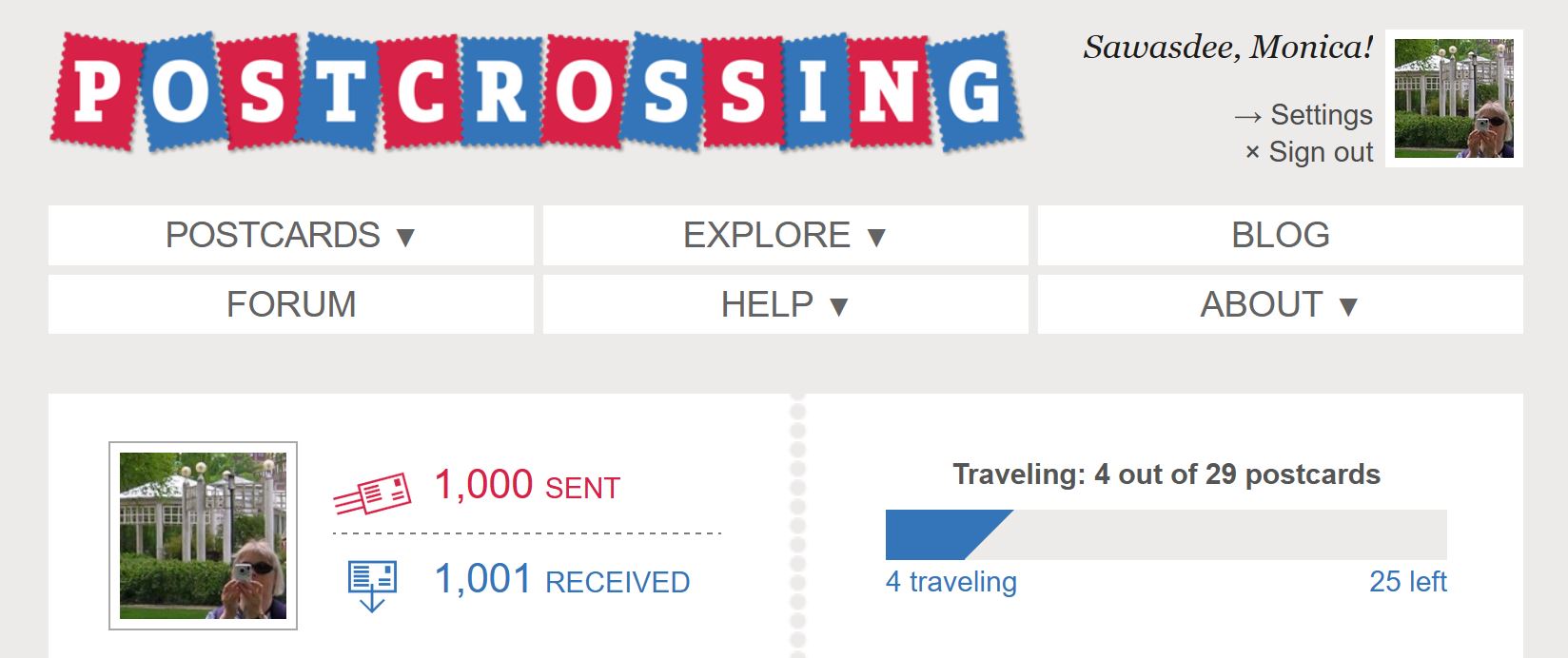
I just registered some incoming Postcrossing postcards, and noted that I've passed the impressive number of 1000 sent, 1000 received... 

I joined 15 May, 2013 - primarily because when going through my dad's study after he died (2011), I found lots and lots of still usable stamps, and decided that the most fun I'd get out of those was to send them out into the world! After I ran out of free stamps (+ postage kept going up, up up...) I've cut down a lot - but I'm still a member, and on 1st October I sent off a few to celebrate World Postcard Day. 

Here are the four incoming from today, that helped bring my statistics up to 1001 received:


From Spain - written in Spanish

 
From the Netherlands - written partly in Dutch

 
From Finland - written in Swedish 


Another one from Finland - written in English

Thankfully, none of the Finnish cards was written in Finnish! ;-) 

Should perhaps add that as for Spanish and Dutch, I have added those to my language profile on Postcrossing, so have only myself to blame!


Thursday, 20 May 2021

Celebrating 5 Years with Duolingo


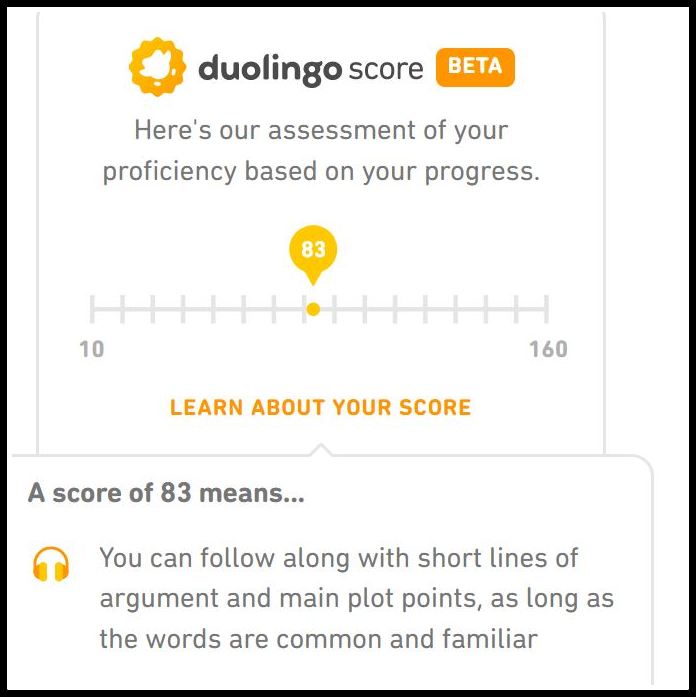
I'm celebrating 5 years of daily Spanish lessons at Duolingo.com

(Spanish)

You who have followed me through these five years know that along the way, I have also dipped into several other languages - some for repetition (German, French), some because they were already somewhat familiar (Norwegian, Danish, Dutch); and some just as a challenge to see how the brain would cope with something totally different (Welsh, Turkish, Russian). My latest addition to the last group is Finnish, which was introduced on Duolingo last summer. (Although Finland is a neighbouring country, Finnish is of totally different structure/origin than Swedish.) While I'm unlikely to ever learn enough of any of those last four languages to be of much use in direct communication, I still feel it's taught me a fair bit about languages in general. And I do feel rather proud of myself for having kept up my "streak" of daily Spanish lessons (+ more) through five whole years now . I would not have dared guess that when I started!

Sunday, 26 July 2020

Keeping Distance and Being Thoughtful


 "Keeping distance is being thoughtful"

These signs are found all over the parks in our city this summer, as a reminder to keep distance, even when sunshine and greenery and holiday mood may tempt us to forget all about the invisible virus.

On this particular occasion (last Tuesday), I had no difficulties keeping distance, though - as I was the only visitor in this little park down by the river when I took the these photos. Plenty of room for me to just be thoughtful all to myself!


Obviously, there are different rules for plants & flowers!


PS. Being a language nerd, I had to try to figure out what the languages on the sign are... I recognize four out of seven (Swedish, English, Finnish, and German at the bottom) but what about the ones in the middle? Google Translate helped me identify the fifth as Somali. No 4 and 6 are likely to be Arabic and Persian, but which is which? I searched for ways to tell them apart, and found a 5 min YouTube course on that very topic... So I think I can now say that the languages from top to bottom on the sign are: Swedish, English, Finnish, Arabic, Somali, Persian, German.

Why? In the previous century, we had lots of Finnish immigrants (and many people with Finnish roots still living here). In later years, many immigrants from the Middle East and Africa. As for German, I guess some immigrants (for example from Eastern Europe) perhaps know more German than English (+ we get German tourists in the summer).

Sunday, 17 May 2020

Another Anniversary! - 4 Years of Duolingo


Having posted about my 7 years of Postcrossing yesterday, it struck me that it's also time to celebrate 4 years of language learning via Duolingo

I'm not sure if Duo too will be sending me a special reminder; but tomorrow my 'streak' on that app will be 1460 days = 4x365 = 4 years. Also confirmed by a blog post of mine from May 2016, On Learning Languages

How time flies when you're having fun! (...and especially in the company of an encouraging little green owl to flatter your ego every time you manage to get something right...)


As followers may remember, I have been reporting my progress and statistics on this blog every now and then over the years. As the app and courses keep developing along the way, I realize that progress is hard to measure and compare in figures, though. Some courses are a lot more comprehensive than others, and so on. And my own ambitions with the languages I've tried also vary a lot.

The first language I started learning on Duo was Spanish (pretty much from scratch). That's still my priority, so I still always start with that and do at least one Spanish lesson per day to keep up my streak. 

Besides that (when I feel like doing more) I'm still also working on some more languages. For one thing, I occasionally review a bit of German and French (which I did learn in school).  'New' languages other than Spanish that I've kept working on are Welsh, Turkish, Dutch and Russian. In Spanish I'm wrestling with keeping apart verb endings expressing past, future etc. And I still can't keep up with the spoken language (like on TV), they speak way too fast! With Dutch, I can understand the written language fairly well; but writing/speaking and listening is quite a different matter (and will probably remain so). With Welsh, Turkish and Russian - while I do feel I'm making progress, and slowly learning to recognize certain patterns (and words and phrases), each lesson is really still mostly "brain exercise" (like games or crosswords or puzzles). I'm satisfied with that, though - as I'm doing it for "fun", rather than aiming to reach a certain goal or level. 

The main reason I decided to try Duolingo four years ago was  really just to check if my brain could still cope with that kind of learning at all, at age 60+. Seen from that perspective, I think I have to be pleased even just with the fact that I've kept on trying!


Monday, 30 December 2019

2019 Statistics

Reading

Since many years, I keep a list (database) on my computer of the books I read (or listen to, as I do much of my reading via audio books nowadays). I probably sometimes forget or leave out some (for example when listening again to old favourites in between other books). But usually I seem to end up with an average of about one book per week - and 2019 again seems to have been a pretty average reading year for me: 51 titles listed. (As for which ones also get mentioned here on my blog, that really depends more on my own inspiration to write, rather than on the book!) 

Languages


Every now and then I also try to sum up my language learning progress on Duolingo. This year, in mid December, I got an email from Duo himself (the little green owl, see image) to celebrate my achievements in 2019. Besides confirming that I'd been practicing every day (which I knew), it says that (over 351 days) I spent a total of 156 hours learning, completed 2340 lessons, and learned 8190 words (!)

As for the number of words, I suspect it depends on how you interpret the word "learn". Considering how many different languages I've been juggling, I don't doubt that from their point of view, they did throw 8190 new words at me... However, how many of those were words that I already knew, vs how many truly new ones stuck in my memory, is probably a different story. I also find the number of lessons surprisingly high, compared to the number of hours. But it may have something to do with my having "tested out" of some lessons in some languages (German, French, Danish, Norwegian). But never mind: I think I can still safely say that I've kept making some progress...

The language I'm primarily working on is still Spanish (slowly but steadily...) I've also been trying to better my French, and update my German (after all, society has seen some changes since my school & university days). With lower ambitions, I've also been continuing with Dutch, Welsh, Turkish and Russian. Ranked in Duolingo points (XP), my list currently looks like this:

Spanish - 51987, German - 22455, French - 20690
Dutch - 19670, Welsh - 15545, Turkish - 15090
Russian - 13191, Danish - 8773, Norwegian -7111
Swahili - 1348, Latin - 918, Scottish Gaelic -157

The last three are recent courses that I added out of curiosity... Swahili because it's "different" but still uses our alphabet. Gaelic to see how it compares to Welsh. (Seem to differ more than I thought.) Latin because I took Latin for two years back in secondary school (nearly 50 years ago) - but usually don't talk about this (shh!), as someone might then get misled to believe I actually know it... The Duo take on it seems to be to treat it like any other [modern] language (rather than jumping straight in to old quotes and tons of grammar). I may give it a few more lessons, and see how it goes...

Sunday, 6 October 2019

Recently Read


A Single Thread by Tracy Chevalier (2019)
Audio narration by Fenella Woolgar (11 h) 


It is the early 1930s, and the losses of the First World War are still keenly felt. Violet Speedwell, mourning for both her fiancé and her brother and regarded by society (and herself) as a ‘surplus woman’ moves to Winchester - a city rather dominated by its great cathedral. There she lives in a boardinghouse and works in an office, but also decides to join a group of women embroidering cushions and kneelers for the cathedral. She also gets fascinated by the intricacies of bell-ringing - and perhaps one bell-ringer in particular...

I did not find this novel quite as fascinating as some of the others by Tracy Chevalier, but enjoyable all the same. (My favourites are probably Girl with a Pearl Earring, and Remarkable Creatures.)


 Silas Marner  (The Weaver of Raveloe)
by George Eliot (Mary Ann Evans) (1861)

Audio narration by Andrew Sachs (6:45 h)

A classic which I have read before (many years ago) but I wanted to refresh my memories of it, and did so by listening to it narrated by Andrew Sachs; but also having access to the text on Kindle.


Silas Marner, a weaver, is falsely accused of stealing money from the Calvinist congregation he belongs to. He loses not only his friends but also his fiancée and his faith, and moves to a remote village where no one knows him. Here he lives an isolated life and focuses completely on working on his weaving (in his own home), and putting aside (hoarding) the money he earns. When that too gets taken from him, he sinks into deep depression. But then a small orphan girl unexpectedly comes into his life, turning it upside down in a different way... There are more twists and turns to the plot before the story comes to an end though. The outcome may be kind of typical for its time, but at the same time the story is perhaps more intricately woven than one might be tempted to think at times.


The Noble Path by Peter May
(1992/2019) (Read on Kindle) 


This book by Peter May was originally written in 1992 but recently re-edited and re-published. The story is set against the background of the situation of south-east Asia in the 1970s. 

I have to say I found it very "tough" reading... To begin with, I found it a bit hard to get into because of the apparent apathy and callousness of some of the characters (but if you keep reading, you will come to understand that there is a point to that); also followed by too much war and weapons and violence and general misery for my general "taste" in fiction... (I'm glad I decided to buy this one for Kindle rather than audio, because when listening it's harder to "skim" parts that get uncomfortable.)


But: Primarily I think it is tough reading, and "gets under your skin", because you gradually come to recognize that there is much more to it than "just fiction"; and it cannot even be shrugged off as history... Today it may be (partly) different countries and borders and ethnic groups etc involved. But the same kind of things still happen, all the time - and even closer to home than the Far East. (And we know that; but don't really want to know that.)

Quoting what Peter May himself says in his foreword:

"[The story] takes place in the aftermath of the war in Vietnam, when the murderous and anarchic regime established by the Khmer Rouge in neighbouring Cambodia systematically annihilated three million people. --- Rereading the book nearly thirty years later, I note with some sadness that one of the primary themes - a refugee crisis caused by the mass migration of people trying to escape war and poverty - is with us every bit as much now as it was then. ---"


So as contrast, absurdly, I felt I had to read/listen to something soothingly whimsical in between, allowing me to pretend there are no worse problems in the world than the kind that may be sorted out by Jeeves (the perfect gentleman's gentleman). (I'm kind of taking for granted that you're acquainted with both him and his employer, Bertie Wooster. If not - look them up!) 


Jeeves & Wooster - The Collected Radio Dramas (BBC) (18 h)


Based on the novels by P.G. Wodehouse   1881-1975
The Inimitable Jeeves
The Code of the Woosters
Right Ho, Jeeves
Stiff Upper Lip, Jeeves
Jeeves and the Feudal Spirit
Jeeves: Joy in the Morning


In between all of the above, I've also been listening to:
 

Language Families of the World
by Professor John McWhorther, Columbia University
(16 h, 32 lectures)

This is not a book, but a series of lectures. Being generally interested in languages, I found it fascinating and enlightening, even if I quickly forget details. But there are around 7000 languages in the world, and most linguists believe they all originate from one original language (just as it is now generally believed that all the people in the world originate from Africa a long long long time ago). But as we can't trace language changes back all that far, that remains a theory. So for now, languages are (still) classified as belonging to various families and groups, based on things they have in common (or not). Language history also ties in with other parts (and conundrums) of migration history - and theories will no doubt continue to change a bit with every new discovery made in those fields. But one thing I take with me from this series of lectures is that "small" languages tend to have a more complex structure than those spoken by larger populations (like English, or Spanish). The "small" languages are in no way "inferior" to the more widely spread ones; just different, and usually extremely hard to learn if you're not born and raised with them - and especially if they are only spoken, and have no writing system. But there are even languages without any alphabet or documents, which can still be said to have their own literature - for example in the form of complex epic poems (of a specific structure and rhythm etc) passed on orally and memorized from generation to generation. 

Sunday, 25 August 2019

Pili-pala

Dw i'n mwynhau gwylio'r pili-pala (Welsh)
= "I enjoy watching the butterfly" 


On Saturday afternoon the sun came out (after having been absent for a few days). I went for a walk to my "Butterfly Park" again and was pleased to find all my familiar little friends there, enjoying the sunshine. (Where do butterflies go when it rains??) Last time I was there taking photos I saw mostly Painted Ladies, but this time the Small Tortoiseshells seemed to be in majority.

I like the Welsh word for butterfly, pili-pala (which I learned from Duolingo). I don't know the origin but to me it kind of sounds like a butterfly moves... (don't know if that makes sense to anyone else!)

Brimstone butterfly (Gonepteryx rhamni)
Swedish: Citronfjäril ('lemon' butterfly)
Peacock butterfly (Inachis io)
Swedish: Påfågelsöga ('peacock's eye')

Small Tortoiseshell (Aglais urticae)
Swedish: Nässelfjäril ('nettle' butterfly)


Red Admiral (Vanessa atalanta)
Swedish: Amiralfjäril ('admiral' butterfly)
Painted Lady (Vanessa cardui, or Cynthia cardui)
Swedish: Tistelfjäril ('thistle' butterfly)

Friday, 17 May 2019

Versaries


Yesterday, I received an email reminding me that it was my 6th Postcrossingversary. Wow. How time flies when one is having fun!


 Postcrossing:
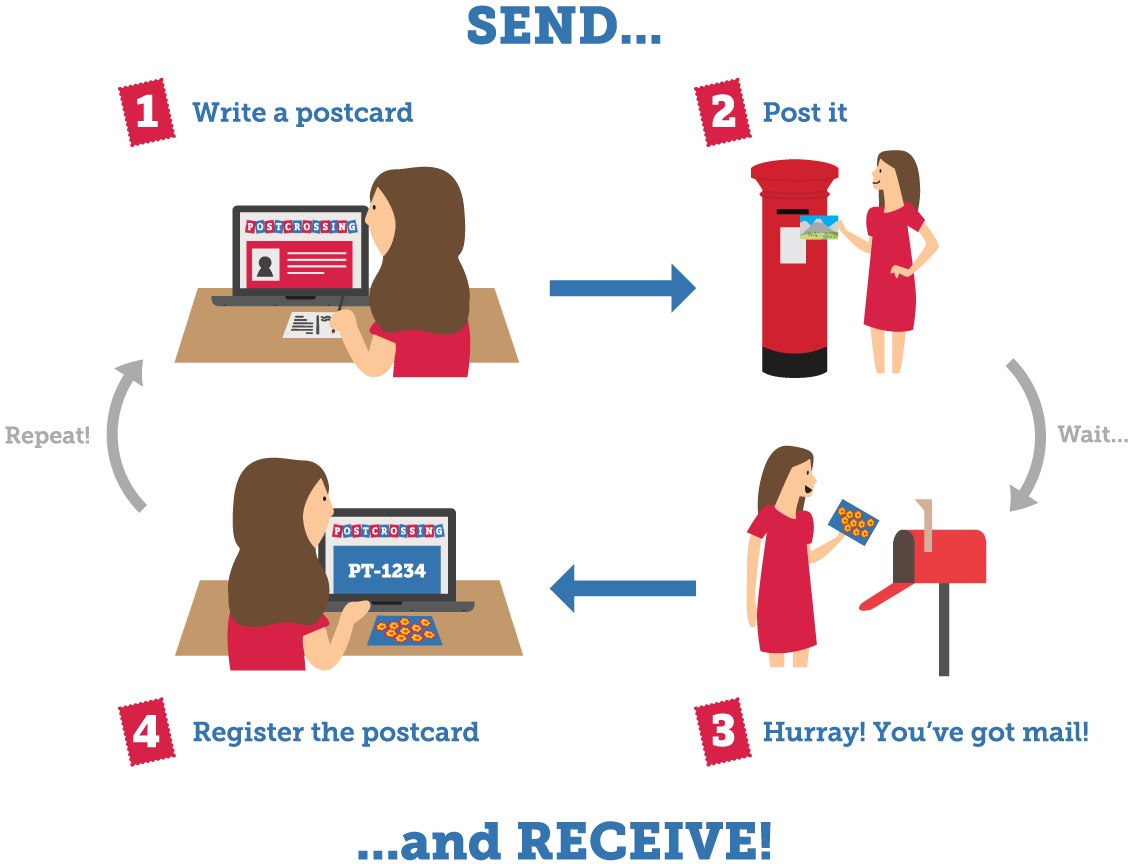
  • The goal of this project is to allow anyone to send and receive postcards from all over the world! The idea is simple: for each postcard you send, you will receive one back from a random postcrosser somewhere in the world. 
  • Simply because --- there are lots of people who like to receive real mail.
    Receiving postcards from different places in the world (many of which you probably have never heard of!) can turn your mailbox into a box of surprises — and who wouldn't like that?


On top of that, I'm also celebrating my 3rd Duolingoversary this week.


Duolingo is a language learning platform with more than 300 million users and offering around 30 different languages. It is free to use and is designed to feel like a game. The course that they have developed the furthest is Spanish; and second comes French.

Spanish was also my own first choice on Duolingo, and is still my priority there. (At least one lesson per day - often more.) However, I have also made use of Duolingo to freshen up my French and German (learned in school many years ago, long before computers and mobile phones); to improve my understanding of Danish and Norwegian (closely related to Swedish); and also to try and learn a little bit of Dutch, Turkish, Welsh and Russian. (I have also had a peek at one or two others, but decided not to proceed with those - for now, anyway!) 

With Dutch, I have come to understand it pretty well (in writing), but have decided to "stop" at that, as I don't want to mess up my German. And it's the same thing with the other new languages, really: Except for maybe Spanish, my ambitions don't really go beyond learning to understand a bit. I have a general interest in languages though, so I'm fascinated when I can just learn to recognize some words and phrases and basic structures. 

Postcrossing and learning foreign languages are of course two hobbies that go rather well together - even if the most commonly used language in postcrossing is English.

Learning more languages has also made me more interested in watching TV series or films in those languages (even if I'd still be lost without Swedish subtitles). For example I have enjoyed the Spanish series Velvet on Netflix (the setting is a Spanish fashion house in the 1950s/60s), and the Turkish series Paramparça (Broken pieces) on Swedish television. At the moment, I'm following a Jewish series on Netflix - Shtisel. (No, I don't know any Hebrew... But I'm fascinated to discover that I recognize and even understand a bit when they switch to Yiddish now and then!).


Related Posts Plugin for WordPress, Blogger...